Short Story
Kateryna Hliznitsova
For Unsplash+
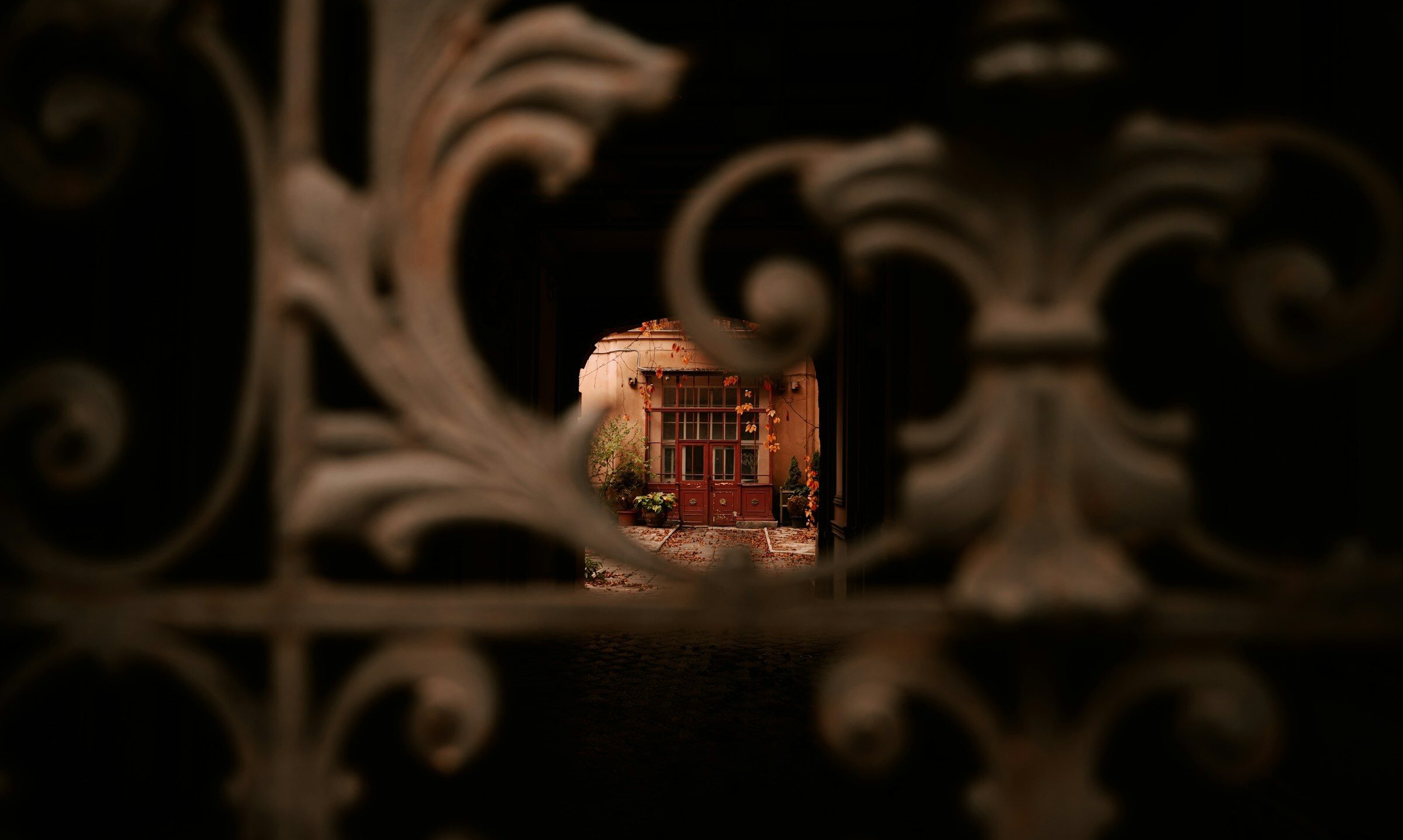
The iron gate at the girls’ house in Munich clanged shut.
Frau Schultz, the girls’ neighbor to the left, lived in a light green, Baroque-style stucco house at the edge of the street. She was a widow; her husband had been a German army commander. The girls slowly absorbed this fact from comments they overheard at dinner and from the careful way their mother pronounced his name.
Frau Schultz was imposing—erect, broad-shouldered, with a mountain of silver-white hair swept into a tall hairdo. She had large, knuckled hands heavy with gold rings. She had two brown, wire-haired dachshunds, Max and Hilda, whom she walked toward the Isar River each afternoon. Frau Schultz moved steadily, her grip firm even when the dogs lunged at pigeons or bicycles.
Her house had soaring ceilings and built-in wooden bookshelves. On one wall hung a large landscape painting in a carved wooden frame: dark fir trees beneath a gray sky. Across from it was a portrait of a plump young blonde girl with very red lips wearing a blue-and-white dirndl. The girls had never seen photographs.
Frau Schultz raised and raced German Trotters—sleek, muscular horses trained to pull drivers in two-wheeled sulkies around half-mile tracks. Sometimes she invited the girls and their mother to harness races on Saturdays. She ushered them everywhere: past the betting windows, into the warm stables, and into low dining rooms thick with tobacco smoke. Plates arrived without being ordered. Sausages were split at the seam and served with Semmeln (crusty bread rolls with a soft interior and a crisp outer crust) and deep brown mustard. They also had potato and cucumber salad, sharp with vinegar; tall glasses of tart Spezi (Coke with orange soda); and apple cake topped with whipped cream.
The younger girl ate greedily. The older girl grew quiet, watching the men slap one another on the back after winning their horse bets. Frau Schultz lifted her glass and nodded to them without a smile.
-----
In the house to their right lived Princess Soraya. At least that’s what their parents had told them.
The girls understood that she was important and somehow far from where she belonged. The word “exile” would come later. For now, they knew only that a sleek black Mercedes arrived without warning at the princess’ house and that men stepped out to open the door for her.
Princess Soraya moved with ease. She wore tailored suits and a variety of hats, with manicured pink fingernails and black sunglasses. Her heels struck the pavement in a steady staccato. Two muzzled German Shepherds patrolled the perimeter of her yellow house.
When the princess spoke, it was in a rapid language the girls did not recognize. Their father said it was Farsi. Sometimes the princess spoke harshly to the men, jabbing a finger in the air. Once, as she crossed the driveway, she glanced directly at the girls through the gate in a brief, unguarded look. She had sad eyes. The younger girl rose on her toes to mimic the princess. The older girl imagined wearing the princess's large sunglasses.
Each day, packages arrived at Princess Soraya’s house—gold-edged bags and heavy boxes wrapped in ribbons. Once, the older girl saw the princess standing alone at an upstairs window, without her sunglasses. When the princess noticed the girl watching, she stepped back quickly into the room. There were rumors on the street—about star-crossed lovers and a tragic divorce. The girls understood that somewhere far away there had been a palace, and that it no longer belonged to the princess.
Sometimes during Frau Schultz’s walks, she passed the Persian princess and her men. Max and Hilda shrank back from the larger dogs, who leaned forward and growled softly despite their muzzles. The dogs seemed to know one another already. They exchanged a quick greeting and continued past one another. The girls watched, waiting for the dogs to engage.
------
Between these houses stood the girls’ own. It was eggshell white, enclosed by a sturdy fence with an intricate iron gate. An oak tree dominated the backyard, its branches spread wide and its roots lifting into the lawn as if the ground were shifting.
From early spring through late autumn, the hedgehogs emerged.
One by one, they slipped out of the leaves at the oak's base. The larger mother came first. Usually four—sometimes five—hoglets followed, their spiked backs moving in short bursts. Each evening, the girls waited for them with shallow bowls of damp bread and water.
The hedgehogs moved quietly, their noses low to the ground. The smallest lagged, distracted by a beetle trail. The others clustered around the bowls, sucking up the contents. The girls wore padded gloves so they could lift the hedgehogs. They felt the spines under their palms. When sounds interrupted their eating, they froze. The mother drew inward first. The others followed almost immediately, tightening into themselves. The garden seemed scattered with small stones.
If nothing followed them, the mother snorted softly, and the line re-formed. By morning, the hedgehogs were gone again, hidden among the roots and leaves.
-------
In December, there was Krampus.
The girls had heard about him before they saw any sign of St. Nicholas—chains against cobblestones, horns scraping door frames, the black tongue extended. They were told that he came first. Good children received oranges and chocolate in their polished boots or shoes outside their front door, by the fireplace, on a windowsill, or under the bed. Bad ones were punished and even taken.
The girls believed in him. The older girl imagined standing guard with a branch stripped from a tree in her backyard. The younger girl declared she would leap onto his back and ride him through the trees.
In mid-December, Krampus figures (men in fur costumes and hand-carved masks) ran through Munich’s city center ringing cowbells and brandishing branches. Their parents took the girls to see them and to visit the Christmas market. The sweet smells of Glühwein (hot mulled wine) and Lebkuchen, one of Germany’s most beloved Christmas cookies, drifted over the stalls.
Near the edge of the stalls, a tall Krampus figure leaned over, then fell. He laughed loudly, his breath visible in the chilly air. He struggled to his feet and checked his mask and horns. Around them, voices rose, bells clanged, and fake fur brushed against wool coats. The girls briefly lost their parents in the crowd but found them again.
The throng thickened and spilled into nearby streets. Krampus figures gathered, kept ringing their bells, and tapped passersby with branches. The older girl stepped back. The younger one reached out to tug at the horns and chains.
They began their short walk home, threading through bodies packed together like a human sea. Even in the crowd, the girls knew their way home, the streets leading to their neighborhood, the right turn to reach the river, and the iron gate.
As they approached their street, Frau Schultz and Princess Soraya stood together at the edge of the crowd. The girls’ parents moved ahead, briefly swallowed by the moving mass. The girls stayed behind with their neighbors.
“I want to dance with them,” the younger girl said, slipping her hand into Frau Schultz’s.
“There are too many people—you might get lost,” Frau Schultz said.
The older girl turned to the princess. “What do you think of Krampus?”
The princess watched him for a moment. “I have known more frightening things.”
Then she looked at the girl. “Are you cold?”
The girl nodded.
“I will bring tea,” the princess said, signaling to one of the men, who slipped back through the yellow house’s gate.
When she looked again, one Krampus figure’s mask had shifted on his face. It revealed part of the man’s damp, prickled skin near his mouth. For a moment, the older girl couldn't tell whether the mask hid him or revealed him. He chuckled, crouched, and hoisted the younger girl onto his back.
“I’ve had my eyes on you,” he said.
“I’ll clean my room, I promise,” the younger girl said.
“You can stay for a moment,” Frau Schultz said to the younger girl, watching closely.
The cowbells and drumming swelled. The Krampus moved through the crowd, the girl clinging to his shoulders as his horns caught the light.
The princess’s man returned with small cups and pistachio-crusted pastries. The princess passed them out. The tea was hot and fragrant.
“Time to come back,” Frau Schultz called. The girl hesitated, then slid off the Krampus’s back.
“St. Nicholas will see you tomorrow. Don’t forget to put out your boots,” the Krampus said, adjusting his mask. Frau Schultz and the younger girl scanned the crowd for the girls’ parents.
After a time, the parents emerged, flushed and warm from Glühwein.
“Krampus is gone now,” Frau Schultz said.
“It is time to go inside,” Princess Soraya said.
The street began to empty, and the princess paused at her gate.
“Wishing you a joyful St. Nicholas Day and small surprises in your boots,” she said.
--------
In the backyard, beneath the oak, the hedgehogs pressed together and settled. They did not stay there forever. The family moved. The oak remained, the roots continuing their slow upheaval of the lawn. Winters came, whether anyone set boots by the door.
Years later, the older girl remembers the iron gate first. Then the oak. Then the small bodies at its base, appearing and disappearing in the light.
And finally, the neighbors.
Read more Stories, Poetry, and Creative Nonfiction in this issue
Read more great stories and poetry in The Write Launch archive of past issues.
Poetry

“Office Hours,” “In the Early Morning,” and “Exit Strategy”
He declares he will fly with such certainty I do not believe he is being metaphorical.Who am I to say…
Leah White
Poetry

“Bone Dry,” “The Rose Water Incident of 2022,” and “Weary Be the Wanton”
It was lonely having An anorexic mother Who was often more concerned About fitness and image Then tending to the…
Monica Viera
Creative Nonfiction

Me and the Milkman
Each morning at dawn, he would stealthily enter the house through the unlocked back door. In the early 1950s, no…
Pam Munter
Short Story

Joaquín
Tuesday night, a group of sicarios abducted Juan José Juárez, his wife, and two children in Colonia Los Duendes. Drugs…