Short Story
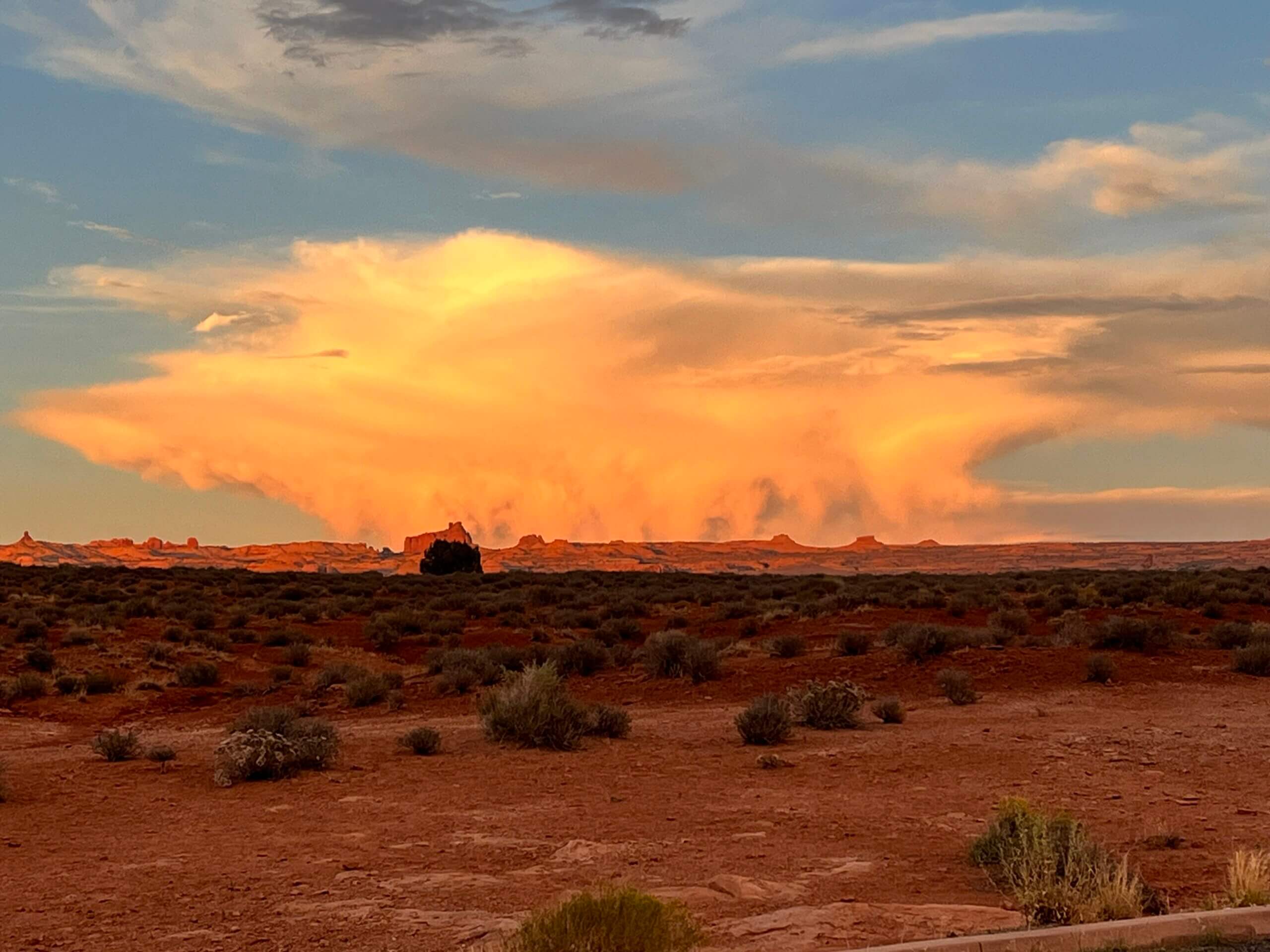
Photo by Brian Demarest
Atsee Wiya’s dream always began the same way: she was a child standing on the edge of a mesa with her grandfather, watching thunderheads gather in the western Arizona sky. An orange flash lit the clouds; lightning danced across the desert floor.
“Where do thunder and lightning come from?” she asked, eyes wide with wonder.
“Why, the Thunderbird, of course,” her grandfather said, smiling down at her beaming face. “The Thunderbird is our protector. But beware its retribution if our moral law is broken.”
“Moral law, Grandfather?” she asked, looking up at his strong, weathered face.
Her grandfather decided it was not the time to explain. “Just remember to strive hard, live well, and Wasiivi m’háni m’vóo—walk in good spirit, Atsee. That is how we stay in balance with the world.”
The sky cracked open in a blaze of fire. Atsee leapt to her feet in fear and reached for her grandfather, but he had vanished.
“Npoó, where are you?” she cried. “Where did you go?” But he was gone.
In an instant, she stood in military fatigues—no longer a helpless child, but a grown woman. And she was no longer in the Arizona desert, but amid the rubble of a bombed-out Middle Eastern compound.
Children lay scattered around her, their bodies broken beyond recognition.
One child, a girl who looked strikingly like Atsee, lay bleeding in the rubble. Military drones circled overhead as the child’s life ebbed away. Their eyes met. The girl whispered to her in Yavapai, words she hadn’t heard since her grandfather passed: “Wasiivi m’háni m’vóo ‘úmi? Do you still walk in good spirit?”
Atsee reached for the child, desperate to save her—but woke, as always, too late.
***
She sat upright, heart pounding, her T-shirt clinging with sweat. She checked her phone: 0213. Too early to rise, but there was no chance she’d fall back asleep. Not after that.
She stepped into the shower.
Hot water ran down her back, easing the tightness in her shoulders. She hadn’t had the dream in months. She flinched again at the image of life drifting from the child’s eyes. A child who looked like her.
Atsee looked up at the showerhead, letting the water stream down her face.
Her grandfather’s voice echoed in the rising steam: Wasiivi m’háni m’vóo—walk in good spirit. She had tried to. But ten years in the Air Force, most of them spent piloting drones in distant deserts, had often conflicted with her deeply held Yavapai beliefs and complicated what walking in good spirit meant.
She had loved her people and her community, but as a young woman she couldn’t imagine a future for herself in the Yavapai homeland, the place her grandfather called sacred. So she enlisted and re-enlisted twice more.
After the service, she used her signing bonuses to start a successful business: SkyPath Aerial Services. But years of working alone had begun to take their toll. She’d tried hiring, but no one met her standards or earned her trust. Now, with artificial intelligence changing the landscape completely, Atsee wondered who needed people at all.
She shut off the shower and stepped out. As she wrapped herself in a towel, she caught her reflection in the mirror: sharp cheekbones, dark eyes her grandfather used to call “deep, mysterious wells.” He used to peer into her eyes and ask, “Who is inside there?” She’d always giggle and reply, “I am, Grandfather. It’s me!”
But lately, when she looked into those eyes, she wasn’t sure who was looking back.
She dried her shoulders and turned to catch sight of the crimson-black Thunderbird on her upper back, wings outstretched, taut with purpose. Her grandfather had sketched the design when she finished basic training. He called it her shield. He hadn’t wanted her to enlist, not in the military that had nearly erased their people, but he gave her his blessing in the only way he could.
He’d raised her after her parents died in a car accident when she was a young child. She had survived the crash, but remembered nothing of it, and very little of her parents, aside from a few faded photographs. Her grandfather had been there through everything.
She missed him, her Npoó, fiercely.
Especially on nights like this.
***
The drone-tone ringtone of her phone shattered the silence. She sprinted to the bedroom and caught the call before it hit voicemail. The caller ID read: Yavapai County Sheriff's Office.
It was 0237. Must be an emergency.
She answered. “SkyPath Aerial Services.”
“Atsee.” She recognized the voice. It was Sheriff Luis Vasquez’s wife, Fatima.
“Hey, Fatima,” Atsee said, reaching for her digital tablet on the nightstand. “What’s happened?”
“A bit of a crisis. Looks like a car went off Thunder Ridge Road and down into the valley. Sheriff needs you out there. It’s too dark and they can’t pinpoint the exact location of the vehicle.”
Atsee entered the sparse details and coordinates of the incident.
“Tell the Sheriff I’m on my way.”
Another life in the balance, she thought. Another mission.
The shift came quickly: adrenaline, focus, duty. Then doubt. Atsee took a deep breath and rubbed her temples, willing her heartbeat to slow.
Then she threw on her clothes, grabbed her thermal coat, and headed into the workshop to prep the rescue kit.
She unlatched her commercial-grade search-and-rescue drone from its charger—a boxy quadcopter with carbon-fiber arms and blinking status lights—packed it in its case and slid it onto the flatbed of her truck.
Then the multi-spectrum sensor unit: a high-resolution thermal and visual imaging module, ready to mount on the drone at the site.
Her hands moved with practiced efficiency. Gear in place. Case latched. No time for hesitation. Just the checklist: zip, snap, go. Lastly, she packed her rappelling harness and handheld GPS in case she found the vehicle with someone still alive who needed evacuation.
The drive would take forty-five minutes through pitch-black hairpin turns and cliffside ledges. With each mile, her chest tightened. The cycle returned: adrenaline. Then tremors. Therapy at the VA hadn’t helped. She’d refused the medication. Muscling through was all she knew. So she worked.
She’d built SkyPath from the ground up but going it alone was wearing her down. Her contracts took her across the country: storm recovery in the Southeast, flash floods in river country, wildfires out West, even shark surveillance along the East Coast. That last one was chaotic: swarms of seabirds dive-bombing and clawing at her drones midair.
And tonight, as she drove to the accident site, the tension felt different, like the sudden appearance of thunderheads on the horizon.
She gripped the steering wheel, hypnotized by the yellow road lines flickering toward her out of the dark. She blinked. Her mouth was dry. And suddenly she was back in Nevada.
***
Captain Atsee Wiya sat in the “cockpit,” a dimly lit, climate-controlled room in the Air Force’s Remotely Piloted Aircraft center in Nevada. Half a world away, their target was a terrorist leader planning an imminent strike against American troops. The mission brief identified a compound in a remote village in northern Syria, surrounded by sunbaked brick buildings, parched farmland, and winding alleyways.
“The operation is urgent,” Lt. Colonel Strickland said. “Credible sources and electronic surveillance indicate the target is planning an imminent strike and may be on the move. Orders are clear: take him out tonight.”
He turned to Atsee. “Captain Wiya, prepare to launch.”
“Yes, sir.”
At her station, Atsee remotely calibrated a military-equipped drone, loaded by technicians at a U.S. base in Turkey. A few minutes after midnight Syrian time, it lifted into the air.
She piloted the drone from her Nevada station. After seventy minutes at high altitude, she received orders to begin descent. Thermal and infrared images of the compound flickered onto her screen.
Strickland leaned in: “Confirm target location.” She swallowed. Her throat was like sandpaper. She studied the feed, cross-checked the coordinates.
“Target location confirmed, sir.”
“Push in closer.”
She zoomed in. The compound looked still. No signs of movement. Heat signatures revealed bodies inside, likely sleeping. Then, without warning, a figure emerged from the compound into the open.
Her pulse raced. This had to be the target.
She relayed the feed to intel. A moment later, confirmation: target acquired.
“Target confirmed,” he said. “Prepare for launch.”
Atsee’s hand hovered over the control. It was easier when the bodies stayed shadows. Just heat and movement. No faces.
Then, new shapes appeared on the screen. Small, fast-moving.
She hesitated, unsure what they were.
“Sir,” she said. “I think there may be children on the ground.”
“Are you sure, Captain? Confirm.”
She had only seconds. The shapes were small. Erratic. Could be dogs. She’d seen that before. But children? What would children be doing outside at 0130?
“Atsee?” Strickland’s voice tightened. She could almost feel his sweat.
She bit her lip. A metallic tang filled her mouth—blood.
She studied the heat signatures again. Children? Maybe. She wasn’t sure. But the shapes didn’t move like dogs. She turned away from the screen, heart pounding.
“I can’t confirm either way, sir.”
A pause.
“Okay, then. Stay on the target and prepare to strike.”
She steadied her breath, hands tight on the controls—and waited.
Then it came: “Execute. Now.”
She launched the strike. The missile streaked toward the compound. Seconds later, a flash lit her screen, followed by a silent bloom of heat and smoke from the explosion.
She shifted into damage assessment mode. The drone hovered over the wreckage.
The target was down—obliterated.
The small shapes that had run toward the compound—children.
All dead.
They were gone—because she executed the order.
She squeezed her eyes shut, but the bloody images burned behind them.
Why hadn’t she trusted her gut?
Why hadn’t she called for a delay?
Why had she blindly followed the order?
***
A blaring horn snapped Atsee out of her trance.
Headlights flooded her vision. She crossed the center line. A tractor-trailer was charging straight at her. She wrenched the wheel, swerved onto the shoulder, heart hammering as she fought for control, then eased back onto the road.
***
By the time she reached Thunder Ridge Road, it was nearly 0330, and the night was eerily quiet. She drove slowly along the gravel road toward flashing emergency lights, which blocked the switchback to late-night traffic. She parked beside a police cruiser and stepped out.
Sheriff Luis Vasquez stood with his team, bathed in the red and blue strobes of the cruisers. As Atsee approached, she paused at the ridge, gazing out over the valley. The crescent moon cast a pale light across the basin—land her Yavapai ancestors had inhabited for millennia, until settlers displaced them in the 19th century. Now, only a couple of hundred Yavapai remained in the Prescott area, and she was the only one left in her family. But tonight, beneath the cool Arizona sky, Atsee felt something stir—something electric moving through the air.
“Evening, Atsee,” Sheriff Vasquez said, as he came up behind her. “Thanks for coming so quickly.”
“No worries, Sheriff. What do we have?” she asked, skipping small talk.
He popped a piece of chewing gum into his mouth and briefed her. “We have a thirty-nine-year-old female. Appears to have lost control of her vehicle, went off the cliff into the basin at approximately 0047.”
Atsee glanced at him. Fatigue had settled into the lines around his eyes.
“So, that was nearly three hours ago. Any witnesses?”
“No.”
“Then how do you know what happened—or what time?”
“We don’t, exactly. But we know there was a sudden impact here earlier tonight. We got an emergency alert from her smartwatch. She’d registered it with our office.”
“Bottom line,” he said, “we know she’s down there. We’ve got a rough fix, but no clue about her condition, or whether anyone else was in the car. We tried calling her phone, but it goes straight to voicemail. That’s where you come in, Atsee. Can we get a drone down there?”
“Yes, sir. Just need a few minutes to set up.” Atsee started toward her truck, then turned. “Do we know her identity?”
“Yes. A name came in with the alert. Kendra Locke. Local realtor, works in Prescott. That’s at least according to her website.”
Atsee recognized the name. Kendra Locke was the face on real estate ads across town: blonde hair, blue eyes, bright smile. “Need a home? Pick up the phone. Locke in a good deal today with Kendra.” She’d crossed paths with her once, when Kendra leased her the space she used for both her business and home. She remembered being struck by her efficiency and warmth—professional, but kind.
She took a steadying breath, then looked up at the sheriff.
“You know her,” Vasquez said.
“Just through business. Does she have any kin?”
“Not sure. We’re working on it. And we haven’t received any calls reporting her missing.”
Atsee nodded and pivoted back along the gravel road to her truck. Given that it had been hours since the car went over the ridge, if Locke was alive, every second counted.
The unpaved road was narrow and winding, with loose gravel that often caused vehicles to skid. Drivers who lost control here rarely survived the fall. Atsee hoped Locke wasn’t among them.
***
Atsee retrieved the drone from her truck and attached the sensor payload. Other first responders, setting out cones and flares to secure the road, stood back at a respectful distance. They knew to give her space when she worked.
Atsee finished setting up the drone and, with its propellers buzzing like a hornet swarm, sent it aloft, gliding into the ravine. Watching the drone’s infrared feed, she hummed an old Yavapai song of hope her grandfather had taught her—the same one once danced in secret after the Indian Wars, when Yavapai rituals were banned by the American military. It felt fitting, as her drone swept through the night in search of the missing woman.
She guided the drone in slow, overlapping passes to ensure full coverage, careful not to miss a single heat signature. After three hours in the desert cold, she doubted the wreck would still give off heat. The drone’s floodlights cut through the darkness as it descended along the ravine wall. Twenty minutes into the grid search, she saw it: a human figure twisted awkwardly on a rocky ledge. It was a woman, and she wasn’t moving.
“Sheriff, I’ve got a visual.”
Vasquez trotted over and peered at the monitor. He studied the body. The woman was blonde, but they couldn’t confirm her identity until recovery.
“What do you think? Is she dead?”
“I think so. There’s no heat signature,” Atsee said.
“Where’s the car?”
“She may have been thrown clear on the way down.”
“Okay. Mark her location and let’s find the car. We don’t know if she was alone.”
Atsee logged the coordinates and piloted the drone over the terrain near the body. The drone’s camera and floodlights soon located the car, lying on its side on the basin floor. A coyote perched on a rock beside the vehicle, staring up at the drone’s lights.
“Well, I wonder what he’s up to,” Vasquez muttered.
“Me too,” Atsee said, guiding the drone into a slow descent toward the car. The coyote darted into the darkness as she hovered the drone beside the vehicle’s windows.
Her monitor showed a faint heat signature inside the car. She eased the drone closer, scanning the interior. A small child sat strapped in a car seat, unconscious but alive, the thermal feed confirmed.
Atsee kept the drone hovering near the child while the sheriff called for a helicopter evacuation. Atsee zoomed in closer, studying the child. She couldn’t be sure, but the child looked like a girl, maybe two or three years old, strapped in a toddler-sized car seat. Then the child stirred, ever so slightly. Was she crying? It was hard to tell in the pixelated feed. But she was breathing. That she could tell.
The sheriff returned from his call, followed by deputies and members of the fire and emergency teams. Atsee turned from the monitor to Vasquez as he updated the team.
“We won’t have a helicopter here until dawn. That’s an hour away. There are no licensed night-rescue pilots available, and the terrain’s too rough to risk using a novice. We’ve got rappellers here from the fire department, but none trained for nighttime descents. And I’m not risking any more incidents tonight.”
While the responders debated, Atsee stayed fixed on the monitor, watching the small, fragile figure. A paramedic’s voice broke through the commotion: “Sheriff, given the cold and the child’s exposure, hypothermia is a real threat. The child might not make it until the helicopter arrives.”
Atsee watched the faint rise and fall of the child’s chest, her head lolling to one side, as if too heavy to lift.
While the others continued debating logistics, Atsee’s decision crystallized. She pulled her coat tight, turned from the monitor, and faced the sheriff.
“Sheriff,” she said, her voice steady and clear. “I’ll go.”
The group fell silent.
“That’s a hard no, Atsee. We wait for the chopper. We stick with the protocol.”
“Sheriff, please—look.” She pointed to the screen. “The child might not last an hour if we wait. We need to extract her now. I have the gear. I’m night-trained. I can be ready to go in ten minutes.”
Vasquez studied the image of the child on the monitor and then looked back at Atsee.
“Luis,” she said softly. “I need to do this.”
He bit his lip. “If we break protocol, and you get injured, or worse—they’ll have my head.”
“Protocol won’t matter if she dies.”
He looked at the faint heat signature of the child on the monitor. He swore under his breath. “Okay. Go. But this is not a free form climb. You stay tethered to our line. My team runs the haul system. Got it?”
She nodded, marked the car’s coordinates, docked the drone, and turned toward the darkness.
***
Minutes later, she was ready. Harness on. Helmet locked. Floodlights blazing. Portable GPS clipped to her belt. Around her, the fire crew anchored the rappel and haul lines, checked the pulleys, and readied the vertical rescue stretcher. They would manage the system from the ridge; Atsee would make the descent.
She packed a foil blanket and marker flags in her knapsack, then keyed in the GPS coordinates for Kendra Locke’s location. Her boots scraped over loose shale as she began the descent. A gust of desert wind caught her off balance. She paused, steadied herself, and shifted her weight against the ropes. The floodlights on her helmet cut through the swirling dust and darkness as she eased farther down the ravine wall.
Maintaining steady radio contact, she followed the GPS beacon until the woman’s body came into view. As she descended, Kendra’s face grew clearer. It was definitely her.
Lowering herself onto the ledge where Kendra lay still in the cold desert night, Atsee knelt beside her and checked her carotid pulse. Nothing. She watched the chest for signs of breathing. Nothing. Then she checked the pupils: fixed, dilated. Her skin was cold, and a deep purple hue pooled beneath her jaw.
Atsee swallowed hard and keyed her radio: “Sheriff, confirming: the victim is Locke. She’s gone.”
For a moment, Atsee lingered beside the body, wondering what had brought her out here in the dead of night. What had driven her off the road?
She checked the smartwatch still strapped to Kendra’s wrist. The screen had frozen at 12:47 a.m., the time of impact.
She planted a marker flag for the recovery team, then reset her GPS. Her priority now was the car—and the child.
She continued her descent, forearms burning from gripping the rope, the harness digging into her hips. Below her, the crumpled vehicle finally came into view.
***
She picked her way across the basin toward the car, following the GPS through loose rock and broken terrain. Twice she had to backtrack around steep drops before the crumpled vehicle finally emerged in her helmet lights.
She climbed onto the tilted frame, careful not to slip on the cold, slick metal. One foot slid on a patch of oil, and she jolted, catching herself in time. Jagged rocks tore at her gloves as she steadied herself for the final few steps.
She crouched beside the car’s side panel.
Her helmet lights flooded the rear passenger seat, where the child lay, unconscious but breathing. Atsee reached through the shattered window and gently unhooked her from the car seat. With steady, trembling hands, she lifted the small body from the wreck and wrapped her in the foil blanket. The child's breathing was shallow, her skin frighteningly cold.
Atsee radioed her position to the crew above and guided them as they lowered the stretcher toward her lights.
As she waited, she held the child close, sharing her body heat. Softly, she began to hum the Yavapai melody her grandfather had taught her. She rocked the girl in a slow, steady rhythm. After a moment, the child’s eyes fluttered open.
Atsee met her gaze, studied the delicate features, and felt certain this was Kendra’s daughter. She held her tighter, her chest aching with the weight of the child’s loss, and whispered, “Hold on, little one. Help is coming.”
The child drifted off again as the stretcher arrived. Atsee secured her and signaled to the team above. As the stretcher rose into the darkness, she whispered into the wind: Wasiivi m’háni m’vóo—walk in good spirit.
She closed her eyes and silently thanked her ancestors—especially her grandfather, and the two faded faces lost in time, her parents—for giving her the strength to save the child.
Somewhere in the distance, the yowls of coyotes echoed across the valley floor. What they were saying, she could not know.
On her ascent, Atsee paused beside Kendra’s still body. The desert wind curled through the ravine like whispering voices. She offered a silent prayer for Kendra’s spirit and a blessing for the child she’d left behind.
By the time she reached the top of the ridge, dawn was breaking. A helicopter rumbled low and steady across the valley like rolling thunder. As she removed her gear, she watched the first responders tending to the child, their voices hushed. Together they had saved a life tonight.
And in that, she glimpsed something close to hope.
Atsee watched as the morning’s first light spread across the valley of her ancestors. She breathed in the fragrant air of her desert home. For the first time in years, she felt the world tilt toward balance.
A long darkness had finally lifted—if only for one night.
ACKNOWLEDGEMENT
The author gratefully acknowledges the Yavapai-Apache Nation Cultural Resource Center for its generous guidance, which helped inform the respectful portrayal of Yavapai heritage, traditions, and language in “To Walk in Good Spirit.”
Read more Stories, Poetry, and Creative Nonfiction in this issue
Read more great stories and poetry in The Write Launch archive of past issues.
Long Short Story

Deus Vult
There’s life on other planets, and we’re fighting again. Not so much fighting each other, me and Hazel, but rather…
No Cañon
Poetry

“Persephone’s Dream of Spring,” “Flotilla,” and “Forgive Us”
While it was dark, (and hellishly cold!) the earth a frozen stone, I dreamt of loam and pomegranates, and a…
Kathleen Holliday
Short Story

The Dinner Party
The rain started on a Thursday night and it never quite stopped again. The moments which were not absolute downpours…
Grace Moore
Poetry

“As Charged,” “My dad,” and “One Last Thing”
The jury found you guilty in just an hour and fourteen minutes. Long enough for bathroom breaks and a single…