Photo by Katia De Juan on Unsplash
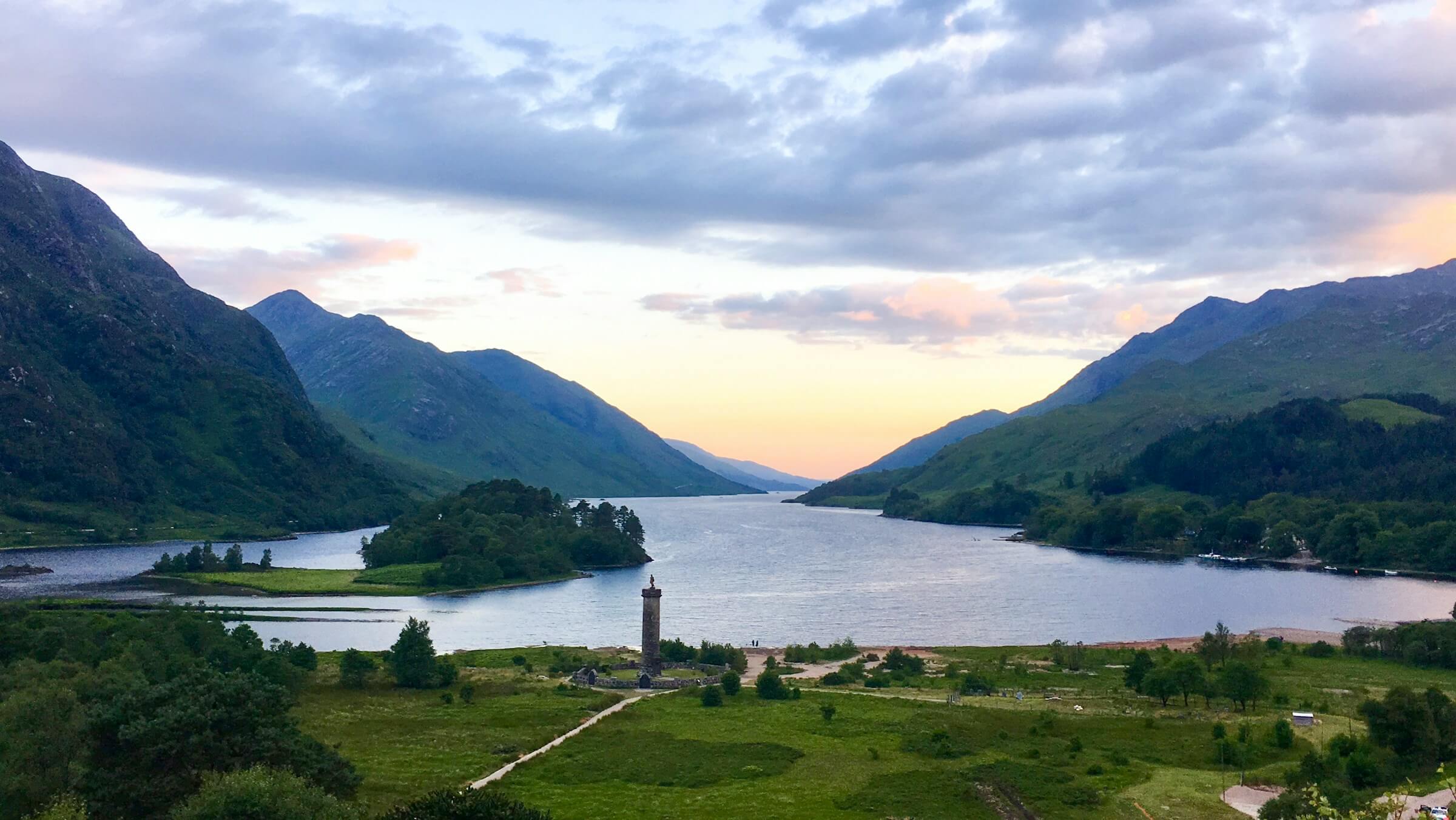
Fog hovers over the treeless valley and the loch. The view is murky through the waves of the old glass pane, like a filter on a camera lens, turning the edges of everything a hazy shade of silver. There’s little daylight remaining. Still, up here the light stays long, and the moon is already out, waxing. Whistling wind sneaks through the small space between the old oak door and the jamb; the fire snaps in the stone hearth, wood smoke mixes with the earthy smell of the room.
Before the wooden desk that looks out to the immeasurable land, I remove the typewriter, compact and light of weight, from its torn leather case with the faulty zipper and rest it on the sun-washed planks. I’ve carried it in my backpack for many miles. It’s an Olivetti, maybe 1963, portable, gray, scratched and worn where the carriage return has repeatedly nicked the frame. Keys work. Ribbon’s good. I light two candles, set them on the windowsill. From my journal, I tear a page and roll it around the platen. There’s no plan to chase down some untold tale. No notion of Kerouac or Rilke, Chatwin or Theroux. No, this is for him, and for those who travel and arrive here to rest.
I’ve come to the bothy from Kylestrome, walking from the main road and the weathered pier. There’s a beaten old sign there for Loch Glendhu. I took the stone bridge and moved along the loch side to the access road. It was more than a two-hour hike, nearly seven kilometers from Kylesku Hotel. I needed a good bed after many days dodging the spitting rain, walking these stony highlands, sleeping in my tent on rugged and barren land and the hard floors of these shelters. Many of the trails here are marked only by cairns stacked by fellow travelers who have wound their way from Loch Fleodach Coire. A full day had passed along that trail, and I saw no one. Here at the bothy, there is no sign of a recent stay, although the last visitor has left kindling and a bit of chopped firewood. I have draped my wet jacket over a chair near the flame and hung my food bag from a hook on the ceiling. A few nights before, field mice chewed through granola bars I’d left in an open pocket of my backpack. Over the fire, I’ve made coffee in an old tin kettle that is in the bothy for all to use.
The Olivetti was my father’s typewriter. Thousands of words had emanated from it over its life, his life. Letters to my mother. Letters to me, ones he would type and slip into envelopes to carry in his backpack for days until he’d discovered a village with a post office. But most of what came from the keys of this machine was his poetry. Verse he’d published in few local newspapers and obscure journals. He made no money from any of it, was never paid any great fee. Most times he gave his words away like the urban street poet who sets up his typewriter on the sidewalk. Poets never get rich, he would often say, that’s why they’re poets. He romanticized the idea of a poet’s life. He revered Yeats and especially Burns. And he loved the walking poets, as he called them, like the impoverished poet William Henry Davies who wandered on foot through Britain and wrote about children playing under snowflakes in winter and among butterflies in summer, thriving in the cold and the warmth of their days. And there was Wordsworth, who famously hiked the Lake District searching for the most perfect words for man’s link to nature, his loneliness, his solitude, and for how to open your heart so it “dances with the daffodils.” My father often reminded me of that Wordsworth line.
There are many of my father’s poems that readers have never seen, stuffed away inside a leather binder. I carry it with me. I’ve come to read them all in time. Every word. Over and over. Each ragged page, words on much that he had found beyond understanding, glimmers of what it was he was searching for. Yet there are poems that evoke only mystery, ones that seem to come from another cavern in his mind. I am here in the middle of this primeval land, the land he loved, the land he couldn’t imagine not returning to, the land he wrote about, and the land where he’d discovered a touch of heaven if there is such a thing. Others have found the muse, if you want to call it that, in Paris, Tangiers, on the streets of Dublin, along the California seacoast, or under the desert’s Joshua tree at dusk. But it seems clear that for my father there was nothing like the majesty of this land. He believed it fueled him, as Sandburg once said, to write the “phantom script telling how rainbows are made and why they go away.”
From the binder, I take one of poems and place the paper on the desk, securing it to the wood with tacks I’ve brought with me. I smooth out the paper’s corners and with the hammer end of the axe left here for chopping firewood, I tap in the tacks, sit forward in the chair, and read the words in a whisper.
Protect me, these walls
that hold the breath of
all seeking shelter,
missing home, finding solace.
For their air is my air,
as the land is, too,
belonging to the world,
surrendering to angels.
Loch Glendhu, May 2010
The type is clean, although the letter O in the words “solace” and “world” are smudged a bit from the errant ink of the ribbon. I have no knowledge of the typewriter ever being properly cleaned, although the ribbon certainly must have been replaced many times in its life. The poem looks good in this place. Proper and right. I’ll stay here tonight, and in the morning, I’ll leave behind his typewriter, knowing that those who travel here will respect its presence, keep it safe, and on my return in many days, I will discover what others have had to say about my father’s words.
I slide the typewriter closer and begin.
For those who travel here,
On this desk, you will find one of my father’s poems written here in this bothy many years ago. He loved all that this land represented and was eternally grateful to all those he met along the trails here and those who shared this bothy on many rainy, windy nights.
If you might, type a reflection, note, or thought on his typewriter to leave it for all to see.
May it help bring you and your heart whatever it is you are seeking.
Forever,
The son of James Douglas Abercrombie, poet.
I tack the letter to the wall.
***
It’s been raining for two days now. Rain is expected again tomorrow, although there’s the chance for a break. I’m prepared. It is Scotland, after all, and I’ve been here before. Water drips from the sleeves of my raincoat and from its hood into my eyes. My socks are dry, but my boots are damp. Mud and peat stick to the soles.
It’s been three weeks since I first arrived at Glendhu bothy and now, after a long hike, I’m returning. It’s taken more energy this time to walk this land. I’m slower, older. But I knew what faced me. More than twenty years ago, my father encouraged me to come here to see what he saw, feel what he felt. My marriage had failed, and I had come to escape, to reset a life. “You should go,” he told me. “Your soul needs it.” I believe my father knew a great deal about what the soul might need.
In my backpack I find the pitta bread I’d wrapped in plastic. My father taught me how pitta stays fresh for long periods, necessary on these journeys. I tear off a bite. I’ve left the ruins of Ardvreck Castle where I’d rested and move along this rocky trail with the hills surrounding me. It will be a couple of hours to Loch na Gainmhich Waterfall, or the Wailing Widow, as it’s called. Legend says a grieving mother threw herself over the edge after her son, while hunting deer in the mist, plummeted into the gorge to his death. A poem my father wrote about the falls is in the binder I carry. He must have stood before it, below or above, listening to something in the wind.
After more than an hour, the rain is lighter, only a spitting drizzle. Across the hills to the south, I see blue sky mix with canopies of gray. The weather to the north appears more ominous, dark along the horizon, fog. But the system is moving out, and the better weather is coming. I smile, watching a buzzard soar high and low and land on a rock cropping some fifty meters ahead. The birds of the highlands are common in my father’s poetry. The osprey, the goshawk, the falcon. He found a kind of freedom in their flight, it seems, a chance to ascend, to fly away from heartache, pain, and burdens toward something heavenly.
My legs ache. I consider making my way to the old road and the easier route. It’s flat and less rocky. I’ve been told that once I arrive at the falls, there will be a climb on unsure ground to reach the top. I want to save any energy I might have left. But with the drizzle subsiding and a bit more of the sun breaking through, I choose to remain on the trail. Father would have never taken the road. Roads take you where others want you to go, he once told me. Roads are other people’s journeys.
There’s a risk of getting my boots more heavily soaked if I hop over the wobbling stones that lie in the loch’s rushing water as it moves to the waterfall’s edge. Still, I trudge forward over the boggy ground, careful not to slide and slip on the rocks. The sound is fierce as the water cascades over the cliff to the narrow canyon more than 200 meters below, striking the protruding rocks, giant medieval steps. The power of it is all around me. I am still and silent as I think of the widow. I think of her sorrow. I think of her son. In the distance and across the loch to the green-gray glen, the craggy hills rise, soundless cries of mourning mix with awe and reverence. For a moment, I am overcome; a once unknown awareness surfaces, a contentment of spirit difficult to explain. My hands tremble. A tear blurs my vision.
The rain has stopped, and the weather’s shift brings a gusty wind. With some fourteen kilometers remaining before I arrive at Glendhu bothy, I follow the rough track from the small parking space to the path that, in time, will take me past the modest lodges and the hotel, an anticipated two-hour hike from Kylesku Bridge along Loch Gleann Dubh. I hope to arrive before dark.
***
Someone is at the window. The late-day shadows don’t permit me to note the details of a face, yet I’m certain it is a woman, her hair red, unruly. She is at the desk. There are two other buildings here at the head of the loch: the byre where ponies were once kept, and a trackers’ cottage. But the bothy is the center of this settlement, and the woman has taken to it. I see woodsmoke from the chimney. As I move closer, she senses me somehow and glances up, smiles, and gives a shy wave. I now see her face. She is not young but not old. She watches me for a time as I walk, and she appears to stand. Her image disappears for a moment and the door opens.
“Are you lookin’ to stay?” she asks, her shoulder leaning against the door jamb. “It’s only me here for the night and there’s plenty of room.” The accent is Scottish, pitched on the higher notes of a scale.
“I am, if you don’t mind,” I say.
“Aye. That’s what these dwellings are for. Have you been?”
“Yes. Many days ago.”
“Well then you know there’s a fire.” She steps aside and waves her hand at the door. “And I carry a knife with me, so don’t be gettin’ any ideas.” She laughs and watches me enter.
“Never crossed my mind.” I smile and drop my rucksack to the wooden floor, remove my waterlogged boots and place them near the fire. “It’s still here,” I say, seeing the typewriter. I am not surprised. There are notes—written with pen or pencil, others typed—affixed to the wall with the tacks I’d left behind. Two have been secured with hikers’ blister tape, others wedged into crevices in the wall. And there’s paper rolled into the Olivetti. Words typed.
“It was here when you were here before, days ago?” she asks.
I nod and begin to silently read some of the notes travelers have left.
Thank you, Mr. Abercrombie. Your words have given me determination to carry on.
Only this wonderful land of open space and forever sky could produce such words. Travel well, fellow hikers.
There’s also a short poem.
The thinnest place
brings the boldest awakening,
and I am buoyed to follow
my quickening heart.
And then there in the typewriter, another note.
I miss you, Dad. But I will always have your words.
I step back, catch an absent breath, and read it again. “Did you write this?” I ask.
“I did. It was my father’s typewriter.” She runs her fingers along the keys. “I’m dumbfounded that it’s here. Do you know anything about this? And this note? I’m at a loss. From his son?”
“I wrote the note. I’m his son. The typewriter is my father’s. I carried it here.”
“How could that be?” The woman looks again at the machine, at the scratch on the body near the carriage return lever, the wear on the space bar where the black color has been smudged away.
“There’s been a mistake, I’m sure. There are other Olivetti typewriters in the world,” I continue, hoping to explain.
“No, I’m certain.” She runs her hand along the platen and turns the machine over. “See here, the initials—J.A.—scratched into the body. He did that with a knife.”
“How did you know this?”
“I know this typewriter.”
“And do you know this?” I ask, pointing to the poem that I’d left behind. “It’s his. And so . . .” I remove the binder of poems from my backpack and hold it before her, “so are all of these.”
The young woman sits in the old chair at the desk and opens the binder. In silence, she reads one poem and then another and another. Out the window, shadows have taken over the hills, and the loch has turned the color of steel. She turns from the poems for a moment and watches a bird, a single grouse, hopping in the grass and among the scattered stones just outside the window.
“There must be some explanation,” she whispers to herself, her eyes returning to the poems. “Are you?” She pauses. “Are you my brother?”
Something heavy rises in me now. Unexpected. There is a loss of something immeasurable, something unanswerable, something I could never know, yet all of it is before me like a germinating seed coming alive in the light, revealing the first sign of a flower’s life, a sapling. I sit on the floor, finding it hard to continue standing, and press my back against the wall.
The woman tells me her father was American. That he came to Scotland often to revive his inner life, she says. He’d met her mother along the trail on the West Highland Way not far outside Milngavie where she lived. She had been a young teacher at the local academy and spent many of her off days walking the open moorlands and the steep mountains. Many times, alone. It was her solace from the world, the woman explains. Over a period of a couple of years when he’d come for long stretches, she says, he and her mother would sometimes travel together. They’d stay in bothies like the Glendhu. She was beautiful, she says of her mother. Even in her final days, she was a beautiful woman.
Like her daughter. Red hair. Mournful eyes.
When her mother told him the news, he vowed to be there for her always, for both of them, the woman says. Her mother knew he had a life in America and would not abandon it. It was a given. And so, for many years, when he’d come back to this land, he would walk for many days and afterward stay with them, cook meals of lamb and carrots, read books to them at night. He helped build a garden, bought them a dog, and in time, brought her, a growing young girl, to these trails, sharing the majesty of them. And poems, she says, he wrote poems. On the night before he’d leave for America, he’d place one on her pillow and promise to return. Over and over, he did this. And always, she says, always, he came back.
He never spoke of his life in America, nothing in any detail, she continues. When she was old enough to understand, she’d ask, but he’d dismiss her questions as if that was never anything she needed to worry about, as if he wanted only to be in their world and their world alone when he was here. Her mother must have known more, she says, but she never talked about any of it. In time, it all became so very normal, those parallel lives. Normal for him, she says, and normal for her and her mother.
The woman pauses in her telling and again runs her hand across the typewriter’s keys.
“And the typewriter? He’d bring it with him when he’d come to visit?” I ask, already knowing the answer.
“He did,” she says. “It amazes me how he never questioned carrying it with him.” She lifts the machine by the roller with one hand to observe its weight. “It’s light.” For a moment, the woman turns to the window. “It’s his. I know it is.” Her eyes meet mine. “Have we not lived the same life thousands of miles apart?”
I stand and sigh. My face flushed. “I’m not sure what to say. What am I supposed to do with all of this?”
The woman touches my hand. “Maisie,” she says. “He used to call me his Little Pearl.”
I hold my hand over my mouth and then slowly take it away. “James,” I say.
“I know,” she says. “I know.”
***
Later that night, orange flames in the fireplace, I roll into my sleeping bag against the far wall of the small main room. Maisie is asleep in hers by the fire. There are other rooms, but neither of us wants to be alone. I stare at the ceiling. Candlelight flickers against the timbers. There are two ways to face the unexpected, I believe. Either you are numbed by it, paralyzed, and you run from understanding so you can protect yourself, or you try to recognize the humanity in it and acknowledge the unpredicted, the unforeseen. I am somewhere in the middle, in a kind of purgatory, stunned and angry, shaken but aching to forgive. I now realize how much I might never know about my father, and I find myself considering my own flaws, my failed marriage, my default toward mistrust. Tonight, though, I will rest. I will sleep. I will dream. Tomorrow, I’ll ask more questions—if Maisie is willing to answer. Tomorrow, I’ll find a way out of purgatory. And, as my father might have done, I’ll write a poem, something simple, something true. Type it on the Olivetti and leave it for others to read. Or give it to Maisie and promise to stay in touch, to someday visit her home, if she’ll agree. We could walk the slow trail to the next bothy together, the one in Glencoul. I hear there is quite a story there. It had been an old schoolhouse attached to a small home, so remote a place that it was easier to hire a teacher to live there in a separate room and teach the family’s two young boys by day. When they became teenagers, the boys were shipped off to France to fight in the Great War. They never returned. There’s a journal that sits on the fireplace mantel, written by the father who lived there until his death. In it, he mourns the loss of his sons. Maybe I’ll go there next. Maybe I’ll leave tomorrow. Maybe Maisie has already been. Maybe she knows of the old journal, of the grief revealed. Maybe we could go together, not wait for some future day. We could read the father’s story together, share his sorrow, for we now understand a father’s sorrow, the kind that’s found in the shadows of what one has done, in regret, in the love and loss we push back into the deepest corners. Together we could read again all of Father’s poems, the ones in the binder, and search between the lines, see his words more clearly, rediscover his secret heart, solve his mysteries. Perhaps then, we might leave the binder behind in this bothy, all his poems on the desk at the window next to the Olivetti for all the many travelers to read, like the journal at Glencoul, like the father who lost his sons so many years ago, words documenting a man’s life, his joys, his grief. Father’s words by the light of the fire, by candlelight, at the window, sharing them with all the wanderers one by one.
Yes, in the morning I’ll ask Maisie what she thinks, what she might wish to do, what would be best, what might give her peace, what would be right. At first light, we’ll decide. We’ll decide then, together.