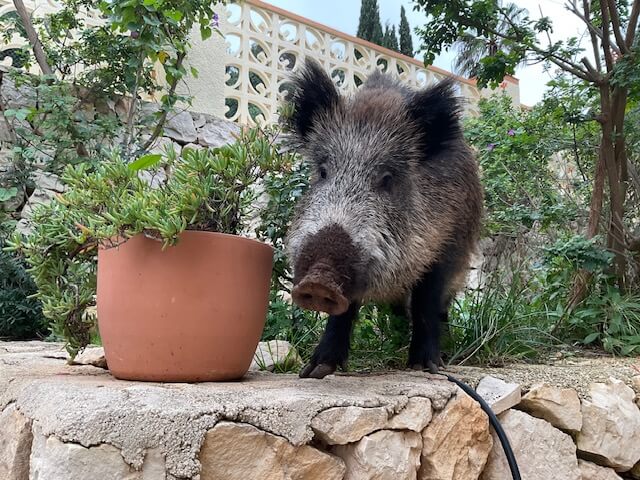
Image by Jennifer Falloon
Walter is feeling pleased with himself, barreling along the Autopista del Mediterráneo, or “AP-7,” as they call it, that starts way up by the French border, on his way to pick up Anna at the airport. It is a soft warm evening in September, the kind they take for granted now, the two of them, having lived on the Costa Blanca for fourteen years.
He is almost on his own out here, the engine purring reliably, the window open just a tad, and the breeze fluffing his hair – greying now but still plenty of it – as the hills of Alicante roll down toward him. Amazing that their expat life hasn’t all gone belly-up, that they are still here. How did they pull it off?
“You drive too fast, Walter,” she had said when he told her he’d pick her up at the airport. “It worries me, thinking of you out there on your own. You could get stopped by the Guardia again, the way we did before, when we’d just moved there. We were on our way to the airport then too. Remember? What a mess that was.”
He heard an infant shriek in the background and pictured her on Tom’s couch, surrounded by the detritus of infancy, holding her cell a foot away from her ear, in that weird way of hers, as though it were something infectious or dangerous, to be tamed before use.
“I’ll get the bus,” she went on, and he could picture her nodding. “I’ve done it before. I’d rather you didn’t drive, Walter, to be honest.”
It would take forever, he pointed out, plodding its way up the coast, making stop after stop in those little coastal towns to let somebody off in the darkness. (On the other hand, if she did, he wouldn’t have to drive at all. He could meet Jim in town for tapas and pick her up later on at the bus station.)
“I’ll be at the airport,” he says finally. “You there?”
“Yes. I’m here. I’m here. I’m ready to be home, Walter.”
“I know.” He pauses, waiting for more. “I’ll see you in Arrivals. Okay?
“Okay. And make a note of where you park, write it down or something. So we don’t have a mess like last time when you couldn’t find the car.”
She was right, especially about his driving. Something about Spain’s wide open autopistas – and the AP-7 in particular – brought out the rebel in him, converted him from Walter Stevenson, dull retired Anglo-American businessman with greying hair and a modest villa in Spain, into Walter Mitty, bad boy, rebel.
But that was the past, he told himself. That was then. He is a tamed man now, looking forward to seeing his wife of many years, who has just spent over a month with their granddaughters and is ready to be home. He checks the odometer. One hundred and fifteen kilometers, or close. What could be more respectable than that?
***
“That’s a long time,” he had said, trying not to sound petulant when Anna told him her plans.
“I know. It is longer than usual. But I want more time with them now. Betsy is almost four. And the little one will be two in no time.”
Walter and Anna had never expected to be grandparents. If Anna had yearned for grandchildren, it was a yearning she had contained over the years or rarely expressed. And Walter had been okay with that.
Tom was their only child, and he had been an easy one. Even now, it was easy not to think too much about him in his married life, or Leila, or the children, for that matter, to let the distance between England and Spain filter their lives, as expats did. They watched from a distance as Tom got on with it, as Anna would say. There had been one love affair, that they knew of, before he met Leila, with a flight attendant for Air France, who had ended it “brutally,” Tom had replied when Anna asked, and never spoke of her again.
He worked as a solicitor with a small London firm and belonged to a hiking group with whom he went twice a year on long, grim-sounding hikes for two or three weeks, to places neither of them had ever heard of.
Over the years they waited, Anna a trifle more pensively than Walter, for the mention of another woman’s name – a Claire, a Melanie, a Diana – but none was forthcoming, and for a while they wondered if their only son might be gay. How would they handle it if he were? They were sure, both of them, of their liberal credentials, but they had never, after all, been tested.
Then Leila appeared, to their relief, the oldest daughter of Moroccan immigrants, tall and broody, with large unruly hair – but loud, too, an odd combination. Out of Tom’s league, Walter thought. Were they ready for this? He knew he wasn’t and pined, mutely, for the Air France flight attendant, whom he had liked and who wore her straight brown hair in a bob that he was sure was very French.
Now the years have rolled on, there are two granddaughters, and every time Anna leaves their leafy London suburb to fly back to her home in coastal Spain, there must be a moment – surely? – when her bag is packed, the cab is at the door, hugs have been indulged in, and she says to herself, feet planted on the step, Should I stay? And forget this whole expat business?
***
The first week she was gone, he woke every night around two and lay there staring into the darkness as if the room weren’t even his, like some sort of imposter, this wasn’t his bed, their bed, with his tiled nightstand and his paperbacks – Ian Rankin, Jane Austen, Georges Simenon – stacked on top and, neatly folded below, the T-shirt and shorts he wore every day in summer.
Was he still in Spain, he would ask himself in those panicked seconds, with its vacant highways, its creaking palms, its rampant bougainvillea? Or was he somewhere else? And if so, where? And where was she? But Anna’s heart was still in Spain, he would calm himself, had been from the first.
Still, after fourteen years, the same old question: Were they cut out to be expats? They weren’t getting any younger. Could they hang on in this villa till one of them died? People did. And if Anna went back without him and decided one of these years to stay, how would that look to their friends, that small coterie of expats they have collected over the years? Brits, Yanks, the odd Kiwi or Dutchman or German or Frenchwoman. Were they already, some of them, wondering?
And what if they were? What did he care what they thought?
But that was the problem. Walter did care what people thought. Always had. Twice, before Anna’s departure – once when she was out shopping and once when she was having lunch with a friend – he had gone into the tiny bedroom they used as an office, slid open the file drawer where they kept important documents and examined, more forlornly than he would like anyone to notice, the dates on the Ryanair printout: August 12 through September 14. They were just dates, for heaven’s sake. He looked out the window at the Mediterranean, blue and indifferent. This was no different than any other trip she had made to see their son, just longer.
***
He was still thinking about this when he sat down with Jim for lunch a few days later at their usual cafe, his ice-cold caña sitting in front of him.
“I miss her already,” he announced with a grin.
“So why didn’t you go with her?” Jim was polishing his Gucci sunglasses with the little slip of felt that comes with them and raised his eyebrows quizzically. “You usually do.”
Jim believed couples should do things together, especially those who had been married as long as Walter and Anna had, should appear paired in public, like bison strolling into The Ark. As he had, until he became a widower two years ago. Indeed, Walter could not remember ever seeing Jim alone, as he was now.
“I’m not sure.” He reached for the carta. “It felt different this time. And you’re right. I do, usually. But there’s a lot to do around the villa, always, keeping the garden in shape, the feral cats – there are six of them now, sometimes seven. And Tom doesn’t have a lot of room. It’s easier, in a way, if it’s just Anna.”
He inhaled the sea-breeze, glad the worst of August was over.
The villa had air conditioning, but they never ran it. Walter disliked AC on principle, because it made him think of Florida, their two years in Fort Lauderdale. He had a low-paid job as a carpenter in a boatyard, Anna had just had Tom, and the motel they were staying at charged them $10 a week extra to turn on the air conditioning.
Each week they tried to manage without, until the sweat was dripping off them and the baby was crying with vexation. Then Walter would set off across the forecourt to the grim little office where the manager sat, thin and balding and swatting flies as he leafed through The National Enquirer – and it seemed to Walter always snickering – and paid him the $10. It had to be cash.
He takes a deep breath while he looks at the carta, counts to five and lets it out. Slowly. He never thought about anxiety during those Lauderdale years – there was no time! – but their lives must have been full of it. You just kept going, doing what you were doing, working at whatever job you could get, feeding yourself, muddling along, and assuming the future would take care of itself. Strange how certain words don’t get used, and then suddenly there they are, all over the place. Anxiety here. Anxiety there. Everyone has Anxiety now.
There was plenty of sex back then, of course. That helped. But it was odd, surely, that here in this retirement life they have been planning for years, anxiety is never far away. And not just the everyday bog-standard stuff – managing the villa, the garden, the car, learning some Spanish, dealing with bureaucracies – but the big existential one, the baggy monster that hovers over the bed in the wee hours, disappears at breakfast or when you’re watering the garden, then comes back, emboldened, in the dead hours of afternoon, and is only shaken by the thought of a beer, a glass of wine, or a gin and tonic later.
“I guess I don’t mind her going back on her own this year,” he says finally.
“Now you’re contradicting yourself.” Jim grins, mischievously. “Either you miss her, or you don’t.”
“It’s both.” Walter looks around. “And I like being here. This place is at its best in September. And I’m not into the grandparent thing the way Anna is. Women are always better at that stuff than men.”
They watch a flotilla of tiny sailboats head out from the marina, like dragonflies on the water. The kids’ sailing class. They do it every year.
“How old do you have to be to take sailing lessons?” Jim asks. “Ten? Twelve? Imagine being ten years old and out there alone on a sailboat, even in calm waters like today, even with Dad watching you like a hawk through his binocs. What good is he back there on the dock if you capsize? And where’s the instructor?”
Walter can just make him out. “Do kids that age really want to sail? I bet the dads put them up to it half the time. They wanted to sail, and they never got the chance, so the kid has to do it. Projection!
“The boars were back again last night,” he continues.
“They were? I thought they didn’t come in the summer.”
“Well, they were there last night. En famille, as Anna would say.”
“The same group?”
“I think so. Two big ones, Mummy and Daddy, and ‘Porky,’ as we call him. It could be another group, I guess. But I doubt it.”
Jim shakes his head. “Is there anything you can do about it? Was the garden a mess?”
“Not really. Nothing I can do as a homeowner, unless we have a hunting license on our land. That seems to be the rule. Which of course we wouldn’t want to do. They are culled periodically, as the numbers are huge in this part of Spain, but it varies.” He pauses. “I had Azhar extend the wall, and now it’s more than a five-foot drop. You’ve seen it. We thought that might deter them, but they still get in. Either they get in up there by the road, and come over the wall, which is still hard to imagine for me, or they come in through the neighbours. And we have no control over that.
“And yes, it was a mess. It’s always a mess. But I tidy it up, it’s not a big deal, and if I think they might be back the next night, I let it go and do it later. It’s odd. We go months without seeing them, especially in summer, and then there they are.
“I can’t figure out exactly what they eat. They don’t seem to eat half of the roots they dig up. They just mill around, grunting, poking their noses into the earth, and spraying it all over the place. Then they decide they’ve had enough and off they go. But they make a mess.”
“Are they carnivores?”
“No. They’re not. I thought they were, too. But they’re omnivores. Like pigs. They were hunted for years, still are in places. And here’s something interesting. They’re the fourth most intelligent animal or mammal there is.”
“So, what are the first three?”
“I don’t remember! And I don’t trust those sites anyway, half the time. One will say one thing, and another says something completely different.”
“Do they go after the feral cats?”
“No. They don’t. I think the cats, even feral cats, are too big. And too fast. Boars are a little slow, but they can get up a sprint.”
“There’s something appealing about them,” he goes on. “The way Porky trots after Mummy, I assume it’s Mummy, is endearing. Actually, the two bigger ones could both be sows. Their family structure is matriarchal.” He stops, and they sit in silence. “For some reason, I can’t get too angry about them, even when they make a mess. Maybe it’s because they’re so ugly.” They laugh.
“There was a piece in The Guardian, just recently, about a boar in France, a huge one, that Bridget Bardot has adopted. He looks darker than ours. French boars are no doubt more refined than Spanish ones. Anyway, his name is Rillette, and he was found as a piglet and everyone wants the government to get rid of him, supposedly, because he’s a menace to public health. Everyone but Bridget Bardot, that is. So good for her. It’s nice to see an old movie star, especially a babe like her, doing something useful.”
***
There had been a full moon last night, it was humid, and he was lying there trying to remember where he’d put the batteries for the mosquito zapper, when he heard them. Right now, he said to himself, he should put on his shorts and sneakers, grab the big flashlight, the one that always has batteries, creep down the stone path to the bed by the compost, getting as close as possible and – in one grand and frightening gesture – wave the flashlight at them and shout, but not too loudly, Shoo!! Shoo!! Get outta here!
Instead, he stands at the window listening to the not unpleasant sounds of grunting and digging. After a few minutes, Mummy lifts an enormous head and gazes placidly up at him, her tiny eyes a watery pink, her trotters sunk firmly in the soil. He can just make out the velvety flesh of her inner ears. They were here before we were, Walter, he can hear Anna saying.
There is something restful about them. Their size, their focus, even their calm and resigned departure on those occasions when he does wave the flashlight at them and watches them head calmly up to Azhar’s newly built wall and the gravel road beyond, their muscular calves and dainty trotters, as they trot by, reminding him absurdly of ballerinas.
***
He is surveying the mess the next day when he sees Inga making her way toward him through her garden, also terraced, a carafe in one hand and a small tray with two tall glasses in the other. Her husband, a large Norwegian Anna refers to as “The Viking,” will be away on business in Munich (two days, usually) and Berlin (three). She will be lonely. He can tell by the way she is sashaying her hips. She is slim again, wearing bright pink shorts and a white T-shirt.
“Limoncello!” She grins. “I just made it this morning! 80 proof.”
Inga’s weight goes up and down, and Walter never knows when he watches the two of them swimming in their pool which Inga he will behold, the chunky one or the slim one.
He is on the verge of flirting a little, telling her how good she looks – Inga’s energy is different from Anna’s – but he doesn’t. Walter is reluctantly aware of what you can say these days to a lovely woman who lives next door, and what you might not. He is okay with this. But if anyone were to ask Walter, he would say in this regard that he is of the old school, fine with the hurly burly of men and women. But no one does. And anyway, Inga knows she looks good. She doesn’t need him to tell her.
“Thank God you’ve arrived,” he says, instead. “Now I can clean it up tomorrow. Is there ice in those glasses?”
“Yup! And they are even chilled! How’s that for service?”
What perfect teeth she has. So white. Why has he never noticed this?
“I don’t get it,” he says, looking at the ruptured earth. “Supposedly, that’s what they eat. Roots. But look at them. All over.”
“I don’t know how they get in.” She shakes her dark hair gently, placing the tray and the carafe carefully on the stone wall. “Gustav thinks it’s from the empty lot next door. But I don’t know. I’m not so sure. Maybe down below, near the lower road. He goes out at night when he hears them and yells at them – you probably hear him! – and they head off. Eventually. When is Anna back?”
“In another three weeks or so.”
“Ah. This is a long time, no. Longer than normal.” It’s a statement, more than a question. Walter likes the directness of European women.
“Well, I guess it is.”
He asks about the grandchildren. There are four of them, four boys.
“They are OK. One of them, the third one, he has trouble in school. He has ADHD, I think you call it. He is needing special help.”
Walter nods. Inga and Gustav also have just one child, a son, and he works for Volkswagen. “How is Ivan’s job? Will he be affected by Trump’s tariffs?”
“We don’t know yet.” The smile leaves her face and she shrugs lightly. “We all are, aren’t we? Or will be. The man is a monster, an idiot. He has no idea what he does, and now he’s in charge of the world. Everything!”
Walter is silent. There is nothing he can say about what is happening in the United States. Europeans don’t understand it, and he cannot blame them. Most have been to the States at some point, worked there for an international company, or taken an extended trip, or have children living there. They have tales of road trips or bus or train journeys, of being treated well, of an almost legendary American hospitality, especially in the South. And now this … How did it happen, they want to know. And he has no good answer.
“What do you think of Merz?”
“He will do what he has to.” Again, that bluntness.
She tops him up, and he sits there on his wall, the morning sun on his back. Is Ivan, the son of parents with homes in Germany and Spain, part of a new and imperilled precariat? And what does that even mean these days? What happens to fathers like Ivan who have had one well-paid job all their adult life and then lose it?
He can hear Anna pointing out that the parents are rich. But are they? And what is rich these days? They chose to have four children, she would add, impatiently. We live in an age of contraception.
“Perhaps you can come over for a glass of wine one evening while Anna’s gone. Gustav always likes to talk with you. It gives him a break from me! He gets back this weekend.”
She bends down and kisses him gently on the mouth. How soft it is! He has forgotten how tender a kiss can be. There is a faint taste of lipstick.
He is shocked. But he also isn’t. He has been half expecting this for a while now. Inga is often alone. Sometimes, standing at the bedroom window late in the evening, Walter will see her sitting at the round table on their terrace behind a bottle of red wine. If she sees him, she waves. All very innocent. So far.
Then she gives him a broad smile, with those perfect teeth, and he watches her amble down the steps away from him, her behind trembling slightly. At times the coarseness of his thinking alarms him.
***
The airport at Alicante. Arrivals. Standing here with the motley crowd at the gate, it occurs to him, not for the first time, that airports are the great equalisers. Sooner or later, unless you are really rich or you have your own airplane – you wind up in Arrivals.
At least this time he’s not the oldest one here. A battered looking couple near him, speaking Russian, are definitely older, the man certainly. He is tall with a large blob of white hair and smiles warmly at Walter, as if he knows him from somewhere.
And there she is! – she must have been one of the first people off – looking older, her hair different somehow, in a dress he doesn’t recognize. Her face tightens imperceptibly when she sees him, as if she is slightly annoyed that he has made it without incident, may even have parked the car somewhere they can find it.
There is a tight little wave, and he goes forward instinctively, aware of the Russian couple watching him. He can feel the smile on his face. He never tires of his joy in Anna, never has.
Later, unlocking the car, he congratulates himself on this smooth pickup, one of his best. In no time he has paid the ticket machine, using his debit card competently, as everyone else appears to, they have loaded the car and are out of the garage. He has resisted the urge to a burst of speed as he glides smoothly onto the autopista, and Anna didn’t have to wait, exhausted, by the elevators like last year, while he raced through floor after floor, trying to pick out their luggage rack. Why do they even have a luggage rack?
***
“Walter, I have some news.”
Her voice is so strange, he takes his eyes off the freeway briefly and looks at her in alarm.
“What is it?”
“Don’t worry. No one has died.” A weak smile. “And no one is terminally ill. That I know of. Tom and Leila are in a bit of a mess. She had an affair, well, not even an affair really, I guess you’d call it a one-night stand, with her friend Sal. We met him a few years ago. They have known each other for a while.”
“Oh, my God.”
“I would have told you before, while I was with them, but I wanted to be with you when I did. I don’t know why. And I didn’t want to do it from their home for some reason.” She pauses. “Even now, I should wait probably till we’re home. But I can’t. I find I can’t.
“Anyway, it’s more than that. It seems that Rosa is not Tom’s child. She is Sal’s, the product of this one night, this event, whatever you want to call it.”
“Oh, my God. What a mess.”
“Yes, you’re right. It’s a mess.”
“Why did she do it?”
“I don’t know. Why does anyone do something like that? She was a little down after Betsy was born, she had post partum, which is linked to depression, but I don’t think it was that bad.”
“Is she sure? I’m having trouble taking all this in.” He winces. “And why did she wait so long?” He pauses. “Will there be a divorce?”
“I don’t know. I don’t think so. He didn’t say anything about a divorce.”
“I thought women couldn’t get pregnant if they were nursing.”
“So did I. And so did she, probably. But we were wrong. I read up about it on the Internet. It happens.”
“Is he still in her life?”
“No. He’s gone. Well, he’s gone from her life for now. Tom was clear on that. And I don’t even know if he knows.” She is silent. “But here’s the thing. He’s her father, Walter. Nothing can change that.”
“Where is he? Is he in England?”
“Yes, somewhere up north. And he is single, thank God. It’s upsetting enough as it is. Imagine how much worse it would be if he was married and had his own family.”
“So it’s over?”
“I guess so, as much as these things are ever over.”
“And you know, Walter, I think I may have been there when it happened.” She glances at him. “You remember that time I stayed with them, not long after Betsy was born? I forget how old she was. Anyway, I never told you this, but Sal came by one afternoon. I was napping in the spare bedroom, and I heard her let him in, and I didn’t bother getting up, because, you know, he doesn’t need to see me, he’s come to see Leila.
“Anyway, I woke up at one point, and I swear I could hear people having sex. Not really loud, but loud enough. And I said to myself, You have to be imagining this. Tom isn’t home, and they wouldn’t be doing this. And she’s nursing! And if they were going to have sex, wouldn’t they do it absolutely quietly, ‘cos the mother-in-law is in the spare room?” She stopped. “Words fail me, as they say.”
They sit there, the two of them, staring ahead as the freeway rolls away before them, smooth and empty and indifferent. Walter could use a drink.
“I don’t know what to say.”
“Neither do I, my love.” She hasn’t called him that in a while. “Neither do I.”
“How long has Tom known?”
“I don’t know. I didn’t ask. Or what made her tell him, now. After all, it’s not as if one looks at the little one and says, Well, she’s clearly not Tom’s. Who she looks like, and it’s a good thing, is Leila. It never crossed my mind. And I’m sure it didn’t yours. She could have gone for years without ever saying anything.”
“What does Tom think?”
“He is doing all he can to accept and forgive because he loves Leila. And the girls. He is a good man, our son. We only had one child, but he’s a good one. And the fact there are two of them, two children, makes a difference. He wants to do the right thing. There are times in life when it may help to be something of a stoic.”
***
At home he carries Anna’s suitcase in. And thinks of Tom, unknown to him still, ready to love this infant as though she were his own, feed her, clothe her, settle arguments between her and her sister, do what he can to turn her into a decent human being – and watch her from the pier as she battles around in her own tiny catboat one day.
He pours a white wine for Anna and a big sherry for himself. The little rituals of drinking matter these days, the smell of the lemon, the solid purity of the ice cube. He thinks of their years together, the three of them, and his attempts to make sure nothing dreadful ever happened, no drift into modern-day penury, no terminal illness, no irreparable rift with a sibling, no bitter divorce. He had been good with money, in his plodding way, and they had even tried for a second child, but when Anna had two miscarriages, they let it go at one.
Tom had been privileged, by the standards of the time, and they had tried to make him aware of that, without reminding him of it constantly. When he got the first job he went for, and that he really wanted, Walter had said, “Don’t be too cocky. People go their whole lives without a stroke of luck like that.”
“Oh, stop being such a killjoy, Walter!” Anna countered, with pride and exasperation. “Let him enjoy it, for heaven’s sake. Life will ambush him soon enough.”
Now it had.
“Should I phone him tomorrow?”
“No. Give it a day or two. It all needs to gel awhile, for all of us. Or it did for me. He knows you’ll be there for him. Give it a few days.”
“Will she see this guy again?” Why he asks this again he has no idea.
“I don’t know, Walter.” She looks at him with fatigue, and it dawns on him that this has been hard on her. The lines around her eyes seem to have deepened. She looks different, the way people do when they’ve been gone awhile, as if those they’ve been with, the air they have been breathing, the very place itself has altered them. They need time to become who they are again. She is thinner, too. Anna has always been proud of being thin. You can never be too rich or too thin! she would announce with a grin, twirling in front of the mirror. And we certainly aren’t the former.
“As I said. I doubt it. And anyway, we cannot control that, any more than we could control the fact that it happened. And I think we have to assume he will want to see his daughter in the coming years. What father wouldn’t?” She takes a sip of her wine.
“What is it about human beings, Walter? Why do we always make a mess of things? But Leila wants to make good, I think. Maybe that’s why she did it. Told us all. Now.”
“You are looking on the bright side again, always the optimist.”
“I am not looking on the bright side. It’s just that in this case we have no choice. What else can we do? And I’m not an optimist, you know that. It’s too much work. In the long run, it wears you out. I’m a realist. It’s much easier. I blame it all on fate. And sex.” She looks at him directly, for the first time since they sat down. “Well, what other reason could there be?”
“So, what do we do now?” he hears himself saying.
“Nothing. We don’t do anything. We go on as we did before.”
***
Two nights later, the moon is almost full, and he is on the phone with Tom. He is at the bedroom window looking out at the cypress he planted fourteen years ago, the year they moved into the villa, massive now and dark against the sheltering sky. Whoever thought he would one day be a grower of cypress trees?
He first saw them when he was about ten years old and on holiday with his parents in the south of France, tall and martial, green velvet soldiers lined up along the country roads, their conical shape so different from other trees. That was what he remembered of France, its cypress trees, that and his father behind the wheel, angry at the roads, the maps, the food – France itself! – and his mother, her spirit floating daily above all the friction, her fair hair adrift in the breeze through the window, as they rattled along. “For God’s sake, Arthur, stop worrying, we’ll find it!” And she would grin back at Walter in the rearview mirror, surrounded by luggage, guidebooks, huge bags of mouldy croissants, rumpled jackets.
“The boars are here again,” he says to Tom. “I’m looking at them right now, son. You should be here. You would behold how terrified they are, almost paralysed with fright, when they look at me up here at the window, waving the flashlight. When they aren’t spraying dirt and roots all over the place.”
As if on cue, Porky looks up at him with watery pink eyes. He is a different colour from his parents, albino like, helpless looking, as if he’s only just been born. Spanish boars, he has read, are raised by the sows. The bulls stay out of it.
“How many are there?” Tom asks.
“Three. There are always three. Mommy, Daddy and Porky, as your mother insists on calling him. They are a proper little family, our boars.”
“Mum showed us the pictures. They’re huge!”
“Yes, they are pretty big. The males can weigh up to 90 kilograms, and the females between 40 and 65, and some of them get up to four feet long.”
How dopey he must sound to Tom, , rattling on about boars, as though he’s some kind of expert, and the BBC will be calling him any day to do a special. Yes, Mr. Mitty, we’d like you to do a documentary on the Spanish boar. How big they get. Family structure. Who runs the show. Whether they raise offspring that aren’t theirs. We’re tired of Mr. Attenborough, and we want to get a younger crowd, he’s so old, and he doesn’t do boars.
“Doesn’t it bother you, that they keep getting into the garden like that?”
“Not really. There’s something about them that we both like, your mother and I. Which is just as well, as they aren’t going anywhere. They’re just trying to survive. Like all of us. But maybe more so when you’re a boar. And they smell!”
They laugh. A light goes on next door, and Walter has a faintly guilty flash of Gustav, fresh from boardroom triumphs, gliding around the kitchen in Viking regalia, a glass of red wine in hand. Inga will have prepared something meaty and hearty, nestled in vegetables.
“Is Mum still awake?” Tom asks.
“No. She had an early night. She’s in bed, out like a light. She always wants to get the house in order when she comes back from visiting you. No matter what I do, I wash the sheets, I mop the kitchen floor, I vacuum, blah, blah, blah. It’s never how your mother wants it. So, she did that stuff today. Tidying. How are the girls?”
“They’re fine.”
“Good.” He pauses for a second. “They’re lovely girls, Tom. Both of them.”
He is trying for some sort of closure as he says this, the kind of thing Anna would never bother with.
“Let time be the decider and live in the ambiguity.” He saw the words scrawled on a wall in Hammersmith, London, years ago. He was in his early twenties and on the way to a dance, long before he met Anna. He had no idea what it meant. Still doesn’t. And here he is living it.
“We should talk more often.” Tom’s voice brings him back. “We missed seeing you this time.”
He can hear a child’s sharp wail in the background, then crying. The boars are heading off, Mummy in the lead.
“Next time you should come too, Dad. We all like it better when you’re here. It is more like family.”
“Will do,” he says, crisply. “Anything to take my mind off these boars!”
The kitchen light goes out next door. He turns his mobile off and stands there at the window, looking up at the cypress and listening to Anna’s measured breathing behind him. Should he tell her about Inga’s kiss? It wasn’t a real one. He has a little pickle of his own right now, nothing that will kill him.
She was right. Humans are a mess, all over the place. He thinks of Tom and Leila in their London kitchen. What are they saying to each other? How can one human being, a husband of years, say, a wife, a lover, ever really know another? How remarkable it would be if we did the right thing all the time, every one of us, never took a risk, made a huge mistake, leapt before we looked. There would be no moments like this one, for sure. Just the terrible certainty of tomorrow.