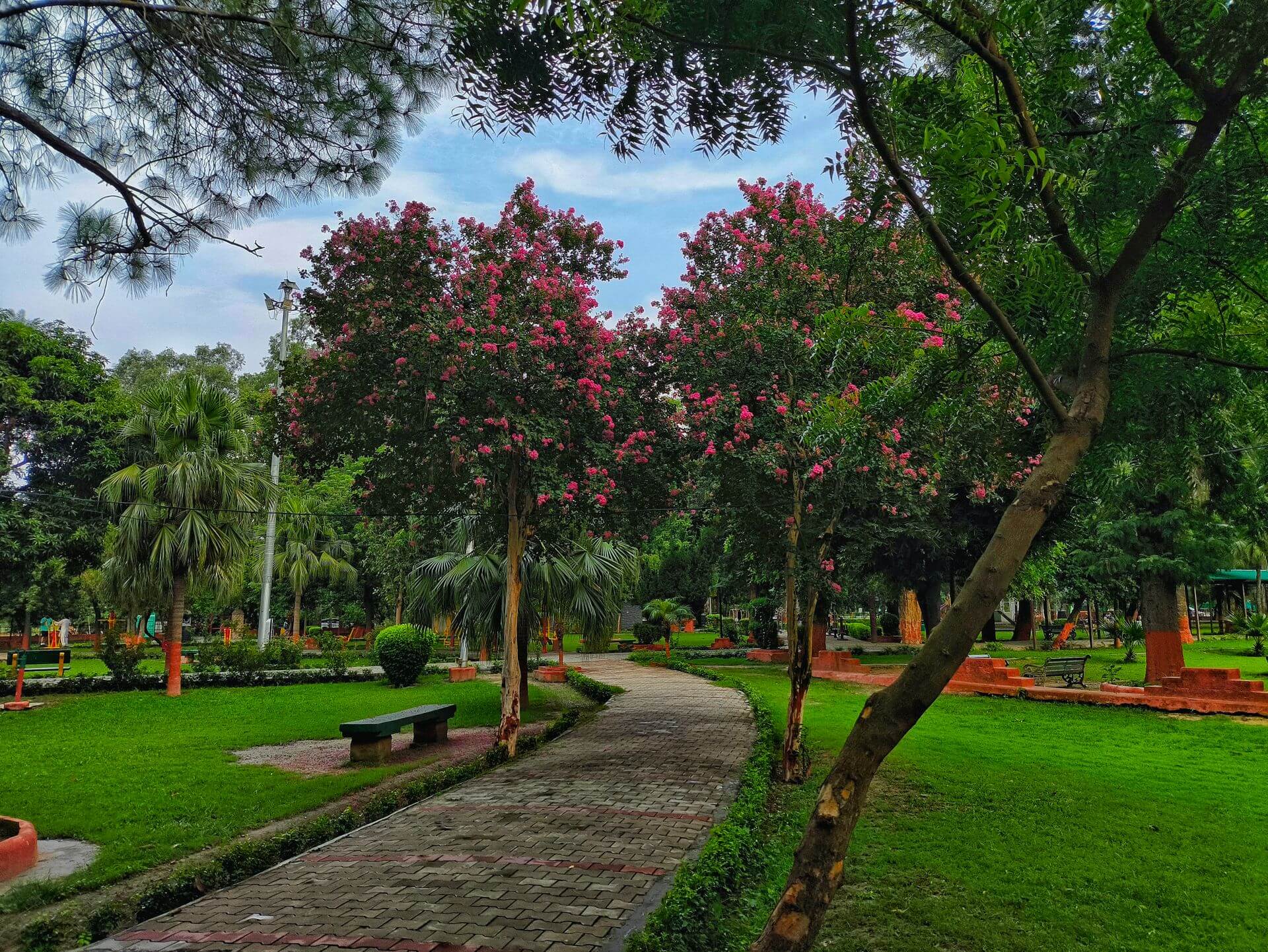
Image by Pranav nav at Pexels.
I know it wasn't my imagination. The man held a large sickle with a long handle in his hand. The handle, a sturdy block of wood on which the iron implement was mounted, was longer and bulkier than the usual sickle seen in the hands of women who harvest wheat or rice. Not many people from this posh South Delhi colony would have seen a woman sitting on her haunches to gather the harvest or heard its swish and smelled the freshly cut paddy. Even the half-moon of the sickle with its sharp, glistening edge, which the man swung as he walked, was bigger than normal, or maybe it was the usual size. I distinctly saw the muscle of his arm tightening on the thick, squarish, or maybe cylindrical handle. I could only see his white T- shirt clad back as he negotiated the barricade of the side gate and entered the Atal Park. He wore old-fashioned skinny style jeans, the kind you can buy cheaply in Sarojini Market now that everyone prefers flared ones. I think he was slightly bow-legged, but tall, his back sinewy and probably used to physical labour rather than gyms. He, my husband—I can only think and write of him with a capital ‘H’—says that I am rather fanciful; I might have constructed these details later. But I had stopped and watched the sickle-man across the hedge of the doggie park. I am always alert when out, and He would be proud of me for observing the man closely; that is, when or if I tell Him about the sickle-man. But these thoughts would come later. I stood and watched the man restrain the swing of his arm and grasp the sickle tightly. I was attentive and observant, just as He instructed me to be. I could not have been very far from the sickle-man; there was a hedge and a narrow road between us. But I hadn’t put on my glasses, which were clipped to the neck of my kurta. I cannot keep my glasses on while walking because they slip due to my sweat, and anyway, my distance vision is quite good. I use them to change the playlist on my mobile. He says I should stop pretending that I have perfect vision and wear them constantly, as the doctor advised. I have been using reading glasses since I was a teenager, but I’m unused to wearing them all the time. Besides, glasses make me feel unattractive. The man’s T-shirt front had something written in black letters, which I could have read if I had worn my glasses. But I didn’t see him from the front; perhaps I was mistaken. It is possible that he wore a plain, round-necked T-shirt. He was young with a full head of thick, black hair; maybe he had a moustache, but I can’t be sure of that. He was definitely not clean-shaven, a bit scruffy—judging by the back of his head with the riot of untidy curls—but not exactly unkempt or unwashed. The side entrance of Atal Park was such that you had to weave through a waist-high iron barricade; maybe I glimpsed a part of his face, but not enough to recognize him in a police lineup if he killed someone. Why else would he enter the garden with the murderous-looking sickle in the evening. Surely, he wasn’t one of the gardeners deputed for hacking away the undergrowth on the edges of the pathways. Gardeners don’t dress in jeans and a T-shirt; at least not the gardeners I know in my small town. Maybe here they dress smart. But it was way after their normal working hours.
I completed my three rounds of the smaller doggie park and was going towards Atal Park to continue my usual evening walk perambulation when I saw the sickle-man. He always warns me that Incidents happen when people are caught in ‘the wrong place at the wrong time.’ I silenced my earphones, took another round of the doggie park, my ears trained to hear a bloodcurdling scream, running feet, more screams and confusion. Was it possible to hear all that above the din of the traffic? Maybe the man chose the other end of the park for the deed. But panic would spread in quick waves. Should I warn someone, anyone? There were no guards around. He always tells me to steer clear of trouble, mind my own business and avoid drawing attention to myself.
The doggie park was not intended to be a doggie park, but somehow it attracted several people walking their dogs—not people, as in the South Delhi crowd, but their house help—so I started calling it doggie park. Most of the dog walkers didn’t clean up after the dogs, so one had to be careful walking on the grass. The mud pathway around the park was cleaner; it had only dog piss pools. I loved looking at the dogs—English Beagles, Alsatians, Labradors, Pomeranians—pampered, well-bred and trained. My mixed-breed Momo would have barked at all of them and strained on her leash. She hates being leashed, and we never put her on one because she lives in the grounds outside our Rampur home, sleeps in a doghouse and has the run of the place. We couldn’t bring her here because she would have to live in the flat with us, and we cannot pray namaz where there is dog drool. Some clerics say that good angels don’t enter a house where there is a dog. We have always had dogs living outside our house—Sam, Michele and now Momo—all with English names for some reason, except Momo, who came after our marriage four years ago and I got to name her. I reward myself after the three rounds of the doggie park by going to Atal Park, but not today. Still no screams.
I love Atal Park with its 13th-century domed monument perched on a small hillock, its lush flowering trees marking the seasons, and the children playing on the swings. There must be children there today, at least some children—it is midweek, and the school kids have other things to do. The toddlers and preschool kids come with their maids. Maybe I should warn someone. I should at least check on them. But the little ones must have left by now; it’s getting dark. I imagine the sickle-man jumping out of a thicket and attacking a woman—a lone walker, an older woman, because she has slow reflexes. Before she can understand or react, a metallic swish on the neck, and it’s over. He says my reaction time is too slow, which is why I can never drive a car. The sickle-man would definitely take me if I were walking there because I look different from them with my full-sleeved, long kurta and the mulmul scarf around my shoulders. In Rampur, our hometown, I wear my voluminous black abaya wrap and a scarf wound tightly around my head. He told me not to wear the abaya here because we should try to meld into society. (How does it make you feel, asked my therapist. Naked, I told her; vulnerable, I added from her vocabulary.) I have occasionally seen some abaya-clad women here. They are all poor or lower-middle-class women—one can tell from their shuffling walk and their dust-covered footwear. You can always wear an abaya when we go home, He says, but He is rarely free to take me to Rampur these days. Trains and buses are unsafe, and ‘incidents’ have happened even in private taxis. A single Muslim woman in public transport calls for trouble. But He allows me to walk in the parks near our flats. South Delhi is generally regarded as a safe place. He says every place is safe till something happens. He says I should feel free to wear whatever I want here—jeans, skirts, shorts. I have the freedom to be like them. Didn’t I always want to dress like women in movies and shows? I should look smart, someone who doesn’t get classified as a Muslim woman. I wear jeans and a top with a scarf around my neck when I go to the shopping mall. He says I look great in jeans. I feel attractive when I catch my reflection in the shop mirrors; the scarf looks odd, but I can’t do without it. I try to fight the naked feeling, constantly fidgeting with my scarf, spreading it across my breasts when I see men looking at me. It is easy for Him, He doesn’t have to change his dress or sit in the salon for hours to get his hair straightened, curled, streaked and dyed. But our speech gives us away—the inflexion, the polite ‘aap’, the elongation of words and the Muslim style of pronunciations. Our English doesn’t have the desirable South Delhi accent sliding over English words, and the careful enunciation of Hindi words as if they feel foreign on the tongue. I watch spoofs on South Delhi aunties for fun. My walk can never be like theirs—the limbs swinging with unrestrained rhythm, the uninhibited thrust of the chest over a curving arch of the back. When I first bought fruits from him, the fruit peddler, who plies his cart in the colony, asked in surprise if I lived in the colony. There are barely any Muslim residents in the area.
I pause once again at the side gate of the doggie park. Maybe I should just walk into Atal Park. A narrow dusty road between the two parks leads to a mammoth mandir–salmon pink with a triangular orange flag fluttering on its golden pinnacle. I look at the cars parked on the sides of the path, the drivers relaxing, watching their mobiles as they await their masters and mistresses. Nothing untoward has occurred as yet. Faint evening devotional songs interspersed with the clanging of bells emanate from the mandir. The women who visit the mandir before their walks generally wear shalwar-kameez with or without scarves. They are usually middle-aged and walk more slowly with a pious expression; their foreheads bear a large red or beige round tika from their visit to the mandir superimposed over the dot of bindi between their brows. The bindi is a sign of their married status. Muslim women don’t wear bindis; it is the mark of the Hindus. When I was in school, we wore sarees and bindis for dances. I loved the bindi on my forehead; it enhanced my eyes. But that was playing a part, being someone I was not. It must have been then that my grandmother explained to me that we cannot copy the ways of the Unbelievers. But they are Believers, they believe in different gods, I told her. It was important to be secular and tolerant—we had been taught that in school; it was the bedrock of our democracy. I smile at my sincere schoolgirl self. Grandmother’s censure is so deeply ingrained in me that even now I can’t wear the bindi— the easiest way to become one of them. I know the sickle-man will spare the pious ones with a prayer tika on their foreheads. He doesn’t want to go to hell. Then there were the young or still-young women in their jogging pants and tight T-shirts, bent on sculpting a body they know lies beneath their skins. Their jiggling boobs and butts, bare midriffs and shoulders make me feel embarrassed; sometimes I almost gasp at their daring.
I stop, almost physically struck with the thought—maybe the sickle-man knows I come for my walk every evening. He is waiting for me, an interloper, who should have left for the Muslim country carved out of the bones of his motherland, the one who still dares to show up here, prosperous and moneyed, taking away what is theirs. He could be an unemployed, frustrated young person, belonging to a right-wing group. My husband always tells me that the right-wing groups backed by powerful people want to create terror among our community so that we go away to Pakistan. They know that even if they kill, they will be released on bail and remain unpunished. There have been so many lynchings by cow vigilantes killing Muslim men for carrying beef or trading in cows. But all that is outside Delhi. It’s not always easy to spot the right-wing people here because they look like everyone else.
I sit down on a bench to process the threatening thought. (My therapist says I should ‘sit with my thoughts’ and try to let them go.) I still have half an hour before I return to my flat for the maghrib prayers. If I go back now, He will ask me the reason for returning early—did anyone trouble you there? What if I tell him about the sickle-man? I think by deciding to sit out my walking time, I have already made up my mind. I know he will react by telling me that the gardens are not safe for me, that I should go to the M Block Market gym. He has taken a couple’s membership at the Gold Gym, and I know he has this mental image of us going there in those tight gym clothes, working out together and eventually making gym friends. There is always a plan. The gym is a great place to find clients for his property dealership. The fact that we have still not made friends after a year of living in the colony—He decided we should move to posh South Delhi neighbourhood from Rampur when his business took off—is a matter of great angst for Him. We are almost as rich as they are, we can both converse in English—‘fair, tall and convent educated’ was the crux of the matrimonial advertisement my in-laws placed in the newspaper to find a suitable bride for him. I ticked all the boxes, plus I belonged to Rampur, which made everything so convenient. I wouldn’t have to go to some other town to visit my parents, for family events or stay with them for the birth of my children. He didn’t tick my boxes, rather my parents’ boxes, except one—he was richer than my other suitors.
Once He asked me to cook and send semolina sweets to our upstairs neighbours. They returned the bowl empty! What kind of people do that, I asked Him. Don’t they know that they must reciprocate, I said. Maybe they will send something around later, He said. They never did. My maid, who also works for them, said that they didn’t eat the sweet because we cook meat in our kitchen, and they are vegetarians. He says that is understandable; would we eat from a kitchen where pork is cooked? I still feel bad about it.
It was almost impossible for us to find a house in the colony. He found a ‘distress sale’ and offered much more than the other buyers—enough for the seller to ignore the fact that we were Muslims. He is very proud of the flat, but I feel squashed, crammed between strange bodies living, eating, bathing, shitting, copulating—I can’t breathe with the thought. (I’m overwhelmed; I tell the therapist in therapy-speak). The upstairs people keep dragging their furniture around all day and sometimes at night. I hear loud voices, arguments, music, and laughter from the lives of people I haven’t met. I feel like I’m suspended in a bubble, hanging like a pupa, but the pupa knows it will emerge and, until that time, it can feel the wind, the sun, the rhythms of the day. I cannot feel the day passing into night and the changing seasons.
In Rampur, I could smell the rain coming in, catch the evening chill, and watch the lengthening winter shadows. We talked about the feel of the day on our skin—the real ‘feels like’ temperature on the weather app. By the evening, the desperation grows, and I need the earth under my feet. The evening air is tired, wrung out and dusty, but under the trees in the gardens, it’s still moist, almost fresh. I look up at the trees as I walk, trail my hands on the plants, touching the leaves and the flowers. I think I would wither and collapse without my walks. I was never a person who went for walks. In Rampur, women don’t go for walks, not even in public parks. We walked in the bazars, our strides slow and purposeful—this was acceptable. Besides, I didn’t need to go for a walk because I was surrounded by trees and had a small garden of my own. Most people here have potted plants in their balconies and in their rooms. I can never torture the plants—I’m sure they can sense their suspension from the earth—so I resist His attempts to fill our balcony with plants peering down longingly at the earth and reaching up at a piece of sky. (My therapist’s diagnosis—I don’t want to grow roots here.)
#
There is no news of a murder or an attack in the papers. I look very carefully; it would be a small report tucked inside. Maybe the man was doing a reconnaissance to see if he could sneak in the weapon without causing alarm, maybe he had hidden the sickle somewhere. I ask Him to come for a walk with me. My therapist has advised taking up at least one couple activity a day, I said. Therapy was His idea to help me adjust to the change, which he secretly felt was making me anxious. It was quite common for ‘normal’ people to go to a therapist; it is one of the things the rich, upmarket people indulge in, like a mental spa, He told me. I don’t know a single person who goes for therapy. Actually, I quite like talking to my therapist. The best part is that I can invoke her name to get Him to do things. He agrees to walk with me. Maybe He had a promising meeting with a client and decided to indulge me that day, or he wanted to be seen walking with me in the park. It might lead to a casual encounter, which could flower into a friendship. It’s easy to guess His thoughts.
I take him to the doggie park first. It’s my routine, and you must follow me, I said. He tells me not to be predictable in my walks—a casual warning, the kind He often throws at me. But He’s right. Maybe I should go at different times each day. A morning walk on some days—the winters were nearly here, so I could even walk in the afternoons and enjoy the sun if it shone out of the dirty smog. He looks at the dog-walkers and remarks that the dogs have better pedigree than their walkers. He tells me that I have a habit of staring, so I slide my glance over the dog-walkers and rest my gaze on the dogs. It is acceptable to stare at dogs.
I point at a middle-aged man dressed in an expensive-looking, ‘sustainable’ kind of T-shirt and cotton shorts. His clothes are crumpled like he shrugged them on in an unselfconscious way, typical of the colony people.
‘There’s your well-bred kind of guy,’ I remark.
‘Hmm... but why is he talking to the maid?’
The maid—we presumed it was a maid sent out to walk the dog—is a scrawny, dark girl probably in her twenties or younger, wearing a churidar-kurta and tugging at a labrador on a leash while she speaks to the man. I tell Him that they often stood talking under the deliberately stunted kadam trees on the edge of the garden.
‘What could be their story?’ I wonder aloud as we walk by, and I catch the smell of an expensive aftershave. The man is slightly bald with tousled, greying hair and a slight paunch. He keeps running his fingers through his hair while talking to the maid.
‘Huh, what story...just plain lust.’
‘Lust is also a story. Maybe lust is his side of the story, but the poor girl...’
‘What poor girl? She must be getting something out of it...money.’
‘Or hope. Maybe he has promised to set her up in a flat of her own.’
‘That’s money too. Everything is about money here.’
‘It couldn’t be easy for the girl if they are sleeping together, or if he is persuading her to. She must get home by eight or her father would suspect something.’
‘She told her parents that she has to stay back on Sundays to help the mistress.’
‘Not Sunday... everyone is home. Tuesdays because the wife is busy with her fast and prayers.’
‘While the husband has all the fun,’ He sniggers.
‘What if the wife finds out? It would be shameful that her husband is having an affair with a maid. He could keep a glamorous mistress—that would be more acceptable and expected of the rich...’
‘Maybe she already knows about it and has asked him to be discreet. The maid is hardly a threat, and they have teenage kids.’
We laugh at the story we created as I lead him into Atal Park. I show him the mausoleum on the hillock. Luckily, the gate to the monument is unlocked, and we walk up the steps. This is the first time I've gone up to the stone building. My mother always warned me about Jinns inhabiting abandoned places, lying in wait to possess women wandering alone in the evening. I peer inside. There is no grave inside its domed interior, so it wasn’t really a mausoleum; it couldn’t be a guest house or a living place. It’s a hexagonal structure with arches all around—two entrances and four windows with stone mesh. The signboard outside the garden indicated that the monument dated to the Delhi Sultanate period, probably the 13th century. Maybe they removed the gravestone. An iron frame outside the structure probably had a signboard about its history, but it stands empty now. We can make up a story about this, too, I smile, but He is already heading down the steps, distracted. There is no one from our block here. ‘Riffraff’, he frowns and points his chin at some boys sitting on a bench. He smiles at an oldish man from our block. The man returns a startled, vague smile and carries on.
‘If you wear a T-shirt and jogging pants, you would look like a Punjabi woman,’ He says as a couple of women pass us, their faces alive with their animated chatter. Most of the residents in our colony are light-skinned Punjabis.
‘But I don’t want to look Punjabi. We are Pathans!’
He scoffs and says Pathans are refugees from Afghanistan and are looked down upon in Delhi. He has picked up some Punjabi phrases which He uses loudly, sometimes inappropriately, with shopkeepers and perhaps with His clients. It’s embarrassing.
I’m alert, scanning for the sickle-man. Maybe I’d recognise him. I glance at people’s hands, most of them are carrying mobiles, an old man holds a stick to chase away stray dogs. There is something about walking side by side with the gaze focused ahead and not at each other that brings out confidences and unconnected thoughts—something like driving together. We had our best conversations during the three-hour drives to and from Rampur. He narrated stories about his college escapades; I even told him about the rude things His mother said about me. We haven’t been to Rampur for two months now. I tell Him I miss home; I want to meet my mother; I miss being with my people. We should have brought a place in Jamia, I say. My cousins live in Jamia, and they are very happy. Jamia is a Muslim ghetto, just like Rampur, and we need to get out of Muslim-dominated places, He replies. Maybe we should have kids, I say. Our mothers wanted us to start a family—a reasonable expectation after four years of marriage and my impending 30th birthday, but He wants us to wait till his business is better established. (I feel a complete blank when I think about kids, I tell my therapist.) My mother says that till a child is born, marriage is a tenuous bond. He can send me back with the kids, too, I tell my mother. She is terrified of me being divorced and sent back like spoiled goods—an unwanted guest in my brother’s household. My brother loves me, but not enough to keep me. My husband loves me enough to keep me—I’m sure of that. I’m pretty, well-educated and have the potential to mutate into a Delhi-woman. Anyway, if he divorced me, the matrimonial advertisement— “wanted fair, slim, convent-educated bride for a divorcee’—wouldn’t get him a better wife. He isn’t good-looking, just rich.
Halfway through the walk, He says he is getting bored with walking in circles, even though we haven’t completed one full circle of the park. He stops, smiles, and says, ‘Let’s go home and make babies then.’ I laugh even though I’m exhausted from trying to keep him entertained. (I couldn’t even listen to music because my therapist advised me to be ‘present in the moment’.) At least the sex has got much better since we moved here. Being away from the constant clamour of an extended family and a highly opinionated mother-in-law has helped. Maybe I will get pregnant. I hope it won’t mean being confined and not allowed to walk.
#
He never accompanied me for a walk again, even though I tried to entice him with ‘let’s check on the lusting couple’. After a week of walking the colony roads, the terror of the sickle-man dissipates. I hate the constant traffic and the hard roads under my feet. I look up at the silent, unblinking flats and think of the lives lived inside containers. He says we are lucky that the colony doesn’t have multistorey blocks. There are just three floors to each apartment in our colony. They keep demolishing old flats and building new ones. The builder shields the site from our eyes with corrugated sheets. We wait for the surprise of the new building—it usually emerges uglier, like a failed makeover, but now fitted with the latest smart gadgets. He estimates the selling price of the new flats.
My lungs feel clogged and dried out; the cement from the building activities adds to the usual dust and smoke. I finally go back to my park, changing the timing and the routes. The regular walkers, and maybe the sickle-man, must have seen me with a man and might think twice before approaching me. I start wearing His loose, shapeless T-shirts instead of my shalwar kameez, and discard the scarf. I don’t listen to songs but keep my earphones tucked into my ears. My eyes scan the hands of the walkers; I’m hyperalert to sudden movements or sounds around me. Some days I put on a bindi between my brows—a tiny red one, not as large as the ones worn by Hindu married women, or as red, but noticeable if someone glances at my face. The lingering pressure of my finger between my brows and the tacky awareness of the stick-on bindi calms me. (How do you feel? Almost normalised.)