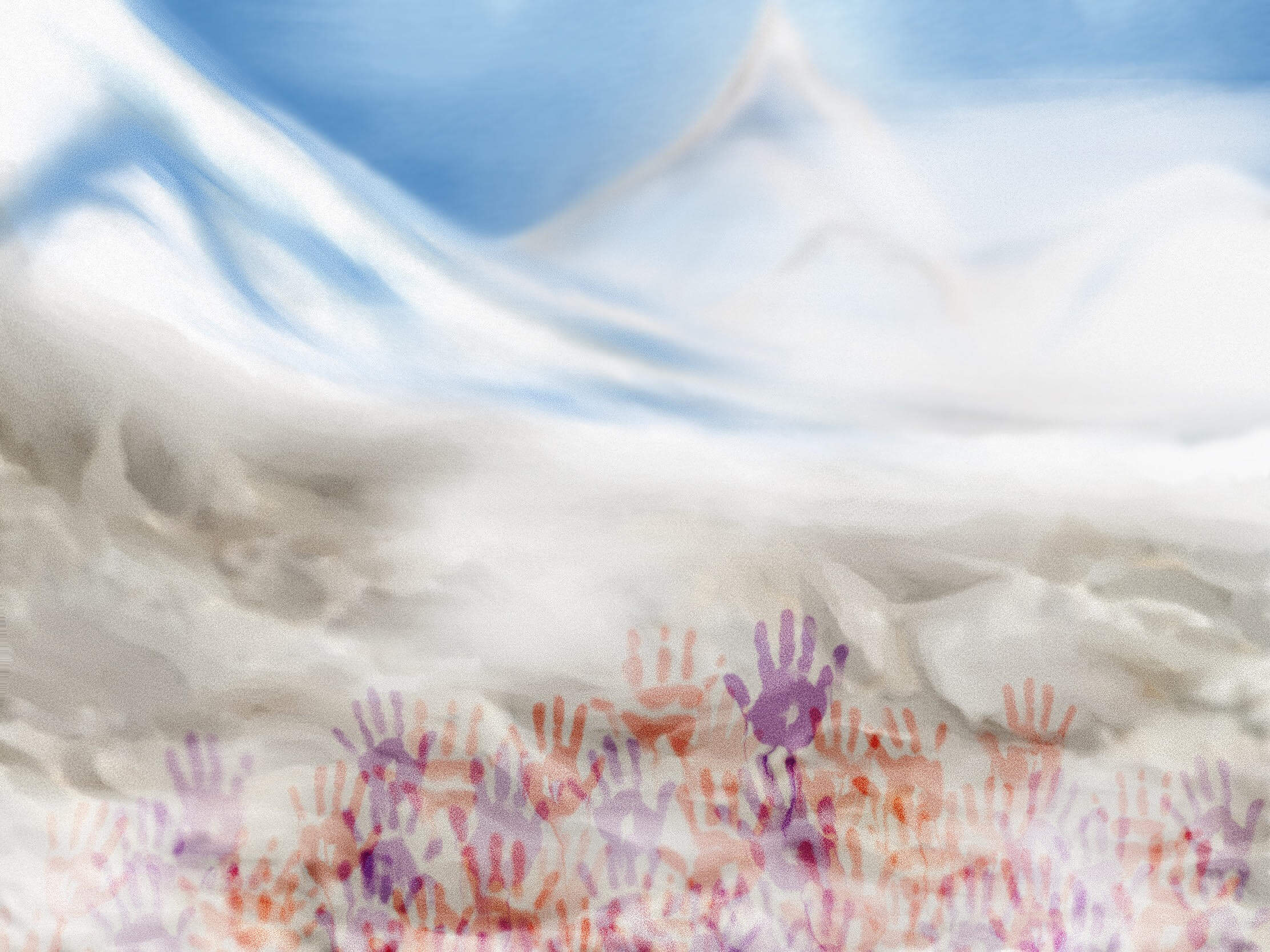
Original art for Valley of Altars by Ben Hammack
It was cruel that Elder Raena had survived the harshest winter in thirteen years only to die on the fifth day of spring. The remaining three members of the village knew the day was near and feared what it required of them next. Her body was getting colder, more frail over the past two weeks despite the growing warmth in the air. She passed quietly yesterday morning surrounded by the men who adored her strength. They took turns saying a prayer and holding her unmoving hands, hoping some of her previous strength would be granted to them.
“‘One last bloom is all I wanted,’ that’s the last thing she told me,” Samir said.
“Early spring blossoms will greet us further down. Her spirit will sense every one of them,” Millo responded.
This would be the last pilgrimage to the valley of altars. It was the smallest number of travelers ever tasked to deliver a body.
May the burden of our last breath exhale softer than spring sheared wool. May it join the chorus of the Mountain’s peak whipping winds.
Their culture meeting its end was not lost on Khreo, Millo, and Samir. Elder Raena was the last-born woman in her generation, and only woman since. She lived to be eighty-three and never chose a male partner. Her wish was to remain alone and was never pressured to change. By the time she was of age to choose a partner, the female population declined sharply in their shrinking village. How could anyone ask young Raena to bear the burden of life after life after life, hoping she’d produce girls who would grow, only to face the same fate as their mother?
No. None of the men expected her to live a life like cattle. So, their village lived under the shadow of fate for a generation, knowing they were the last to practice their culture of worship to the Mountain. Each winter took more and more villagers, many old, some too young. Not so long ago, there were fifty-two of them, then forty-seven, thirty-seven, winter, winter, winter. Cold bodies needing to be carried to the valley yearly until the last four were left tired of burying loved ones and strained by the guilt of being the last altar caretakers.
The three men made their packs earlier in the morning, readied one cart with supplies and dressed the other cart with soft wheat grass and wild Asters. It would carry Raena’s body as gently as possible for the three-day journey. Raena was wrapped in her favorite wool blankets, her face showing towards the sky and her frizzy hair pushing out like bouquet flowers.
Khreo walked to the pen of goats and sheep. He freed them hoping they would embrace wild summer days before the dangers of the Mountain found them. Millo did the same for the poultry and cattle. They had four cows and three mules remaining. The two younger mules would lead the carts on their journey.
Their oldest mule named Lilly, Millo’s favorite, would not survive another trip. She was still in pain from an injury sustained last winter. Millo couldn’t handle seeing his gray mule struggle; she deserved freedom from this grueling life. He walked up to Lilly with a grain sack hanging in his left hand. He reached in his right pocket and slipped some wild orange berries into her food. Lilly pushed her face in, thankful for the surprise meal so soon after her usual breakfast. Millo had never eaten the orange berries himself. They were known to be one of the few poisons near their home. Based on Lilly’s eagerness, he assumed they were sweet enough. The bursting orange fruit would put Lilly to rest by the afternoon. Millo believed this was a kindness, but not enough to tell the others what he did.
In the center of the village huts, Samir grabbed the papers Raena wrote her altar instructions on and put them in his chest pocket. Following tradition, the member who lived closest to the deceased would safeguard it during the pilgrimage and read it only once they arrived at the deceased’s altar.
The group began their slow, switchback descent along the great Mountain’s side with Samir leading, Khreo guiding the cart holding Raena, and Millo trailing with the second cart of supplies. They said nothing for the first hours of their journey. Each man reflecting on the duty of their travels and respecting the peace the Mountain was offering them.
Millo and Samir traveled the valley path before winter; Khreo had not made this journey in two years. He was the youngest of the three, but the tight grip on his walking stick gave away his struggle with the hip and leg injury he sustained. It happened three winters ago, while returning from burying his older brother.
Khreo didn’t know his exact age but based on his brother’s best guesses, he was around twenty-two. He watched many of his elders and friends die. That was life on the Mountain–it grants a place for life and for death. Tallest in the range, it is consistent in its protection and its danger. It exposes its inhabitants to the wind and the rain one day, then gives sanctuary the next. It is the provider, it is home, it is worthy of village devotion. Not until his brother’s death and Khreo’s injury did he start to doubt, and take notice of his doubt, in their faithfulness to the great Mountain. Bhronin wasn’t old when he passed, it wasn’t his turn to go. There were many elders who should have been next, but the Mountain chose his brother and Khreo could not release his resentment. That resentment evolved the further he searched for hope and meaning.
Khreo had traveled with six others to bring Bhronin to the valley. During the tough winter journey, he rarely spoke. He was in his own mind searching for answers that he couldn’t find. He went back and forth with anger and guilt, feeling shame for wishing it was an elder’s body in the cart and not his brother. How could Khreo believe he would have made a better choice than the Mountain? Why couldn’t his brother have lived to see a few more perfect sunrises? Why would it matter if he died then or now? Everyone’s time was nearing and death was at the door of the village, their entire culture, their worship of the Mountain. It would all be erased. The silence on the Mountain would be confirmation its disciples were gone.
On the last day of their return trip, he slipped on the steep of the trail and tumbled off the side of the Mountain, only stopping when the whole of his right leg crashed into a boulder. Broken bones and a crushed hip left him immobile for months. He could not garden, he could not shepherd flocks, there was nothing for him to contribute but his belief. The bed-ridden months forced him to examine his faith and his place in the village. The result was a shaky truce between him and the Mountain, the rituals he grew up with were all he knew. The others still practiced the traditions ardently, and despite his new doubts, Khreo feared being the odd man out.
Those traditions drove the three men walking with Raena’s body now.
May we live in the memory of the changing seasons, in the sunlight that thawed us after ice daggered storms. May the Mountain grant peace in the valley.
As they moved farther away from the village steps, from the summit of the Mountain, they prayed more. It slowed their travel, but each man knew it would be the last prayer uttered on the ground where they kneeled. The weight of that responsibility often stopped them in their tracks and dropped them to the rocky path they traveled. The mules grew impatient with the lack of rhythm, in the starting and stopping. Each time one man felt compelled to drop and pray for a few beats, the others stood silently waiting to see if the Mountain would call to them too.
It wasn’t a competition to see who would stop more often, but if the Mountain was counting, Samir prayed three times as much as the other men combined. Somewhere under the surface, Samir had something to prove. Not to the other men but to himself. Many of his prayers were covered by the sounds of nature. Only Samir and the air knew that nearly every prayer was a question rather than a prayer of affirmation. His search for worthiness masked the pious stature of his prayers.
May the Mountain reconsider. Why am I one of the few chosen to see the last of our culture? What greatness in me is able to bear this calling? I cannot find it. I cannot feel it.
The lack of conversation stretched through the first day, until Samir stopped near an outcropping of trees. Millo and Khreo half expected him to start praying again but were quietly relieved to see Samir removing the bindings around his feet. They sat in the grass near the path, following suit. Millo built a fire, Khreo tied the mules to a large tree limb, and Samir began taking out wrapped meat and various vegetables to cook. All three muttered prayers to themselves and ate their fill. Millo angled the cart that held Raena’s body towards the fire believing that she ought to be included in the huddle sitting beneath the star-riddled sky.
“What do you think she would pray for during this journey?” Millo asked while sitting again at his spot near the fire.
“Always thinking of others,” Samir replied, “she would pray for the three of us first and then ask favors and sunlight for herself before closing her eyes.”
The three men said nothing else, but all thought of Raena and the host of others they brought to the valley. It is a distinct human trait to romanticize the dead. They dress up altars with their favorite flowers, the same way they pick memories to dress up their lives. Covering the dead’s shortcomings in a fondness for nostalgia rather than appreciating them while they walk left of their neighbor’s shoulder.
The Mountain is vulnerable enough to romance us while we are here. It grows flowers for each person to choose a favorite and then grow more over and over. The Mountain shapes preferences for life and provides them until no one would know what life would be like without favorite flowers, or fruits, or bend in the pacing river.
By a greater will, the Mountain doesn’t wait until we are gone to think more of us. It cares wholeheartedly and insists on a good life.
The second day of travel started when the two mules became restless and made it impossible for the men to stay asleep. Khreo’s weakened leg forced a grimace on his first dozen steps. A full day and a half journey remained before they would reach the valley floor. He prayed quietly that his pain would not hold the group back.
The village was just over half way up the Mountain. As the men continued with Raena, the wild along the path became livelier. Trees weren’t trimmed bare by the wind, greens were greener and animals were happier. The farther they were from the summit life thickened.
Millo often wondered if all gods worked this way. If something was too close, would it become frail in the presence of a deity? Humans become altars, altars crumble and become mountains, mountains become altars to something else. And it goes as it goes. He fixated on this thought each time he partook in an altar procession. On this occasion, Millo thought about it longer than before. Somewhere in his mind he hoped he would feel healthier and livelier once his body took to its new home.
Raena and the three men had been traveling without a stop or a word for over an hour when Khreo noticed Samir looked on edge.
“Samir, are you okay? I can hear your mind racing from the other side of the cart.”
He stopped the group, trying to lessen his agitation before answering. “Each step we take closer to the valley I feel mixtures, mostly the sadness I have for myself. I fought to hide it all day yesterday. It’s just so imminent, isn’t it? Raena told us months ago, but I’m beginning to understand what she meant when she said finality feels like dread.”
“It's difficult to be the last.” Millo stepped in with a hand on Samir’s shoulder. “None of us expected this responsibility, but we owe ourselves peace where we can afford it. We can choose to make this day and the next quiet, joyful ones. Raena deserves to have peace and reflection like all before her.”
“I know these things. In my mind I know them like any other instructions,” Samir’s voice hardened, “prayers help, and faith helps, and our traditions ease the shallow pains, but pushed further down in my body I hurt and I fear seeing the altars again. My wife Bela passed eight years ago…”
Samir paused to regain control of his voice again. Khreo limped closer to Samir and took the leading reins from his hand. As soon as he did, Samir rested his weight on Millo to stop from collapsing to the ground.
“My wife’s body gave up long before she passed. Millo, you remember how she was in her last days. She was brittle, but behind our doors her spirit was a raging fire. I saw what no one else saw. She was at odds with her mind for years. She could not find enough peace, or any peace on this Mountain like so many of us did. She could barely stand, but she was angry all the time. She was my altar, what I worshipped in the hopes I could be enough for her, to temper the flames beneath her skin.
“But I wasn’t enough and I hate it. Nothing on this Mountain was enough, and she died with rage on her shoulders. I’ve come to the valley many times since her altar was made, but I’ve never gone to it. I can’t look at it and pray to her when she is not alive in front of me. A few springs ago, Raena told me what my wife’s inscription read. There was no fondness for life in her final words. It shows just how deeply I failed her.”
Samir paused again, finding courage for his last sentence.
“A part of me knows I must see it. I owe it to her and myself to face her altar, but I’m afraid Bela’s inscription will break me for good.”
“We won’t let that happen, we are here with you Samir,” Khreo said, “you will not walk into that valley alone.”
“Our young friend is right,” Millo echoed, “your strength on its own might not be enough, but combined I know you will stand tall.” He finished his statement giving Samir a kind, warm wink only old men have the talent for.
“Thank you both, I know I am blessed to have men like you seeing out this journey to the end. You give me strength even now,” Samir replied.
Let us stand tall like the Mountain always has, as we were called for a time like this.
Conversation stalled and then began again through the rest of the day. The men ate while they walked and prayed less often than the day before. As the sun was starting its descent in the sky, they arrived at the painted wall. The winding path to the valley had been escorted by swaying flowers, wild berry bushes that rustled with woodland creatures safe in their homes, and untamed trees that kept travelers cooled in their shade.
All of that came to an abrupt stop by a long, flat limestone wall neighboring the path. It was nine feet tall and ran nearly 200 yards from start to finish, framed by sloping brush and occasional wandering vines. It stood on the right of the travelers, stamped everywhere with purple and red handprints. It was a stunning and welcome sight.
Khreo dropped the reins of their mules and relied on his stick to walk towards the painted limestone, feeling the topography of the wall. Pocks and smooth territory shared space with no pattern or order. It was just as wild as the rest of the Mountain. Some handprints had been present for centuries. It has been a tradition for as long as anyone could remember and any story could be told. On the way to the valley, travelers would cover their hands in the juice of nearby berry bushes and leave their mark on the wall.
The village did not always have the luxury of time to create art for art’s sake. Survival had been their mission. This wall represented a chance to set aside survival just for a moment, a silent declaration that shouted “I am here. I was here.” Travelers would pause, meditate with the hands that were placed on the wall before them, and add their hands joining in the act of art. It was impossible to know all the names of the people who touched this wall, but names were less important when their fingerprints could still be traced and felt on the wall.
While Khreo absorbed the ancestral wall, Samir and Millo retrieved enough berries for all three to coat their hands with vibrant colors. They moved closer to the end of the wall and found a section where some of the handprints were barely visible. They all three added purple and red handprints to the wall and pressed them a second time to ensure the stains settled boldly.
“A rational man elsewhere would find the Mountain’s sacrifices foolish,” Millo began, half to the others and half as an observational prayer, “but the Mountain never gave the rational man diamond spring water, a secret sunny winter day, or witness the first steps of an unsure lamb. That man from elsewhere was not passed down the rituals, prayers, or a plot for his own altar. How could that man ever understand the Mountain’s ways without bearing witness? Without binding his feet for the rocky paths?”
Khreo wondered what had been on Millo’s mind that brought him to these words. He shed a tear once he walked away, leading the group farther down the road, and another moment of finality the men would face during this journey. How lovely to be the last prints so carefully added to art spanning generations.
Protector, Finder, Keeper,
Others call you dirt when you are clay.
Walked on and over until a crafting mind
Sees something different.
Shaped by a guiding hand,
Firmed with the heat of the day,
Molded into art or tool.
All things are valued by someone
Who knows what you are.
A cool evening matched by the morning left the group feeling refreshed as they walked the last three hours onto the valley floor. A river running north and south split the valley, the west third mostly untouched forest and wetlands. The east two-thirds contained another type of forest, a forest of tilting inscribed rocks that marked the gravesites of all others that came before Millo, Samir, and Khreo. After lunch and digging, Raena would soon join those numbers.
The valley of altars started out as a near perfect grid in the lush soil softened by the river’s moisture. It didn’t take long for all of the easy dirt to be claimed by altars, forcing the village to work the rockier land that led up to the start of the Mountain’s walls. Once the village relied on the harder soil to hold their dead, the perfect grid slowly turned into winding, imperfect rows. Paths were determined by boulders and trees that could not be uprooted. It was never thick enough to lose sight of the river or the small outcropping of huts near the water, but the altars were a maze of names and inscriptions.
Samir had never seen his wife’s altar, but he knew the exact plot where it sat. Once all possessions and rations were carried into the circle of huts and the cart that held Raena was steered into the shade, Samir started walking towards the altars. Millo and Khreo followed wordlessly as they moved through the acres of stone marked plots and scattered piles of extra stones waiting to be used.
The most common formation for altars was a stack of seven stones total: four of the largest stones at the base to create a diamond, two placed on top covering the small gaps in the middle of the first stones. Lastly, the most oddly shaped stone would sit as the crown of the stack. When the village stopped producing children years ago a new tradition started. If the altar was being built for someone who was the last of their family, the stack would be constructed of eleven stones. An extra foundation of four would be placed as a sign of eternal family strength.
Samir found his wife’s altar and read its inscription. He still said nothing as the other men gave him space. A few minutes passed and Samir began looking around. None of the earlier agitation appeared on his face. He looked relieved that tears were not crowding his eyes. He moved to the nearest pile of unused rocks, and one by one carried over four new stones to Bela’s plot. He added them to the foundation marking her as the last of their family.
“I thought it would feel different, it doesn’t. I thought the altar and her inscription was what scared me. The real fear is remembering her too much. Remembering her pain and her anger is knocking at my door. If I stay here, so close to her resting place, I know it will push my mind to madness. Yesterday I told you both I hate myself for not being enough for her. That’s still true but I know another truth now. I cannot hate myself into improvement. I try to be better in a faith that has always been better than me. It persevered me enough to not break in front of my wife. For that I will always be thankful for this Mountain. But what more is there to do for us to do at the end of our beliefs?
“Samir, there will always be mor–” Millo tried to interrupt.
“We pray and we pray,” Samir continued by raising his voice a level higher, “we’ve given our life to the Mountain and still we carry a body. I can’t bury one more. I reached my limit five friends ago. I don’t see the purpose of waiting for it to be my turn in the ground anymore. I’m admitting to you both and to myself, I want a different life. I won’t ask for the cart, but I will gather a small pack and be the first of our village to leave this place. I’ll travel west from the mountains looking for life outside of our own. Follow if you want.”
Samir retraced their steps back to the huts. Khreo stepped up to Bela’s altar inscription to find what made Samir so sure he wanted to leave:
May the Mountain forgive me, I’m guilty of thinking about another life.
A somber tone filled the sun splashed valley. No goodbye is ever long enough. Khreo cut off a strong branch and stripped it down to form a new walking stick. Millo helped Samir collect his belongings as they spoke quietly out of Khreo’s earshot. It didn’t look like Millo was trying to convince him to stay. Instead, it looked like two friends soaking in the last few minutes they had together. Khreo walked up to them and handed Samir his new stick.
“I love you friends. We have carried this burden of the end for so long, now I will bring that burden with me to the undiscovered country. The gods leave the work to us.”
Samir left the valley hoping fate would be kind to him for the simple act of continuing.
The evening arrived and Khreo took the responsibility of digging the site for Raena’s body. Millo rewrapped her outer linens, drizzling sweet, infused oils over her and tucking her favorite wildflowers into the folds near her chest. After hours of grueling work, a crude rectangle appeared in the dirt where Khreo stabbed at the ground with his walking stick and clawed the loosened dirt aside with his hands. The men gave Khreo a moment to catch his breath, then settled Raena’s body into the earth, pushed the dirt back over her body, and stacked eleven sturdy stones in the center of her plot.
“I want you to have this honor,” Millo said, handing over a chisel and a small scrap of paper. “Samir gave me her inscription before leaving. This is the time for you to complete your first inscription.”
With the remaining daylight, Khreo worked to clearly inscribe the words Raena wished to be remembered by.
I lived my life on a Mountain of blessings. I was loved and gave my love. To my Daedra, I only feel my age when I start to count the months we don’t speak.
When he finished, the two men prayed and meditated at the foot of her altar, praising the Mountain for Raena’s life and wishing impossible strength for theirs. Millo lit a torch and led them back to their new homes at the river’s edge. Before separating into their huts, Millo touched Khreo’s shoulder to stop him.
“You’ve proven yourself over and again in your life on this Mountain. It’s strange to say we’ve lived a wonderful life, but I believe we have. You will outlive me and be the last man. I hope you can see it for the privilege it is. You are the last and the best of us. I want you to remember that.”
Millo paused for a moment.
“I know you feel the weight of our people too. We have moved beyond the pain of misunderstanding, there is nothing that could cause permanent hurt between us. I have felt this way for these waning years, and I wish I would have said this to you sooner. I wish I would have said it while Raena and Samir could hear me. It is just you and me now, just you and me…”
How many lives has the Mountain lived? When did it shape itself so monumentally?
Millo and Khreo spent the summer months repairing their huts, collecting wild berries, and fishing the abundant river. Their new normal suited them. Millo knew fall and winter would arrive soon, so he soaked in the sun as much as possible. He cherished the warmer climate and the protection from sudden winds the village knew so well. His life was better here, but his mind did wander to his old farmlands and the animals he left behind. The village sustained them for so long it was hard not to reflect on the bounty they left behind.
In their spare time Millo would walk along the riverbank or meditate with his back resting against his favorite tree one bend from their huts. Khreo joined him occasionally, but he felt if he slowed down too much, he would lose sight of himself and spiral his head deeper than the heart of the Mountain. Instead, he took it upon himself to walk through the altars and reassemble or replace the stones that had toppled, cracked, or seemed an unfit marker. The constant walking helped strengthen his uneven stride.
It also gave him a reason to wander the rows of altars and read inscriptions he had forgotten or never seen before. He would walk for hours through the maze of names and inscriptions. Some inscribed the basic prayer of the village:
May the Mountain grant me peace, I would find it resting in the light.
Khreo found the altar of a man named Wouk. His inscription read:
Death is only sadness. Tragedy lies in waste.
He was the first body Khreo helped deliver to the valley when he was younger. That was when the village began treating him as an adult. Raena took him under her wing that journey. He was not the only one who grew from her mentorship. Many young people shied away from their first body, but Raena was often the elder to guide their steps and teach them the importance of ritual.
“Protecting the body is necessary, but dressing our beloved’s cart with flowers is spiritual. It keeps them alive. Each petal is love for a moment we never had.”
Her favorite purple flowers were abundant in the meadows near the village. Many neighbors teased that she was the Mountain’s favorite. She never acknowledged the tease, but she never denied it either. She let the Mountain do the talking with the endless wild Asters sprouting one meadow away from her door.
Many of the older altars didn’t ask for peace but demanded it:
If a powerful man can profit from war, he will invent a reason for the first battle. Do not entertain what can only bring our misery.
He couldn’t imagine a war within their village. Maybe he wasn’t thinking big enough, he never considered there could have been multiple villages that once existed. Khreo noted he needed to ask Millo about any knowledge of violence on the Mountain.
Other inscriptions were more intricate and showed the soul of the person:
The invisible thread that ties us together. I’ll forget it for a winter season, but then I brush against it, or trip over it. Or an unknown hand plucks at it and plays heaven made music that brings our humanity back to the forefront of my mind.
The wisdom and the history behind the inscriptions drove him to read as many as he could. If he was going to be the last, he wanted to carry the catalogue of his people until he was gone.
Khreo’s favorite inscription to read was from a man named Eder. He passed before Khreo was born, but the village remembered him as a self-preserved, stoic young man, always thoughtful and empathetic to his fellow villagers. The rare moments he wasn’t his quiet self, he brought more laughs than any other member on the Mountain. The sly look in his eye was his tell that a clever saying or wisecrack opinion was working its way through his mind.
They called it a fever, the sickness that took him. The truth was they didn’t know what came over him, but it was too severe to be the fever they knew so well. Eder’s humor lived on, his inscription simply read:
Best two out of three?
He was not the first to question reincarnation, but Eder was the first to challenge it to a competition. Khreo lingered at the altar and thought of him.
We were all cut from the Mountain’s ridges, we were all its eyes but Eder’s vision was always clearer.
After a long day of walking and reconstructing altars, Khreo would often find Millo with a hearty catch cooking over a fire. Today was different. Millo was nowhere near the firepit or the ring of huts. Khreo started a fire, gathered two trout from a nearby fish trap, and prepared dinner. Once his stomach was full of berries and fish, he walked a few minutes to Millo’s tree.
He found Millo dirty and exhausted, sitting in a rectangle in the ground at the base of the tree. His breathing was heavy, clean streaks where tears had cleared away dirt and dust marked his face, and his hands were torn open from scratching at the earth. Blood pooled at the ends of his fingertips where they now rested.
“What have you done, Millo?”
“Please forgive me. The days started to run together weeks ago. I have outlived my purpose. The more I heal, the less ambition I have, the less faith I have. What drives me? If the fire for the things I want comes from trauma, what will I become when I am fully healed? Cooled in the valley river is the feeling that takes hold peace or defeat? The veil of my own importance is at its thinnest. On the other side is the realization this is all there is. For the first time, I see that and I’m ready to tear it down.”
Millo opened his left hand and revealed it was covered in juice from smashed orange berries. A handful of the poisonous berries would stop his heart within a few hours.
Khreo tried to find his voice. “Why are you leaving? It wasn’t meant to be this soon.”
“I’m sorry, this was always how it would go. You are the last man standing for all of us.”
Khreo climbed down into the self-made grave and held Millo. They cried together for what seemed like hours. Millo started to sweat and the tremors began to start, softly at first. He didn’t want to abandon his friend, but Khreo didn’t have the strength to watch what the berries were going to do to him. He walked back to his hut and collected his blanket and pillow. He brought them back, wrapped Millo in the blanket and put the pillow under his head. He lay down on the other side of the tree from Millo, praying for dreams to take him. It’s not supposed to be like this, or end like this.
Khreo couldn’t sleep with the sound of Millo’s convulsions sounding a few feet away.
It took a week before Khreo had the nerve to visit the tree again and cover Millo’s body in linens before pushing the dirt over his still body. He also noticed for the first time a pile of eleven stones set to the side of the tree, one of them already had an inscription carved into it.
I have seen what is meant for me. Finally arriving at my protector’s doorstep, I am returned without lament.
The shock never truly wore off from Millo’s death. Khreo was forced to brave his first solo winter years before he planned to. He stayed by the fire, repaired stones, and offered up half-hearted prayers to a voiceless, guideless Mountain. He was alone, and he could feel it deeply like a cold chill finally settled. The valley was empty of life. The valley was full of lives. With all of the memories represented by altars, could this Mountain, or any mountain, know its importance? We! We have eyes and minds and thoughts. This great peak is nothing but strong bones from the earth beneath it, and what can a spine notice? The Mountain’s nature is fixed. It simply is, and nothing more.
Khreo did not resent the Mountain, how could he? It raised him and delivered him to this life, this very triumphant and lonely life. They were entangled, impossible to separate. No, he did not resent it, but he thought he could feel its indifference towards him. He reciprocated that indifference with the casual apathy he now carried.
Years passed in the valley, Khreo’s routine continued and his body became accustomed to a life alone. His mind and his heart could not come to terms with it. He felt like he was rotting from the inside out, becoming thoughtless and uncertain of his own identity. It was like watching someone else walk around in his body as he moved through the valley paths.
All altars crumbled, and he knew he was no exception.
Before he lost control of all thoughts, Khreo dug a rectangle in the same spot he laid when Millo passed. They would guard the tree with their altars, the last monuments in honor of their people. No one would be there to cover Khreo’s body, and for one fleeting moment, he realized how sad that was. He placed his eleven stones around his rectangle encompassing it completely. On the stone nearest where his head would lie, he inscribed his last message.
When we enter the ground, are we still ourselves? Mountain, will you look at our altars as good company?
Are you also afraid of being alone?
Maybe this time the Mountain would answer him.
We pray to the Mountain, we call out and ask so much of it. Ignorance convinces us there is silence, a twisted delight in claiming it never calls back. Our wants and needs have been abandoned. We pray and we call and we expect and we lose hope, and we churn through the cycle again.
Why can’t we break the cycle and hear the Mountain shouting for our attention?
Lift your eyes, I am here and there is more. If you are brave enough to call for me, I am brave enough to make my way.
To my skies above I weep. I call out and weep!
Did they not know I heard all of it? That I witnessed entire lives and each feeling, big or small?
They must know my response was the roots of every subtlety.
Can’t we see the reply is in the mighty pines that give us shade? When the pines shed its needles, is that not the Mountain making a bed for us? It’s no fault of the wind that nearby ears can’t translate gusts of diligence.
For the first time in centuries, no human life existed on the Mountain. Without feet to keep the paths trampled, the village began to camouflage itself in the growing slender grass. Wildflowers planted their way to Raena’s old home. The farm gates were open, the goats and sheep stayed in their fences until one day the instinct to leave outgrew the habit of staying. Seasons came and went, the river altered its course, animals raced through the thickets, and birds chirped their delights. Trees fell, stones tumbled, and clouds observed it all in passing.
The Mountain still stands and the valley still rests amongst the ending of things. It is a strange paradise, where we mourned and where we hoped, and where the altars prove both.