Short Story
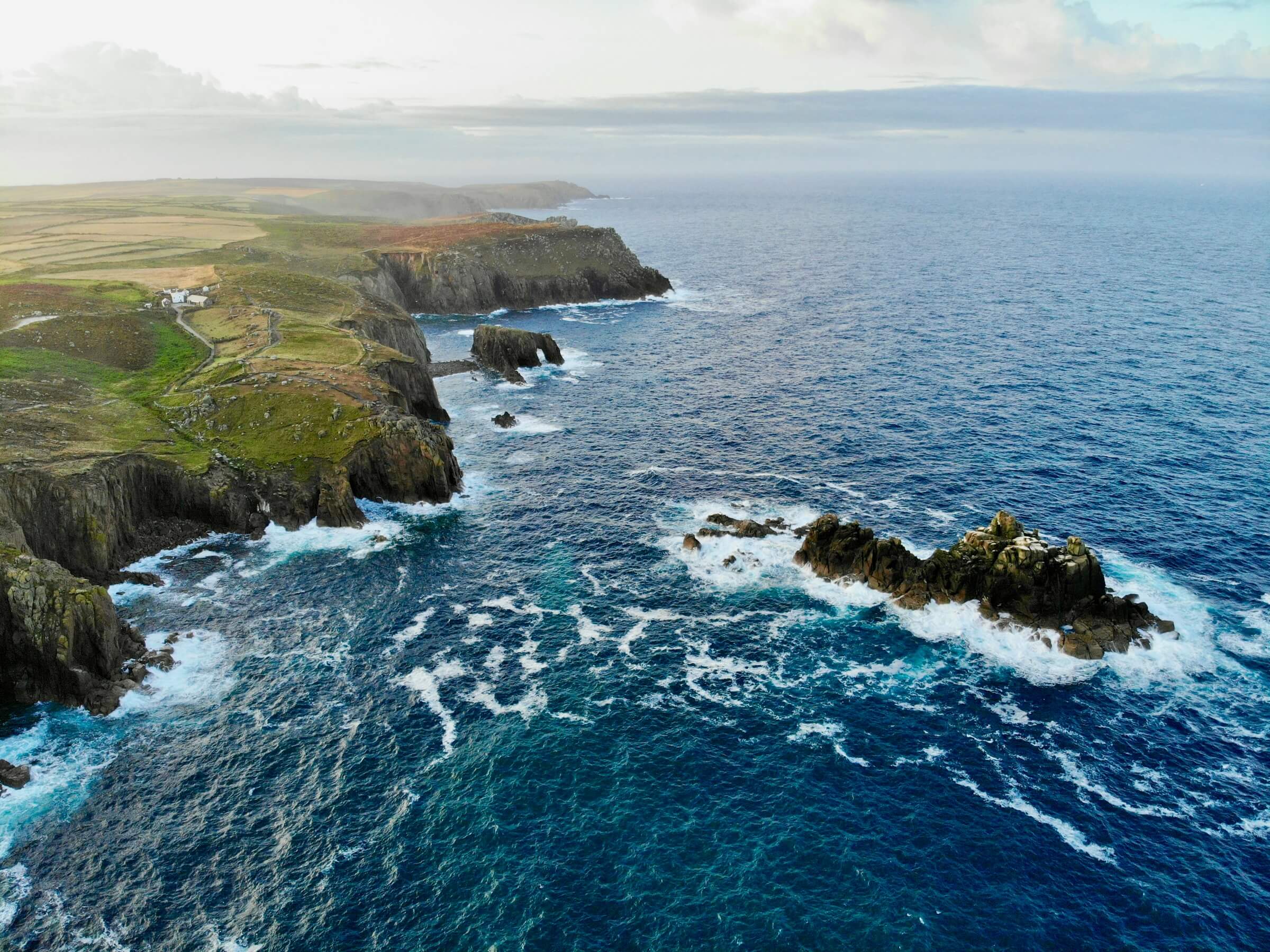
Photo by BEN ELLIOTT on Unsplash
Treen, West Cornwall — November
The barn sat at the end of a lane that had no business being called a road. Marta's hire car scraped gorse on both sides, the branches clawing at the paintwork like something trying to pull her back. She had forgotten how narrow everything was here. How the land refused to accommodate machinery. How the sky seemed to press down on the granite as if testing it.
She parked in a wet patch of mud that had once been a turning circle and killed the engine. The silence that rushed in was not silence—it was wind over grass, a distant sheep, the low percussive mutter of the sea at the base of the cliff. She sat for a moment with her hands on the wheel, breathing.
Seventy-two years old. Fifteen years since she had last stood here. A lifetime of war zones and hotel rooms and faces she had trained herself not to remember. And now this: a barn on the edge of nowhere, a tenant who refused to leave, and six weeks to sell the only piece of land she had ever owned.
The barn had not changed. That was the first surprise. She had expected it to be smaller, or larger, or somehow diminished by the scale of what she had seen since. But it was exactly as she remembered: granite walls the colour of rain, a roof of corrugated iron streaked with rust, a single window facing west toward the sea. Her father had bought it in 1972 for a sum so small it embarrassed him to mention it. He had planned to restore it, live in it, paint the light that fell across the cove at sunset. He had died before he could do any of those things. Marta had inherited it at twenty-eight, already a rising name in conflict photography, already too busy to care about a derelict building in a county she had visited twice.
She had rented it out instead. First to a potter, then to a retired couple from Exeter, then to a woman who ran a bed-and-breakfast in St Just and wanted space for her kiln. The tenants had come and gone, and the barn had absorbed their lives without complaint. The current tenant had been there for three years. Her name was Eden. She worked at the village pub, The Logan Rock Inn. She paid her rent on time and never called about repairs. The letting agent in Penzance described her as "ideal."
Then Marta had received the letter. Not from Eden—from the letting agent, a man named Pascoe who wrote with the careful discomfort of someone delivering bad news.
The tenant has refused to vacate. She has changed the locks. She claims she has nowhere else to go and will not leave until a court orders her. I'm sorry, Marta. I know you need to sell.
She had read the letter three times, standing in her flat in East London, the light grey through net curtains she had never liked. Six weeks. The oncologist had said six weeks, maybe eight, if the new cocktail held. Not enough time for a court order. Not enough time for anything except a conversation.
So here she was.
The barn door was new—thick oak, reinforced, a lock that meant business. Marta knocked. No answer. She knocked again, harder, and heard movement inside—feet on stone, a pause, the scrape of a bolt.
The woman who opened the door was younger than she had expected. Thirty, perhaps. Dark hair pulled back, a face that might have been beautiful if it hadn't been so carefully closed. She wore a fisherman's jumper that had been mended at the elbow, and she smelled of cigarette smoke and wood polish.
"Marta Hayes." The woman's voice was flat, unsurprised. "Pascoe said you'd come."
"Then you know why."
"I know you want me out. I know you want to sell. And I know you're not going to get either of those things without a fight."
Marta looked past her into the barn. The space had been transformed. The old stone floor was covered in Persian rugs, worn soft. A wood-burning stove glowed in the corner. Shelves lined the walls, crammed with books and jars and the accumulated debris of a life being lived with intention. It looked nothing like the cold shell she remembered. It looked like a home.
"How long have you been here?"
"Three years. Four months. Twelve days."
"And you have nowhere else to go."
Eden's jaw tightened. "That's what I said."
Marta nodded slowly. She was tired. The pain in her hip had been bad on the drive, and she had forgotten to take the morning dose, and the wind off the sea was cutting through her coat like a blade. She needed to sit down. She needed to not be standing on a doorstep arguing with a stranger about a building she had neglected for forty years.
"I'm not here to evict you," she said. "Not today. I'm here to look at the place. Decide what it's worth. Talk to you like a human being instead of a name on a letter."
Eden's expression flickered suspicion, perhaps, or the beginning of something softer. "And then?"
"And then we'll see."
The barn had two rooms. The main space, which Eden had made into a living area and kitchen. And a smaller room at the back, accessed by a low stone arch, which had been converted into a bedroom. Eden showed her both, standing at the edges while Marta moved through the space with the careful attention of someone who had spent a lifetime observing.
She noticed things. The photograph on the mantelpiece—a child, perhaps eight, with Eden's eyes. The absence of a second toothbrush in the bathroom. The way the rugs had been arranged to cover a crack in the stone floor, a crack that ran east to west like a fault line.
"You live alone," Marta said.
"Yes."
"Child?"
Eden's hand moved to her stomach, a reflex she immediately suppressed. "She's with her father. Weekends."
"Where?"
"Penzance."
Marta nodded. She did not ask why the child was not here. She had learned, in forty years of photographing strangers in extremis, that the questions behind the questions were the ones that mattered. Why are you alone? What did you do? What are you running from?
She sat on the edge of the bed—Eden's bed, she realised, the sheets still warm from a body that had left recently—and looked out the small window at the sea. The light was already going, the November dusk clotting at the edges of the sky. Somewhere below, invisible in the gloom, the Atlantic threw itself against the rocks.
"I'm dying," Marta said. "Not quickly. But certainly. Six weeks, if I'm lucky. Eight, if the drugs work. That's why I'm selling. Not because I want to. Because I need to leave something behind that isn't a problem for someone else to solve."
Eden stood in the doorway, arms crossed, face unreadable. "You want me to feel sorry for you."
"No. I want you to understand that this isn't about you. This is about me trying to close a life without leaving loose ends. And you, whether you like it or not, are a loose end."
"You could keep it. Leave it to someone. A charity. A trust."
"Who?"
Eden had no answer. Marta watched her stand there, this woman who had changed the locks and refused to leave, and saw something she recognised: the desperate architecture of a person who had run out of options.
"Let me stay here for a week," Marta said. "In the barn. With you. We'll figure out what to do. Together."
"Together?"
"Yes. I know that's not what you wanted. But it's what I'm offering."
Eden looked at her for a long time. The light through the window had shifted, and her face was half in shadow, half illuminated by the last of the day. When she spoke, her voice was quieter.
"The bed's small. You'll have to sleep on the sofa."
"I've slept in worse places."
"I mean it. It's not comfortable."
Marta almost smiled. "Daughter, I've slept in a ditch in Kosovo, a port-a-cabin in Fallujah, and the floor of a burning hotel in Aleppo. I think I can manage your sofa."
Eden's mouth twitched. Not quite a smile, but close. "Fine. One week. But you don't get to tell me what to do. You don't get to ask about my life. And you don't get to take photographs."
Marta hadn't touched a camera in two years. The hands that had steadied a Leica through mortar fire now trembled when she lifted a teacup. The oncologist said it was the nerve damage. Marta knew it was something else.
"Agreed," she said. "No photographs."
She moved in that evening.
The sofa was exactly as uncomfortable as advertised—a low thing with a sagging middle and cushions that had been flattened by years of use. But Marta had brought her own pillow, the one from the flat, the one that smelled of lavender and the staleness of an apartment where no one ever visited. She lay in the dark and listened to the barn settle around her.
The wind had picked up. It moved through the trees outside, through the gaps in the stone walls, through the small cracks she had not noticed during the day. The sea was louder here than she remembered. Not a roar, exactly, but a presence—a deep, continuous exhalation that seemed to come from the earth itself.
She thought about the last time she had been in Cornwall. 2008. A commission for a magazine, photographing the effects of coastal erosion on the villages between St Ives and Land's End. She had driven past the barn without stopping. She had told herself she was too busy. The truth was simpler: she had been afraid of what she might find. A building her father had loved. A life she had never lived. A version of herself that had chosen differently.
In the other room, she heard Eden moving. Footsteps on stone, the creak of the bed, a long silence. Then a sound she recognised: crying, suppressed, the kind that comes from deep in the chest and cannot be entirely hidden.
Marta closed her eyes. She did not go to her. She had learned, in places where comfort was a luxury and survival the only currency, that some griefs must be their own witness.
The week unfolded in a rhythm neither of them had planned.
Mornings, Eden left early for the Logan Rock Inn, where she served breakfast to walkers and couples on romantic getaways. Marta stayed in the barn, making tea from the leaves Eden had left out, sitting in the chair by the window, watching the light move across the sea. Afternoons, she walked. Not far—her hip wouldn't allow it—but far enough to feel the wind on her face, to hear the gulls, to remember that the world was larger than the dimensions of her dying.
Evenings, they sat together. Sometimes they talked. Mostly they didn't.
On the third night, Eden asked about the photographs. Not to see them—she had made that prohibition clear—but to understand.
"When did you start?"
"1975. I was twenty-two. I'd just dropped out of university. My father gave me his old camera and told me to go and find something worth looking at."
"And did you?"
Marta considered. "I found a lot of things worth looking at. I'm not sure 'worth' is the right word. They were things that needed to be seen. Bodies in the aftermath. Children in refugee camps. The way light falls on a face that has just watched its home burn. Worth isn't the word. Necessary is closer."
Eden was quiet for a moment. The stove crackled. Somewhere outside, an owl called once and then was silent.
"Why did you stop?"
Marta looked at her hands. The tremor was visible now, even in the low light. "Because I couldn't hold the camera steady anymore. Because I'd seen enough. Because I realised, somewhere around year thirty, that I had spent my entire life bearing witness to other people's catastrophes so I wouldn't have to look at my own."
"What catastrophe?"
Marta smiled. It was not a happy smile. "I have a daughter. She's forty-three. She lives in Melbourne. She hasn't spoken to me in fifteen years. I wasn't there. I was never there. I was always somewhere else, photographing someone else's children, telling myself that was the work, that it mattered, that I was doing something important. And it did matter. But so did she. And I chose."
The word hung in the air between them.
"Chose what?" Eden asked.
"The wrong thing. Or the right thing for the wrong reasons. I don't know anymore. I only know that choices have consequences, and that some consequences can't be outrun."
Eden stood up, walked to the window, stood with her back to Marta. Her shoulders were tight, her hands pressed against the stone sill.
"You think that's why I'm here," she said. "Consequences."
"I think you're here because you ran out of places to run to. That's different. But it's not better."
Eden turned. Her face was pale in the light from the stove, her eyes bright with something that might have been anger or might have been tears.
"Three years ago, I was driving home from work. It was raining. There was a child on a bicycle. He came out of nowhere—a side road, no lights, no helmet. I didn't see him until I hit him. He died in the ambulance. I wasn't drunk. I wasn't on my phone. I was just... driving. And a child is dead because of me."
Marta said nothing.
"I served eighteen months. Dangerous driving. The family wanted longer. The judge said I wasn't a criminal, just unlucky. But I know what I did. I know that every day, that boy's parents wake up and remember that he's not there because of me. And I can't—" Her voice broke. "I can't undo it. I can't even apologise. The lawyers said not to. Said it would make things worse. So, I came here. I hid. I changed the locks. And I thought if I stayed long enough, the guilt would turn into something I could carry."
"Did it?"
Eden shook her head. "No. It just got heavier."
Marta rose from her chair. It took her a moment to find her balance—the hip was bad tonight, the pain sharp and insistent—but she crossed the room and stood beside Eden at the window. Outside, the sea was invisible, but she could hear it. That low, patient breath.
"I spent forty years photographing the worst moments of other people's lives," Marta said. "I thought I was helping. Bearing witness. Making sure the world remembered. But I was also hiding. Behind the camera. Behind the work. Behind the excuse that I was too important to be present. And the person I hurt most—my daughter—she doesn't care about the photographs. She doesn't care about the wars I covered or the awards I won. She cares that I wasn't there. And she's right."
Eden was crying now, silently, the tears tracking down her face without sound.
"You think that boy's parents care about your guilt?" Marta continued. "They don't. They care that he's gone. Your guilt is yours to carry, not theirs to absolve. And the only way to carry it is to stop running. To stay still. To let it sit on your chest until you learn to breathe around it."
"How do you learn?"
Marta looked out at the darkness. Somewhere out there, beyond the invisible sea, beyond the horizon she would never see again, her daughter was sleeping. Or awake. Or thinking of her. Or not.
"I don't know," she said. "I'm still learning."
On the fifth night, Marta told Eden about the barn's history.
Not the legal history—the human one. Her father, the painter, who had bought it as a refuge from a marriage that was failing and a city that was suffocating him. The summers they had spent here, Marta and her brother, before the divorce, before her brother's death, before everything became complicated. The way her father had stood at this same window, watching this same sea, painting the same stretch of water in every season, every light, every weather.
"He never finished," Marta said. "The restorations, I mean. He died before he could do more than fix the roof and put in the window. But I think he liked it that way. A work in progress. Something to come back to."
"You never came back."
"No. I was too busy. Too afraid. Too certain that the past was something to outrun, not something to sit with."
Eden was quiet. Then: "Your brother. What happened?"
"Motorcycle accident. 1980. He was twenty-four. I was in El Salvador, photographing a civil war. I didn't come home for the funeral. I told myself I couldn't leave the story. The truth is I couldn't face my mother. I couldn't face the fact that I was alive and he wasn't, and that I had chosen to be somewhere else when he died."
Marta's voice did not crack. She had told this story before, to therapists, to friends who had since drifted away, to the empty air of her flat in the small hours. Each time, it became less sharp. Not easier—just worn smooth, like sea glass.
"You've lost a lot of people," Eden said.
"I've lost everyone. Including myself, for a while. I'm only now finding my way back."
"How?"
Marta looked at her. At this young woman with the closed face and the hidden grief, who had changed the locks because she had nowhere else to go. "By being here. By not running. By letting myself sit in a chair by the window and watch the sea and not need it to mean anything."
On the seventh day, Marta made a decision.
She called Pascoe, the letting agent, and told him to stop the eviction proceedings. She called a solicitor in Penzance and instructed her to draw up papers transferring ownership of the barn to Eden. Not a sale—a gift. With one condition.
"What condition?" Eden asked, when Marta told her.
"That you stay. Not forever. But long enough to know whether you want to. And that you write to that boy's parents. Not to apologise—you've already done that, in your own way. But to tell them his name. To tell them you remember. To tell them that their son, whose name you haven't even said to me, is not just a crime you committed. He's a person you killed, and you will carry that for the rest of your life. They deserve to know that. So do you."
Eden stared at her. Her face was white, her hands shaking.
"His name was Joshua."
Marta nodded.
"Joshua Tremayne. He was seven. He liked dinosaurs and strawberry ice cream and his grandmother's dog. He was supposed to be at his friend's house that night. He wasn't."
"Say it again."
"Joshua Tremayne."
"Again."
"Joshua."
The name hung in the air between them, fragile and enormous.
"Now write it down," Marta said. "And tomorrow, we'll walk to the postbox together."
She had nine weeks in the end.
The drugs held longer than anyone expected. She woke each morning in the barn, on the uncomfortable sofa, and listened to the sea and the wind and the small sounds of Eden moving in the other room. She walked to the cliff's edge on good days. She sat in the chair by the window on bad ones. She watched the light change and the seasons turn and the woman she had given the barn to slowly, painfully, begin to learn how to breathe.
They never became friends. That wasn't the word. They were something rarer: two people who had seen each other's damage and chosen not to look away. There was no sentiment in it. Only the slow, unsentimental work of sitting still.
Eden wrote the letter. Marta did not ask to read it.
The postbox was at the end of the lane, a red pillar box that had stood there since Victoria's reign. Eden posted it on a Tuesday, in the rain, and came back to the barn with wet hair and dry eyes. She made tea. They drank it in silence. The sea continued its endless work against the cliff.
Marta died on a Thursday, three days before Christmas. Eden found her on the sofa, her hands folded on her chest, her face turned toward the window. The tremor had finally stopped. The sea was calm, the sky low and grey, the gulls crying in the cove below.
Eden did not call anyone immediately. She sat in the chair by the stove, the one Marta had used, and watched the body of the woman who had given her a second chance. Not forgiveness—Marta had never offered that. Not absolution—that was not hers to give. Just presence. Just the stubborn, inconvenient fact of someone who had refused to look away.
The barn is still there. Eden is still there. She works at the Logan Rock Inn, serves breakfast to walkers and couples, comes home to the rugs and the stove and the window that faces the sea. She has not changed the locks again. She has no need to.
On the mantelpiece, beside the photograph of her daughter, there is a new picture now. A woman with grey hair and steady hands, standing on the cliff above Treen. The woman is not smiling. She is looking at the sea with an expression that might be peace or might be exhaustion or might be something else entirely—the quiet of someone who has finally stopped running.
Eden took it on the last good day. She had broken her own rule. She had not asked permission.
But Marta had seen her raise the phone, had held her gaze, had nodded once.
That photograph is the only one she kept.
The rest—the wars, the famines, the faces of a hundred catastrophes—are in boxes somewhere, or archives, or the memories of people who were there. They will outlive her. They will be seen by strangers. They will matter, or they will not.
But the barn endures. The sea endures. And in the small hours, when the wind is high and the waves are loud and sleep will not come, Eden walks to the window and looks out at the darkness and says the name aloud, just once.
Joshua.
Not as a prayer. Not as an apology. Just as a fact.
He lived. He died. She remembers.
The sea offers no answer. It never does.
But the light keeps coming, grey and patient, and the gulls keep crying, and the lane that has no business being a road still leads to a barn where two women who had lost everything found, if not peace, then something close enough.
Stillness.
The tide does not negotiate.
But sometimes, if you are very lucky, and very still, it lets you stay.