Photo Unsplash +
When Tracy camped at the lake again the following summer, a zipped pocket of her jacket held a tiny silver pendant that was smaller than a dime and bore the whorled imprint of a baby-sized thumb.
Lola’s mother had explained this was a replica of her daughter’s thumbprint. Holding it, she had pressed her own thumb against the concentric ridges for a long moment. Then she had given the little silver disk to Tracy, asking her to leave it in the place where Lola had died.
“They did everything they could to save her,” Tracy had assured Lola’s mother.
Too much, perhaps.
Tracy climbed to the ridge above the lake, haunted by memories of Lola’s protracted death. She hoped that leaving the pendant up there would create more peaceful images.
The pine tree looked the same, still half living, half dead. Tracy knelt in a patch of coarse sand, where a root twined into a crack between granite blocks. As she scooped aside loose gray and white granules, making a shallow hole for the pendant, her fingers met something solid.
She pulled the thing out. It was a thin, cylindrical rock as light as bone. A circular depression at one end suggested a hollow core. The surface was rough, with clumps of fused sand and an occasional circular hole. This had to be a fulgurite, created by the electrical energy of a lightning bolt hitting the ground. She’d read about such rocks but never found one before. More poetic names for it were shocked quartz or fossilized lightning.
Reluctantly, she decided it was more fitting to leave it than take it with her. She set the pendant on the sand, placed the fulgurite on top, and took a photo for Lola’s mother. After that, she walked around the tree to collect the scattered debris of the large format camera she had seen the year before. Having left a new human mark in the High Sierra wilderness, however miniscule, she wanted to pack out this old one.
Lingering, she peered down at her tent beside the tree-fringed lake below. The sky above was clear and out of the deep calm she heard a gust of wind moving over the ridge. The wind’s whisper through the needles of the contorted pine tree brought with it a conversation between two women, one young, one old.
***
The older woman’s name is Connie. A storm is gathering yet she stands naked in the stark rock landscape. Her clothing lies beside a group of trees lower down the ridge. Kent is bent over his big black camera on its tripod.
“Yes!” he shouts to her. “This is better. But the light’s going. Hold still!”
He’s intent on getting the picture in his mind’s eye. She is experienced in holding a pose but finds it hard not to shiver. The wind’s increasingly icy touch pushes between her legs, as un-gently as the hands of many men she has known.
Every day for the past three days, she and Kent have seen cauliflower clouds boil up in the morning and join into gray soup by midafternoon. Neither knows what the indigenous people always have and the Basque sheep herders learned quickly when they came here: if a thunder storm has been threatening for three days it’s likely to break on the fourth.
Connie’s body begins to tense with fear. But because she’s only 25 and a city girl, her mind mislabels that fear as discomfort and irritation. She’s mosquito-bitten, dehydrated and dirty. If only he’d let her pose down near the lake, on the smooth granite that shines like a tilted ballroom floor! If she’s got to personify something, why not a breeze or a sylph? That might help promote her future career as an actress.
“Your aesthetic is out of date,” he said in answer to her suggestion. How can she argue with him? He went to university and she left school at twelve to become an artist’s plaything. “Nobody wants that blurry pictorialist stuff anymore,” he adds. “I like how solid you are. I’m using f64. Maximum depth of field to capture the physical world.”
He sees the dark-rimmed irises of Connie’s pale eyes as perfect circles to center the geometric forms of his composition. He wants her to sit on a tree root, next, with her legs open as the apex of a triangle.
“Kent, darling, this is vulgar,” she drawls, aiming at the sophisticated tone of her idol, Garbo.
“I’m showing you as a real woman, not a symbol,” he says.
Sitting, she lets her mind drift. Back in San Francisco, this job sounded like easier money than working in a bar. She never knew she’d have to hike so far. She would have been better off to stay and seduce the bar owner’s eighteen-year-old son. He’d admire her in any position on a nice, comfortable bed. He wrote a poem about her soft cheeks that still makes her smile. If he asks her to marry him, she might accept. In a fast-paced city like San Francisco, nobody knows she’s a fast woman who gave up a baby for adoption.
At least Kent had the sense to buy her a diaphragm so they can take their pleasure safely. He’s relatively considerate as a lover and good looking. His face is almost feminine, with pointed chin, broad mouth and dreamy brown eyes. But he’s a tyrant as an artist, like all the rest.
He tells her to stand and lean back against the base of the pine. He wants to juxtapose the curves of her pale (but increasingly sunburned) limbs with the tree’s twisted form. She must drape one arm over a branch with bark as bristly as a scrubbing brush.
She lacks words for what her senses increasingly scream. A force raises the hairs on her arms and neck. Her toes and fingers tingle. She can taste metal and smell something sharp that reminds her of the bar in the morning, after the cleaners have left. A minute ago, she was cold. Now she’s hot. She swipes the sweat between her breasts.
Kent is dabbing his forehead with a bandanna. Humming, buzzing and crackling sounds swirl around him, like the laughter of demons. He suspects the noises emanate from his camera but he ignores the complaints of his machine as he has those of his model.
Connie’s legs move of their own accord. She knows just enough to trust them. She turns, crouches, puts her hands behind her on the rock and, crab-like, scuttles off the shelf of granite. Her body flows down over the rock, like one of the tree’s roots.
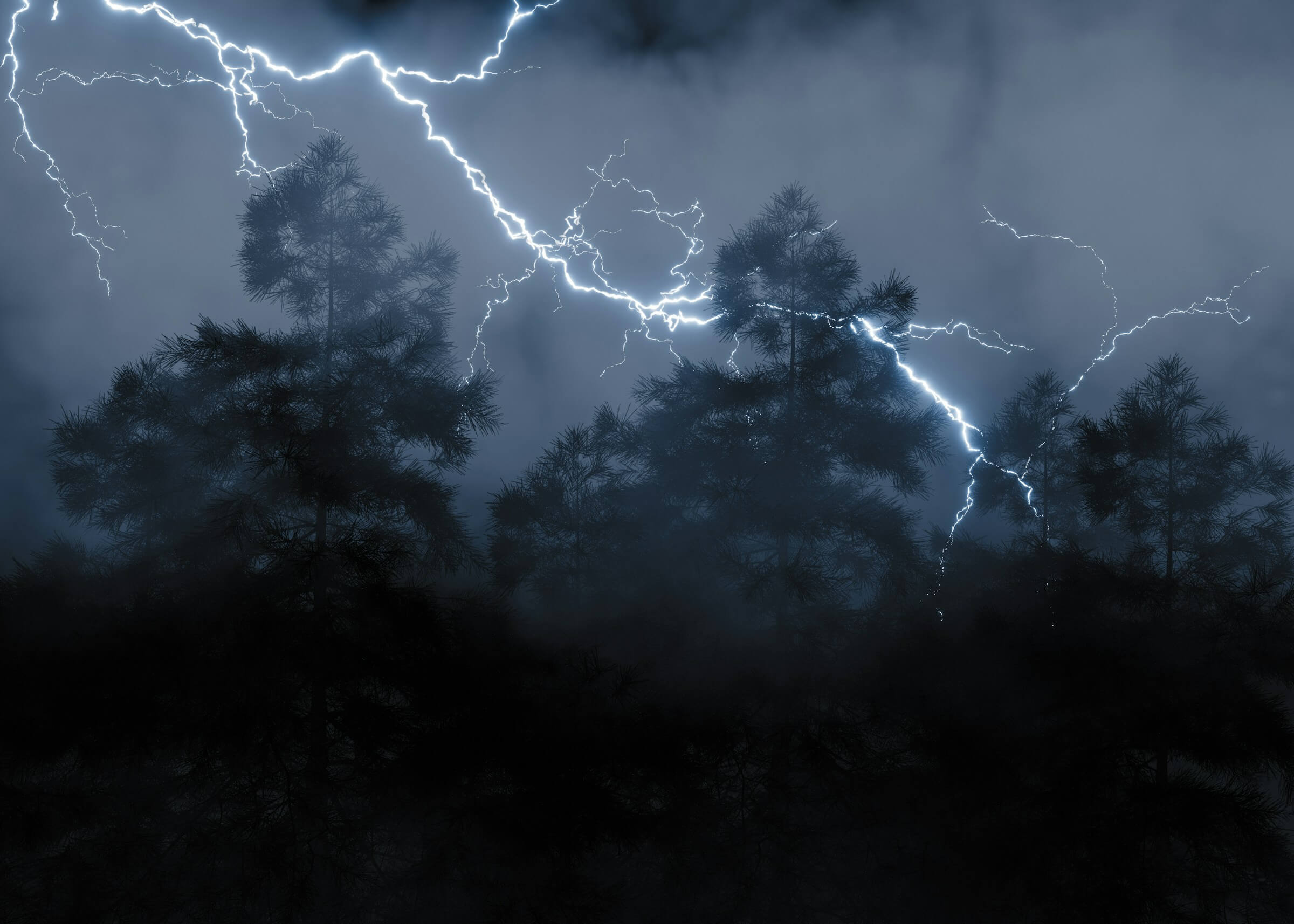
A massive noise cracks the air and splits into crashing, shaking, shuddering sounds that echo off the peaks. Silver lightning blasts the pine and melts the camera’s glass and metal. She’s free.
***
The younger woman is Lola.
Tracy saw her appear at the outer brim of the lake’s bowl. Lola paused there, at a distance. She must have noticed Tracy and her tent on the far shore. To see another human being at this nameless lake was indeed surprising. On her own arrival, Tracy had not found the solitude she expected, either.
Eventually, Lola walked toward Tracy along the grassy side of the lake. The other side was impassable, with shattered boulders tumbling upon each other to the water’s edge. Tracy noted Lola’s shorts and crop top. Younger women had never faced, as Tracy had, guys who would ask, even of two women together in the wilderness: “Are you alone?” Nor did they cover their skin against the harsh sun. Tracy took Lola for one of those fearless women in their twenties she had often met while giving talks in sports shops about long distance hiking. Living in a stream of texts and images, they had often asked questions she couldn’t answer about solar panels to recharge their devices. They loved trail community, which meant being online as well as friendly to other hikers.
Lola did not seem friendly at first.
“Do you have antibiotic ointment?” she asked without any preamble. “I have an infected mosquito bite.”
Tracy was happy to fetch her first aid kit.
"Where are you heading?” she asked.
Lola waved a hand in a vague gesture.
Tracy felt pushed away like a fussy mother or a too-talkative hiker, not to be encouraged as a potential companion.
She reversed her question, to show herself less inclined to intrude.
“How did you get here?”
Lola said she’d been hiking alone for over a week. She’d outpaced a few hikers in her first miles, waved to distant fisherfolk on the second day, and the last time she’d seen people they were moving dots in a valley far below. Her voice grew more assured as she spoke.
“I’m following routes on a map made twenty years ago by a packer who took trips to follow the forgotten paths here made here, before these mountains were protected as wilderness. The map came from my uncle, who was a friend of the packer. It marks things like sheepherder camps that used to be in meadows but are in forest now. And deer traps made by indigenous hunters.”
“That sounds amazing! Do you have photos?” Tracy asked.
“Yes, but things like that don’t show up well.” Lola said. “I keep a journal.”
She scratched absent-mindedly at the mosquito bite on the back of her neck she’d just treated. In doing so, her face twisted towards the wedge of thinly-forested slope that rose from the lake on its steep side. Camouflage-patterned tents were pitched up there on ledges. Only the motion of the campers made them visible, Tracy knew.
She followed Lola’s glance. A man had just emerged from one of the tents. At a distance, his face under its peaked cap was featureless. His silhouetted shape was intimidating. Neck as wide as his head, torso so thick it looked padded, arms held out on broad shoulders, legs planted apart to balance his heavy body.
“Ah, the guys are back,” Tracy said calmly. She had felt a little uneasy at her first sight of them. “It’s a group of vets. I’ve talked to their leader. They’re in a research program, hoping to establish that wilderness trips work better than drugs for PTSD.”
“I should go,” Lola said, standing. “I want to get over that ridge by tonight.”
“Maybe you should wait a bit,” Tracy said. “I think an afternoon storm is building.”
Lola shook her head. She flung open her pack, pulled out a transparent poncho and threw it over her crop top. She kept her eyes on the man standing beside his tent, as upright as though keeping guard.
“They stay out of my way,” Tracy said.
Contradicting her words, several men started descending from their rock perches. Their boots avalanched dust, as they slid down a sandy gully between cliffs.
Lola heaved her pack on and hurried off. Puzzled, Tracy watched her small figure, bowed by the heavy pack, labor upward. Polished granite shone like a mirror as sunlight cut under clouds that were swiftly merging and joining above. Would Lola make it over the ridge before the storm broke? The men had told Tracy they had a bad feeling about the lone pine tree up there. They seemed to think it dangerous even on a clear day. Tracy guessed that it helped them feel at ease, focusing their hypervigilance on just one place.
Thunder shattered the silence. Barely a heartbeat later, lightning flashed. In its white light, Tracy saw the dark figures of the men racing upwards. They were so close to the top of the ridge they must have caught up with Lola. When Tracy saw they had stopped and squatted down, she hurried to join them.
In the exposed spot by the tree, Lola was lying on her back on the ground. One man, kneeling beside her, was taking deep breaths then fixing his lips to her mouth to blow air into her lungs. After a few minutes, another man took his place. The leader of the group was pressing down on Lola’s chest. When he weakened, a companion with fresh muscles took over.
Tracy’s initial admiration for the men’s heroic efforts skidded into distress as they continued and Lola’s pale face grew blue-tinged. Was oxygen reaching her brain? They were keeping this up too long. Who or what were they trying to save? Not the tough, interesting and oddly evasive woman Tracy had met, whose darting green eyes they hadn’t seen and whose account of following half-vanished paths they hadn’t heard. Their mechanical motions were only keeping Lola a corpse in suspended animation.
Tracy turned away and almost tripped over a rusty box of fused and crumpled metal. It was the remains of an antique camera. About a hundred years ago somebody might have been photographing this solitary tree when a lightning bolt hit its crown and sideswiped through the ground, destroying the camera and stopping the photographer’s heart. If the men had seen the camera, that would explain their feeling about this place.
Later, searching in Lola’s pack for contact information, Tracy found among all the usual compressible lightweight items, three small journals and a pencil. She couldn’t resist reading each one to learn more about Lola and her journey.
All three started with Lola’s decision to quit her job as a business consultant when imposter syndrome hit her. A therapist suggested its cause was her childhood trauma at finding out she’d been adopted. In search of healing, Lola headed to the mountains alone.
In one book, she was a timid and unprepared klutz who exaggerated all her relatable blunders –insanely heavy pack, foot-torture boots, lack of sufficient food – into absurdist comedy. By overcoming all the obstacles of her ignorance, she began to believe in herself again.
In another journal, she was released from depression by physical adventure that melted her frozen emotional state. She grew ecstatic the further she hiked, covering extraordinary distances in a day. She described the rapture of climbing a peak at sunset or sliding down watery chutes over rock into emerald pools. She experienced or imagined transformative exhilaration climbing a tree in a windstorm. It was an echo of John Muir that made Tracy wonder why she’d never questioned his account of such an unverifiable solitary adventure.
The third journal abandoned these narratives and matched what Lola had told Tracy about following the wilderness history map made by the packer. She’d found log seats decaying around intact fire rings, as though waiting for the long-gone men and flocks to return. She’d walked into deer traps that led downhill between natural rock formations that only small signs revealed had been carefully reinforced by human hand. She’d felt her heart beat faster when the walls converged to a blind end. She wrote compellingly about following invisible footprints and meeting with ghosts in a place that only looked unmarked by human activity.
***
A year later, Tracy sits beside the lightning-struck tree and wonders why Lola was in such a hurry to leave when she saw the group of veterans. Even Lola’s inexperienced hiker persona, in one journal, expressed no fear of men. And as someone released from the grip of depression, revealed in another journal, she would surely have sympathized with their trauma. She happily explained to Tracy her quest to follow the wilderness history map, as described in the third. Perhaps the threat she fled from was simply that of a multitude, of being seen by too many eyes. Moving on alone, she could keep the multiple selves she was writing.
The dead trunks of the pine tree spike white against a sky so blue it’s almost black. Only a frill of green twigs near the roots and one thick branch writhing upward show the tree is still alive. Is there a boundary between death and life? Tracy was convinced when she saw the men trying to resuscitate Lola that they were making a terrible mistake. Now she wants to believe their actions did them and Lola no harm. To do so, she must stay a little longer and keep listening for gusts of wind and the voices they carry.
***
At first Connie welcomes the mist that blurs the air. The atmosphere has thickened. The sky is sepia like wildfire smoke or white like cloud creeping up slopes. Days after rain are no longer brilliantly clear. She blames her familiarity with the place for subtracting color. She has been here a long time. What a coward Kent was, leaving after that first storm! Something is different, though. She can no longer see the cushions of tiny bright flowers or the red surprise of a friendly grosbeak. Time continually adds layers of opacity, causing her to examine everything more closely.
Sudden silver lightning ladder-forks across the sky. It shows the full height of the peaks and the unsteady slant of talus slopes, dark stripes of water seeping down cliffs, white streaks of snow on north-facing shoulders. Everything is in motion. The cracks and fissures of towering pinnacles are a chaos of thrusting or falling rock. The terrain heaves with the tremendous noise of thunder.
In another flash, the ground flares with colors Connie last saw on an artist’s palette. A patch of tangerine surpasses the orange of fungi, the chartreuse matches no meadow grass, and an ultramarine glows more intensely than the evening sky before the first star. Around this gaudy heap is a margin of gray. It’s a color less variable than speckled granite.
Connie gradually makes out a woman wearing those bright colors, who is lying on the ground. Gray-clad men are gathered around her. One man presses down on her chest with his hands. Another has tubed his lips to her mouth. They’re taking complete control of the woman who lies beneath them. Forcing her heart to beat to the rhythm of one man’s hands and her lungs to take in breath from another’s.
The woman’s voice has left her body behind. She can hear and speak to Connie alone.
“I saw you before, in the lightning flash,” she says. “You were sprawled naked on the ground.”
“I don’t hold still for anyone anymore,” Connie says. “I get close to the ground to see what lightning does to it. Up close I can feel the thunderbolt’s heat and count the currents coursing up and down from sky to earth and back again. Solid turns to liquid. Rock flows, pooling outward. I watch it lock into crystal form. But your eyes are hammered shut by hail, your mind empty, your arms and legs limp. Those men are taking you over. Don’t let them.”
The men shiver as Connie touches their coarse clothing and runs a finger along the horizontal zippers at the knees of their pants. She lifts the light, slippery stuff of Lola’s poncho, and pats the strong webbing fabric of her boots.
“What will they make you do?” Connie asks. “Become what for them?”
She hopes to work the bellows of Lola’s spirit, against the mechanical pumping of her heart and lungs.
“Let go. Stay up here with me,” she says. “You can find what you came for. What was it?”
“I can’t remember,” Lola says.
“You’re here. You don’t have to look any further,” Connie urges.
Together the women cross the airy ridge. Their light footsteps move fast, leaving each talus block the moment it starts to tilt so that they can stay balanced. A glacial lake on the other side of the pass fills a deep barren bowl, with no level ground. They follow its outlet stream over a slanted amphitheater of rock down to a shallower lake, dotted with boulder islands.
When Lola drinks, she can’t see her face in the water, nor Connie’s.
On the shore is the branchless splintered wreck of a tree. Chunks of singed wood from its former crown lie everywhere. The pieces of bark and wood are still dry despite the rain. They’re perfect for a campfire Connie starts with paper from Lola’s pocket. The folded page flares and curls upward, the lines of a map appearing in the moonlight before the white surface blackens and slumps into a disintegrating carbon leaf.
Connie marvels at what she found in Lola’s other pocket: a camera that is so light and thin. It takes moving images, Lola says.
“Maybe with this I could record the lightning rocks as they form,” Connie says. “I could catch the black glass flowing and the tubes sprouting in the sand.”
“Have you found many of them?” Lola asks.
“Yes,” Connie says, throwing another log on the fire. “The rocks here have a history of lightning strike longer than that of human feet.”
***
Tracy has stayed much longer on the ridge than she intended. Time has expanded. Her identity has exploded outward. She has been Connie and Lola. And even the baby Connie gave up and the birth mother Lola never knew, those unnamed women merging to link Connie and Lola as grandmother and granddaughter.
The afternoon cumulus clouds are piling up, dark beneath dazzling white. It’s time for Tracy to go down to safety before she, too, is taken by the tree.