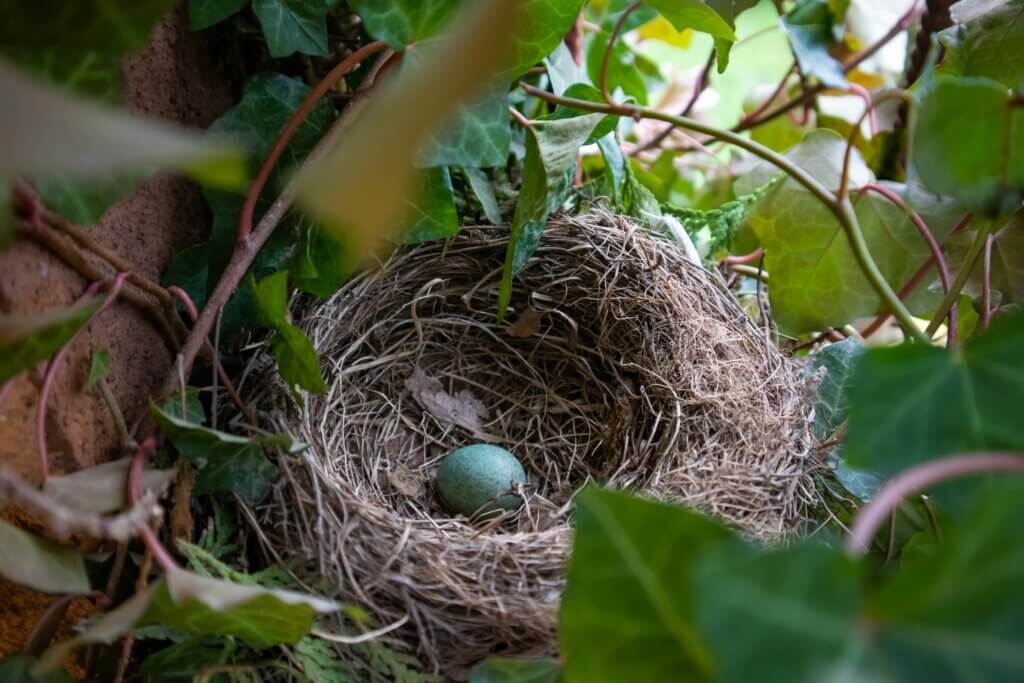
Photo by Landon Martin on Unsplash
Neglect for the Birds
My hanging basket of geraniums dies
on my front porch, soil in a pot
surrounded by three sides of bricks.
I leave for work, come home every day,
thinking I should clean this thing out,
put something new in its place.
One Saturday morning, I mess with it.
What are all these twigs doing here?
I pluck them from the container.
No, put them back!
There are eggs here.
Have I destroyed, killed
this clutch with my carelessness?
I put the twigs back.
I better not disturb
the silence from which they came.
At night she comes back,
left to get food, I think.
I watch her from my front window.
She sits, just sits—refusing
to budge as she broods
in her nesting box.
I see her leave occasionally,
which makes me anxious,
this neglect issue, I worry about.
It’s July. I’m out of school. I wait.
I watch. Never have I been so fascinated
with someone, some little thing being born.
I dare not even lift the twigs to see
how these four little ones fare.
She comes back, sits for hours, days
while I think of myself as a midwife.
Fledging, I read about, even the
things that can go wrong, cause death.
But am I starting to see feathers
instead of twigs?
Twenty-one days since she first sat,
I sit on my front porch, look
toward an empty nest, turn
my head to see four little birds
and mom launched in the trees.
Birds on a Wire
What do they see,
perched high above the foil
of human desperation?
Are they the fragile,
or are we,
who sit in our high
and low places, longing
to be free, to fly away
when the wind shifts?
Perhaps it isn’t a matter
of freedom at all, but flight
perspective, like at the carnival
Tilt-A-Whirl, when, young,
we push up, push down,
round and round
we go—until
we take a deep breath,
start again.
We line up on the wire,
tilt our beaks,
take a dip.
The air currents steady
the nerves frayed
from constant change.
Curtain Call
Sailboats speak to the wind
to calm the roaring sea,
surrender with their white flags
raised above the mast.
While the tide ebbs,
a drawbridge summons
the billowing clouds
to let the fishing boats pass.
The waves roll on.
Flying birds touch the shore
like surfers propel their winged arms
to ride the tumbling waves.
Men throw inflatable footballs,
like playing “catch me if you can”
or a touchdown in the end zone.
The rushing waves invite the audience
onstage so boys and girls jump,
swim in the ocean-peaked suds,
actors with the rushing waves
enjoying the show.
Buried in the sand, except for her head
exposed from her safari hat,
a little girl wiggles her toes.
The mud massages her body
in the sand-castle spa.
Beach-towel blankets beckon
her to relax, like fishing rods, mounted
in the sand dune, salute the sea.
Night falls.
The water’s pointed, silver-white crystals
glisten from the moon’s glow,
like fireworks explode,
a stage draped from the sky.
The waves rush to the shore to take a bow.