Photo by Pierre Bamin on Unsplash
Think for a moment of your childhood home. Your bedroom, where you slept, played with your dolls and cars, and sludged through homework. Your kitchen, where your mother hovered over the stove, stirring chicken noodle soup. Your living room, where you watched TV with your siblings, decorated the Christmas tree with both breakable and paper ornaments, and sat in the corner, sulking in time-out.
Think of how that house watched you grow up. It watched your memories play out, both good and bad. It watched you go from being small enough to fit in your mother’s arms while she smiled down at you, to tying your own shoes before your first day of kindergarten, to packing up everything you own to embark on a new adventure. One day, you walked through the front door, knowing you would be different when you walked through it again — still you, but changed. So you saw, in one long last look, all the different versions of you, shadows of the past, left behind in the house you were leaving.
***
Now I’m going to describe to you someone’s childhood home, their comfort place, where they spent most of the moments of their life.
The Browntown Road Estate is on (not surprisingly) Browntown Road just off of Dayton Boulevard in Red Bank, Tennessee. It is a property and an experience that will live in my memory forever. The estate, specifically the house itself, has been a legend in our family for a few generations. When driving down Dayton Boulevard where it could be seen sitting magnificently atop the hill, my Great-grandfather, Papaw Skelton, used to tell my then-child mother that the house had golden toilet seats. I never got to meet my Papaw Skelton, but I have heard enough stories about him that I can imagine him looking into the backseat with a mischievous twinkle in his eye and a playful smile on his lips, while my mother looked out the window in wonder at the splendid white-columned brick estate. My mother told me it wasn’t until high school that she realized Papaw Skelton had probably been pulling her leg because he had no way of knowing if that was the truth.
So when we saw the estate sale advertised on Instagram, we marked the upcoming date in our calendars and waited with anticipation to find out if the legend was true. Finally, July 11 found my mom and me, my grandmother, my aunt, and my 5-year-old cousin walking up to a big, white fence gate leading to the long driveway that prefaced the house, which wasn’t even visible from the end of the driveway. Once we reached the top of the hill, there was already a line of people waiting to go inside – a long line, and it was already a hot day, even though we were standing in the shaded driveway at nine in the morning. We waited for at least an hour and a half, shuffling forward every once in a while, when they let another group in the front doors. Our anticipation grew, now not only to see the legendary house but also to be inside the blessed air conditioning.
I remember the moment when we were standing on the porch, next to go inside. The white columns seemed huge, looming up next to us. A Juliet balcony over the front door overlooked the wide green lawn that spread before the house. A line of trees kept the road below invisible from our view. Between that and the long driveway, the house felt far removed from any other civilization, like a piece of history that hadn’t been touched by the outside world in a long time.
Finally, the moment arrived and we were allowed inside. The living room, the room we entered into, held some antique furniture, including an old-fashioned couch, armchairs, and a church-pew-like bench with intricate carvings. A coffee table in the midst of it all displayed year books from Red Bank High School and various black-and-white photographs. A grand piano hovered in the back left corner of the room. Not a bad first impression overall, but the windowed French doors led us to what immediately became my favorite room of the house: the library.
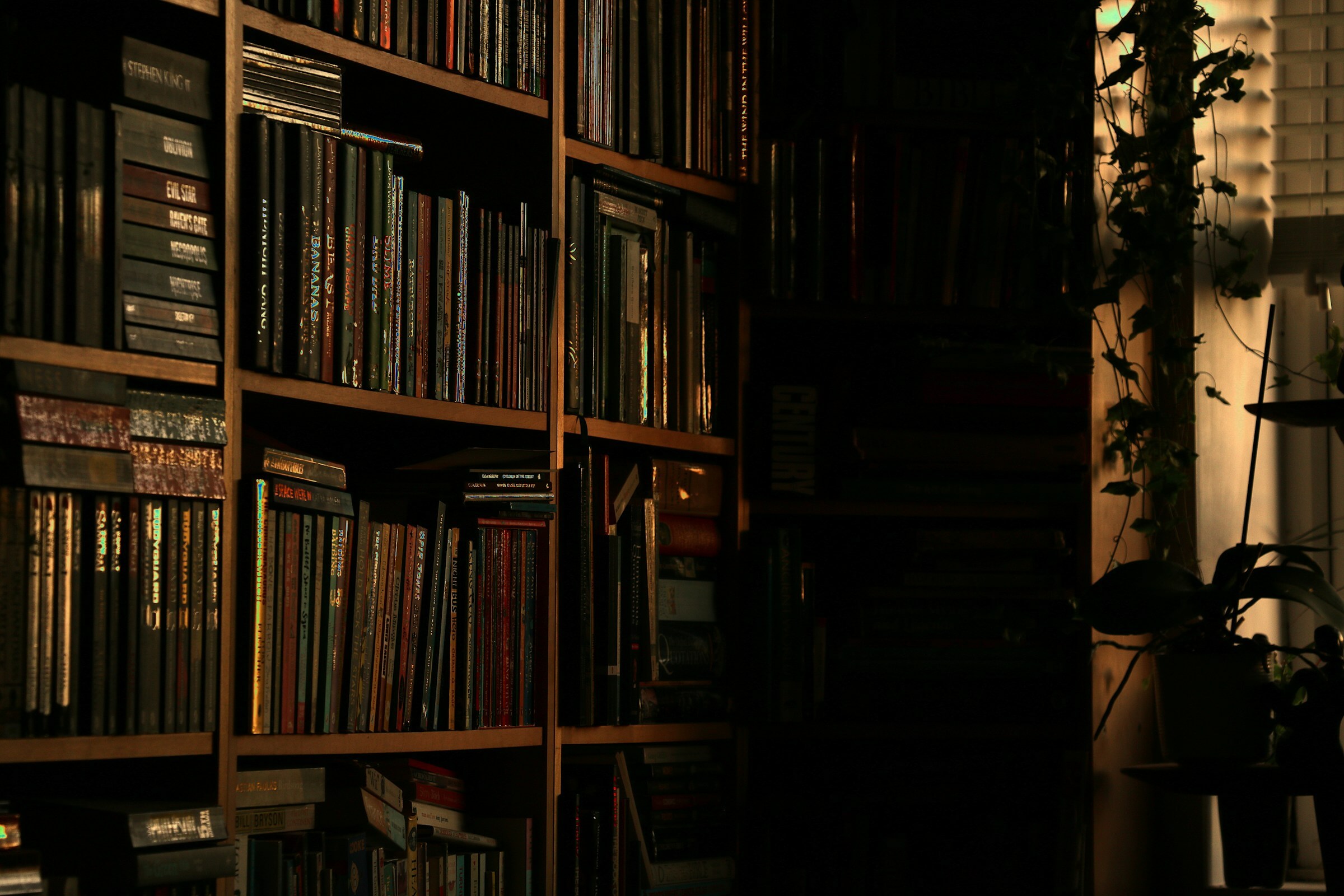
And what a library it was! One full wall of floor-to-ceiling shelves full of beautiful, beautiful books. Most of them were Franklin Library books of poets and short story writers I had read in literature classes. Beautifully bound in dark shades of brown, blue, red, and green with gold embellishments. I saw a lady leaving the room with three books in her arms and knew I had to claim mine now if I wanted to be sure of getting one. I only had the funds for one (they were $35 each), so I chose a book of Ernest Hemingway short stories, published in 1978.
It was sort of an afterthought compared to the books for me, but there was also a desk in the corner near the door, and a fireplace on the wall facing the bookshelves. There were a lot of odd objects scattered throughout the house, but on the shelf above the fireplace were two of the oddest things I found in the house: a mold of someone’s teeth and a box containing a dog’s ashes. I remember my grandmother pointing out these objects to me, and I could only stare in fascination as the lore of the house grew in my mind. Maybe the house belonged to a dentist? And the box – with the dog’s name and years of life listed – what a sad reminder to have in view each day.
We moved on through the kitchen, and my mom chose some juice glasses to purchase – an item she usually defaults to at garage or estate sales. From the kitchen, we drifted into the dining room, which contained a large table with fancy matching wood-carved chairs. As I studied the two china cabinets that held tea sets and elaborate painted plates, I wondered if the family of the house had ever used them when guests came over, or if they were their best Christmas party dishware.
Once we had looped back to the living room, the staircase brought us up to the hallway of the second floor. An alcove in the middle of the hallway held more Franklin Library books and a table that was covered in more old, black-and-white photographs. I got distracted looking through some of them and was surprised to discover that some had handwritten notes on the back. I found one (that I purchased) of a lady dressed in a dark dress and a coat and scarf standing on the doorsteps of a house. In elegant cursive on the back was the message, Standing on the doorsteps waiting for you. – C. And another, a portrait of a woman with a note on the back expressing fondness for a cousin, signed, Genevieve, ‘59.
This, to me, was the epitome of the mystery and wonder of the estate. It was these photographs that kept the house in the forefront of my mind for several weeks after the sale and even over a year later. Those photographs and all the others on the table were from a different time, and a different world. How different and more intimate it would be to receive a wallet-size photograph of your best friend or lover with a handwritten note on the back – so different from today’s equivalent of an Instagram post shared by your friend that you’d quickly like and then scroll on.
But these photographs also raised my curiosity to a burning level in a different way: were there not any relatives of the estate’s previous owners who wanted all of these photographs? These family photos that told stories and history? Or were the previous owners the last ones in the family line, leaving all of their belongings, their stories, and their history to be sold to strangers and separated to various parts of the state, country, and world. It broke my heart a little to think of that.
From the hallway alcove, we shuffled down the crowded hallway to stop in each of the bedrooms. They contained a myriad of clothes of my grandparents’ styles, records, more books that the shelves downstairs could not contain, and expensive jewelry that had real stones and pearls. Again – family heirlooms – such strange things to be left for strangers in an estate sale to pick through. The rest of the house held some beautiful antiques like a silver hairbrush and matching hand mirror, a Victorian dress, a candle holder that looked like it was from the age before electricity, and a set of large, old-fashioned keys.
Once we were done touring the main part of the house, we got back outside and looped around the house to the back, where some concrete stairs led down to the door of the basement. The basement was a confusing loop of rooms holding an even more confusing jumble of items: a pool table, Playboy magazines, Civil War memorabilia, more records and books and – I couldn’t believe my eyes – a bowling alley with a single lane and some dusty bowling pins.
Back outside, we explored a bit of the property beyond the house. There was a lovely (but overgrown) garden that included a small fountain, a barn that was full of piles of wood, and a corn crib, which was something that definitely felt ancient and unique.
***
Recently, I searched for the property on Zillow because I was curious if the estate had sold yet. Answer: It is still for sale, and it is currently selling for $3.1 million, but it started off on the market for $4.5 million in 2024. I also found a detail that adds together some of the context my curiosity has been yearning for: the house was built in 1920, but this is the first time in over 100 years that it has been up for sale.
Which means that the Browntown Road Estate was collecting dust, memories, books, records, laughter, tears, couches, chairs, dishes, conversations, clothes, and so much more for 100 years. I don’t know about you, but I just want to know the stories that those walls could tell. The happy moments, the heart-breaking moments, the long-awaited moments, the anxious moments, the tense moments, the boring, normal life moments. That house has seen so much change – in itself, in its inhabitants, in its landscape, in its visitors, on the road below it, in the state of Tennessee, in the country of America, in the world we live in. Technology, culture, and people have changed.
Those photographs had notes and messages on the back that real people wrote. They had intentions, hopes, goals, and love for the people in those photos. Those photos must mean something to someone somewhere. Who was C waiting on? Where was she waiting? Why was she waiting? Did Genevieve stay good friends with her cousin? It’s a story that someone, somewhere knows, and I’m jealous of their knowledge. I’m jealous of what the house has seen: a grand picture of the life of a multigenerational family over 100 years. Perhaps you and I will never know the true story, but for now, the story takes its own turns and twists in our imaginations.
In the minds of my family, it started as the story – the legend – of the house with the golden toilet seats. As we left the house that day, wearily making our way down the road back to our cars, my grandmother chuckled aloud, “Papaw Skelton is probably laughing down at us from Heaven right now.” While we all laughed at the image and at our eagerness to determine the truth of the legend that had turned out to be false, the story of what the house truly contained saturated our minds. It encompassed the story of something so much more valuable: the story of life.
We drove back to our own homes, each one’s walls there to sustain us, comfort us, and gather the stories of our lives. The walls of my own home tell the story of multiple generations: the home where my grandmother grew up, the home where she and my grandfather raised three girls, and the home where grandchildren came to stay for sleepovers, the mystery of the house new in their eyes each time. And now, it is my family’s home, full of memories of the past and hope for the future.
Our homes are stories of life, and that’s what the Browntown Road Estate is: a story – in my head, in your head, in the heads of its remaining previous inhabitants. Only some of those stories are true, and others will remain a mystery. While that does drive me a bit mad, I know that I have my own story to get on with; so I’ll leave the Browntown Road Estate to be a cherished memory of time spent with family and an untold story in the back of my mind.