Creative Nonfiction
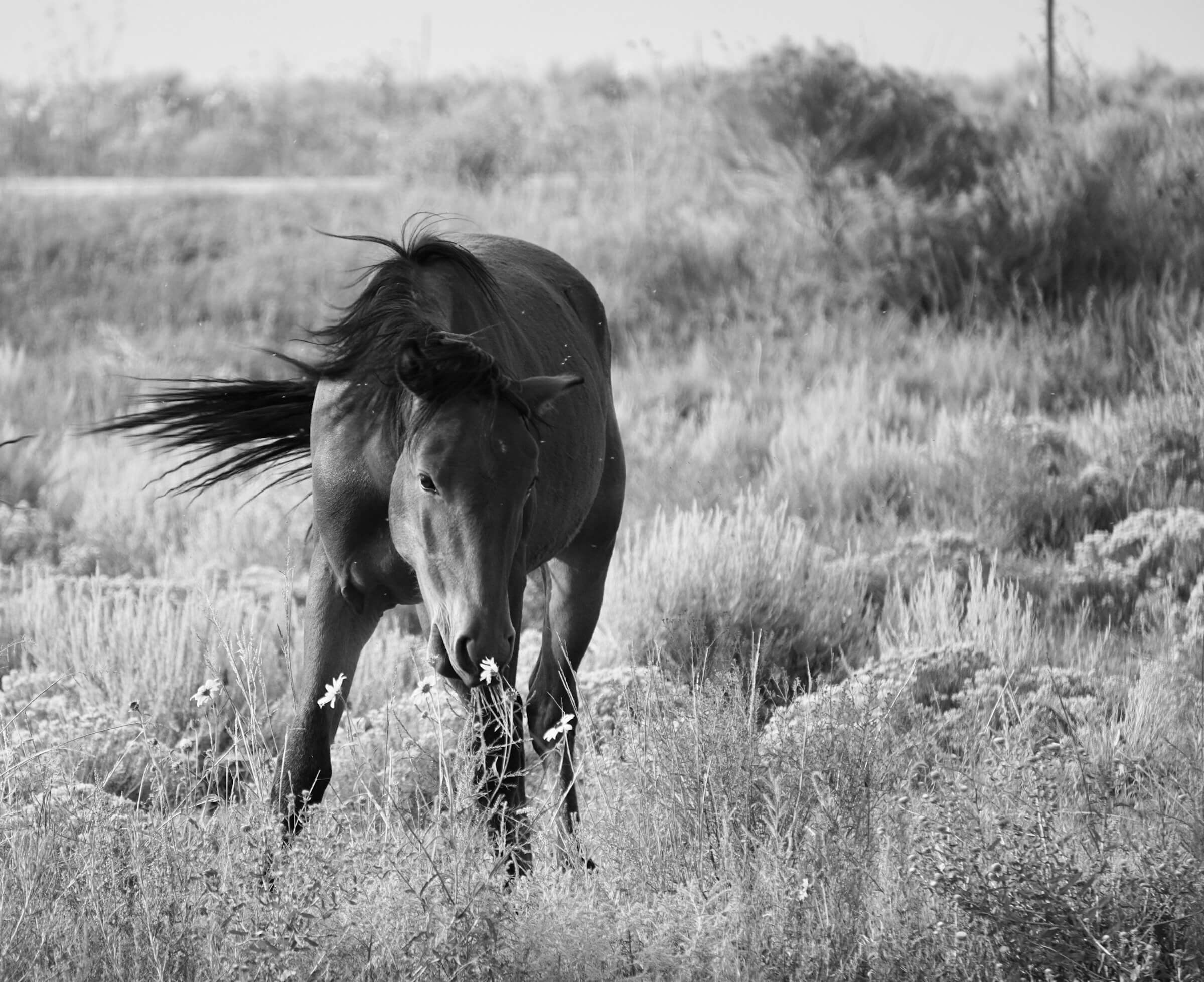
Today we have left one home for another. Taos is our heart-home, and Colorado’s Front Range is the other. Driving north on NM 522 which crosses the state border at Costilla and turns into CO 159 is our long goodbye. We have left midmorning, packed the Subaru, settled ice into the cooler, and loaded our dog through the hatchback to harrumph into his blanketed nest.
Each time we make this drive, we look for them – the wild horses of San Luis Valley. Their band marks a physical farewell to our heartfelt one. Nearly every North to South journey they greet us, welcoming us toward our heart home about an hour and a half drive away. Or, like today, the South to North route marks a roadside goodbye as we have another four hours to arrive at our Boulder County house.
This time we are blessed, on the left-hand side toward Ute Mountain on the horizon we see them. I ask Daniel if he is ready to stop. He pulls his long lens from the place he has set it, on the floorboard between his feet. Hazards on, I slow to the right and pull into gravel road. Daniel sheds his baseball cap, placing it on the passenger seat, and hops out with his camera. He closes the door as silent as possible and edges out into the white sage.
Our dog is on alert, wondering where Papi is going. He sits regally, looking out into the sage toward the biped figure that is paralleling the road, and nearing the darkened dots that bend muzzle to gamma grass. Those aren’t the same beasts we sometimes encounter out at Santa Barbara Trail, where open range funnels into hiking paradise singlet track. Those cows are familiar with Australian Heeler Cattle Dog nips. They are aware of staying clear of the Pyrenees-Border Collie mix that is tethered to leash, bounding in joy, wanting to play with the oversized “puppies” with horns. The beasts his male-human approaches are a more wary four-legged animal – los cimarrones.
Local legend has it that these horses, and their prior generations, have resided within the San Luis Valley since 1599 when the Spanish Conquistadors first arrived in the region during Juan de Oñate’s campaign to conquer the area. The Spanish soldiers, Franciscan priests, and some farmer colonizers settled along the Río Grande del Norte. There they established an encomienda system, where farmers planted small homesteads within the river basin, and subjugated Tewa, Towa, and Tiwa Indigenous speakers as well as Apache, Ute, and Navajo peoples to labor these lands for the Spanish crown. Decades later, because of this cruelty, nineteen pueblos united under Po’Pay, a Tewa leader and medicine man from Taos Pueblo. On August 10, 1680, the Pueblo Revolt began. Through their coordinated attack, the Spanish retreated all the way south to El Paso, Texas, and back to la Ciudad de México. As the Spanish fled, they left their farms, stockyards, as well as their animals behind. This is how the horses became feral: they escaped their corrals.
Eventually, the Spanish returned twelve years later during “la Reconquista” and reestablished “La Provincia Española de Nuevo México.” At that time, this Castillano speaking province of Spain included lands that paralleled the Río Grande from Texas, New Mexico, and into Colorado. Spain controlled this area until 1821 once México gained independence from Spain and therefore control of these lands until 1850. Then the United States after the Mexican-American War took over these territories. In 1851, the settlement of San Luis became the oldest established town in the territory that would become the state of Colorado. Throughout these times, more and more trappers, homesteaders, and ranchers came into the area. They brought their own horses, and these equines interbred with the Spanish cimarrones that now were feral horses.
However, this wild horse legend doesn’t ruminate just there. There also is the belief that these horses are not feral and invasive but are endemic. Anciently horses evolved in North America around fifty million years ago. This species – Eohippus Equus - was small in stature and were forest dwellers. Yet, because of climactic change during the Pleistocene epoch, they died out. Others believe – and if one listens to some indigenous oral storytelling – these Equidae did not perish but came to integrate into wild horse bands that came across the Bering Strait. Horses have been a part of Native cultures for centuries.
Whichever the case, the cimarrones along the NM 522 and CO 159 corridor are beautiful. Often, we are blessed by an encounter of a lone black stallion with a white star on his forelock standing solitary within the sage brush. Other times a brood of chocolate-colored mares will protectively surround a foal at road’s edge. Or if we are lucky, we might spot the all cream-white colt suckling its sorrel roan matriarch. These are precious moments that Daniel captures with his lens.
What is worrisome is that the United States’ and the Bureau of Land Management has protected American mustangs through the Wild Free-Roaming Horses and Burros Act of 1971. However, this protected status is being stripped through our current administration under President Trump, Secretary of the Interior Doug Burgum, and BLM Director Stevan Pearce. According to this conflict, the BLM must manage horse populations to protect the ecosystem and local ranch and grazing lands. The BLM is actively removing wild-feral horse populations through helicopter roundups and placing them in holding facilities, supposedly to prevent overgrazing.
It is true, the San Luis Valley is undergoing a severe drought. Reservoirs are extremely low, aquifers are not being replenished by once plentiful monsoon seasons or snowmelt, and grasslands are turning to dust. This is not the fault of the wild horses, but they are competing for a drink with the landscape and the people that live upon it.
One such place in particular is the Sánchez Reservoir and Wildlife Preserve. On our drive north back to Boulder County, we take a detour to the reservoir – that promises “lake lots for sale” because we had heard that nearly 150 wild horses called those shores home. Through the town of San Luis, we turn East on County Road 21 to the entrance of the preserve. The road is grated gravel and claims to lead directly down to the boat ramp access.
This time of year – late summer to early fall – there is no lake access. The ramp lies over forty feet above waterline. The cement cuts a man-made precipice, a severe high dive down to the murky water below. Rounding the public access site, vehicles can approach the reservoir on its eastern shore. Mucky sandbars extend out into the narrow knife of water that reflects the periwinkle sky. It isn’t a true blue, the surface mirrors a sea green mother-of-pearl. The flats smell briny and reminiscent of distant oceans.
Daniel, our dog, and I park above upon the gravel and walk along the approach way which scuttles the shoreline. Our hiking boots sink into the muddy silt, and we follow trails of long white feathers and hoof prints. I pick up a feather and run it through my index finger and thumb, dusting it of the silt-soil and wonder which bird shed this frond.
Daniel glances with his lens over the water. On the far end, dotting the surface where it meets the western shore, rests a flock of large white waterfowl. In the distance they look to be swans, but I knew that couldn’t be. Daniel takes a shot, a digital frame shows the evidence. Wide wingspans tipped in black, and yellow long pointed beaks. Daniel searches online and we are dumbfounded. American White Pelicans, an ocean fowl, also makes the San Luis Valley part of its migratory home.
Large flocks appear at the reservoir late summer and September as the pelicans move away from northern breeding grounds. This is one of their stops; it has been ever since the reservoir was built in 1912. These waters provide shelter, a rest area where the pelicans can fish in the shallows, and then eventually make their way to other shorelines such as the Texas Gulf Coast.
Like what greets us on our way toward our New Mexico heart-home, the wild horses within San Luis Valley also welcome the American White Pelicans. It is a Bienvenida. This time, a band of thirty individual horses, mostly brown mares, stand at the southwestern tip of the water knife.
The water clearly is extremely low, making for a narrow landing pad for the pelicans. The horses hover like a mirage. The real them on solid ground, their blurred images reflected in the fata morgana. They hold vigil for the squadron of American White Pelicans. If a pony flicks its ear nervously, if another whinnies, the birds take off to a further reach of the pond.
They all see us now or have for quite a while. Daniel walks farther ahead, so my shadow tethered to our dog on leash does not inch into his shot. We near them, the horses take a step away from shore. The horse’s group in a tightened circle; there are young ones in their midst. This was revealed in the hoof prints prior, tiny U-shapes next to larger ones.
We all peer from afar. I raise my hand to shadow my brow. The pelicans swim their legs to pivot their bodies and face us. The horses graze the far grass turned green from the drought-receding shallows. They pretend to ignore, but their darting eyes keen on the dog, while our canine whimpers to go bounding with the “other big dogs” that would easily outrun him.
Two species, so significantly different, yet calling the same heart-space their home.
Two species that have evolved to coincide, side by side for over a century. What makes this tolerance work?
Their shared reciprocity is in the dung and guano they leave behind that fertilizes the grasses that the horses graze and the reeds that shelter crustaceans and fish that the pelicans gullet. Their mutual observations of potential predators warn each other of danger. Their cross-species communication may be subtle, the nickers of the ponies, the grunts and gronks of the fowl; but is an understood conversation, nonetheless.
If these two species that are wildly different co-exist – why can’t humans with others who are different, who speak other languages, who migrate to other ends of the spectrum?
Or is survival only in the speed of our gallop or the far-reaching upswells of flight rather than a common land that roots us into a shared heart home.