Creative Nonfiction
Imkara Visual
For Unsplash+
I’m almost 80 years old. And for most of those years, I’ve thought of myself as a drummer. Last week, as I watched their new owner drive away with my drums, I wondered if—without my drums—I could still call myself a drummer. And if I’m not a drummer, who am I?
Recently, I was showing some interns how I edit the weekly podcast I produce for Passager Books, how sometimes I’ll replay the same sentence or phrase over and over, trying to decide whether the pause between two words needs to be a quarter or even an eighth of a second longer or shorter. That’s how aware I am of rhythm.
I’ve always been that way. I remember lying on the back seat of our 1954 green Ford counting the power poles that passed across the car’s back window, wishing I could ask my dad to either speed up or slow down so the power poles passed at the same speed as the big band music playing on our car’s radio. That’s how far back my memory of counting and rhythm goes. In fact, when I was a baby—somewhere between nine months and a year, probably—my uncle bought me a drum and painted my name “Jonny” on the head. I know that because I still have the photograph of me sitting with it.
Years later, walking home from school, I’d count the steps it took to get from Clovernook Ave. to Desoto Dr. When I rode my bike to the swimming pool, I’d count the number of pedal strokes from the park to the cemetery, from the cemetery to the Mt. Healthy Drive-In sign. When I’m walking on the treadmill at my gym, I vary the speed so my walking matches the tempo of the Pandora song playing through my hearing aids. And when I’m driving, I channel surf, trying to find a song whose tempo matches the rate of the flashing turn signal on the car ahead of me.
In sixth grade music, we had to choose an instrument to learn. Any guesses? Mr. Ramos, the band director, showed me how to hold the sticks and then led the new class of drummers as we alternated sticks on the high school marching band’s snare drums: right, left, right, left, right, left. My parents bought me a pair of drum sticks and a practice pad. A year later, they bought me a walnut-veneered marching snare drum and a stand to put it on.
When he was reasonably confident that we could control playing with alternating sticks—single strokes—we moved to double strokes: right-right, left-left, right-right, left-left. Once he handed me off to a private teacher, it was all about the rudiments, the building blocks of drumming, broken into weekly portions by Harvey Whistler in his book Reviewing the Rudiments: flams, paradiddles; ratamacues; five, seven, and nine-stroke rolls; and on and on.
By ninth grade, my drum teacher felt like I could find my way around the basic rudiments and suggested that we move to more complex coordination, adding my right foot on a bass drum pedal and my left foot on a hi-hat cymbal pedal. My dad and I took the snares off the marching snare, turned it on its side to become the bass drum, attached legs to the back to keep it from rolling around, and clamped a Ludwig kick pedal to the front. My parents bought me a five-inch snare drum, a ten-inch cymbal and a floor stand to put it on; and for the next few years, both hands and right foot occupied, I imagined the sound of a hi-hat cymbal snapping whenever I pressed my left foot down on the imaginary pedal.
My best friend Lenny and I were the lead snare drummers in marching band and the two lead percussionists in concert band. He was always better than I was, but I was no slouch. Every year at the county-wide individual music competition, he usually came in first; I often came in second. The classic rudimentary drum contest solo was “Downfall of Paris.” The first time I played it in tenth grade, I had trouble getting through it. The second time, in eleventh grade, I got through it just fine but couldn’t play it quite up to tempo. And my senior year, I came in second in the state competition (Lenny, of course, was first).
In marching band, the drumsticks we used were 2Bs, thick with big tips. Sometime around my junior or senior year, we discovered Regal Tips, drum sticks with nylon tips. We read Hamlet in senior English and thought ourselves oh-so-clever for a couple weeks after that in the band room: “2Bs or not 2Bs?” Lenny and I would say, cracking up every time. Regal Tips, it turned out, had been around since the late 50s, but we’d never seen them before. They felt crisper, more precise. They changed my life. Although we continued to use 2Bs in marching band, we mostly used Regal Tip 5As in concert band and with our drum sets.
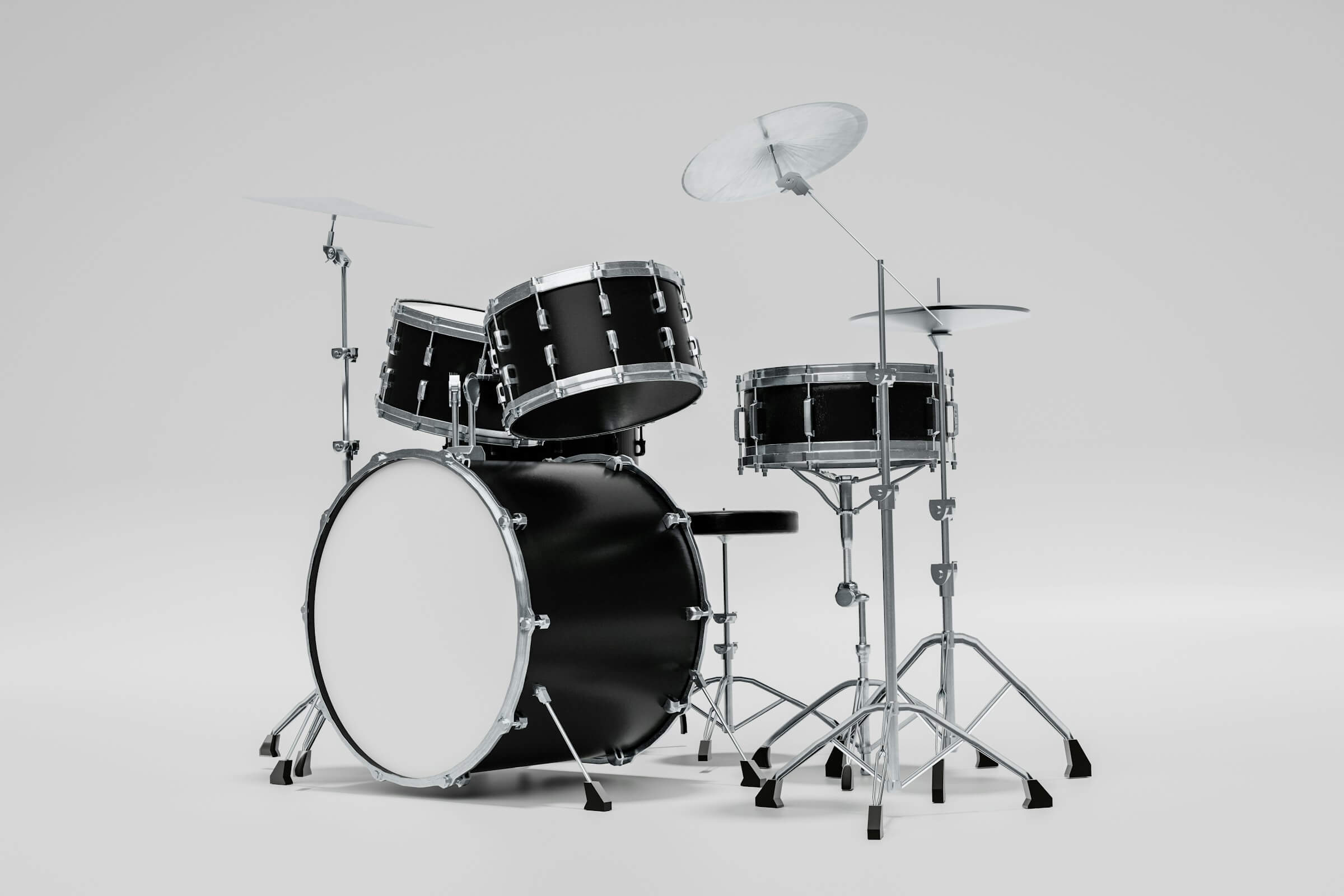
During the summer between high school and college, a neighbor told me that her uncle was selling his drum set. My dad and I drove across town to his house and bought it for next to nothing: A beat-up 1940s Ludwig gold sparkle bass drum with a tom-tom mounted on it, a six-inch snare that didn’t match, a woodblock, and a cowbell. My dad got a couple rolls of black marble contact paper, carefully removed all of the nickel hardware from the “new” bass, tom, and snare and the chrome hardware from my original snare; even more carefully applied the contact paper; reattached all of the hardware and created a matching set in black marble: bass drum, snare drum, and mounted tom-tom. My old, original marching snare, now with added chrome-plated legs, became a floor tom-tom. We didn’t cover the old five-inch snare, figuring there was no place for it in the new configuration. We bought a used 22-inch Zildjian ride cymbal and stand, as well as two used 15-inch Zildjian hi-hat cymbals and a stand. We kept the 1960 bass drum pedal and got a clip-on arm to attach that original little 10-inch cymbal to the bass drum.
And for the 60 years from that day in July 1964 until January 2, 2026, that was my drum set.
My freshman year in college, I found a part-time job giving drum lessons at a music store in nearby Hamilton, a job that continued through graduation. The trade-off, of course, was marching band. Football games were always Saturday afternoons, the very time I was teaching.
Also in Hamilton was the Hamilton Symphony Orchestra, a community orchestra whose members were mostly area music teachers; former music majors now selling insurance; and a few current grad and undergrad music majors. The only paid staffer was the conductor, now in his last year as a conducting student in my university’s master’s program. And when he offered me a position in the orchestra, I jumped at the opportunity.
So for most of my four years in college, I spent Monday and Wednesday afternoons at concert band practice, Tuesday and Thursday afternoons at orchestra practice, and parts of most weekends hitchhiking or taking the bus to and from Hamilton, Saturday mornings to teach and Sunday afternoons rehearsing with the Symphony.
At about the same time my cousin Ray told me that a guy he worked with at the Baldwin piano factory in Cincinnati was in a band that was looking for a drummer. I called the guy, and he put me in touch with his friend Bill whom he said called the shots. Bill said he was a guitar player, his buddy Frank that I’d talked to played rhythm guitar, they had a gig coming up, and a drummer would really help. He asked if I’d ever played drums before, if I could keep a beat, and if I could pick up on cues from the lead musician. I answered yes to all three, hoping for an invitation to audition with the group. Instead, Bill gave me the address of the birthday party they were playing that Saturday night and told me what time to be there. “What should I wear?” I asked. “How should I know?” Bill said. “It’s not my birthday.”
That Saturday afternoon, I hitchhiked the 40 miles home from college, dusted off my drums, now stored in the basement, and tried to remember how to fit them into my parents’ car. It’d been years since I’d played them, much less loaded them into a car. After trying various configurations, I finally slid the bass and floor tom onto the back seat, wedged the snare and mounted tom on the floor between the seats, and the cymbals, stands, pedals, and stool in the trunk. There was no place to park at the address Bill had given me, so I double parked in front of the house, carried the bass drum to the front door, and rang the bell. “Yeah?” said the woman that opened the door, a Hudepohl bottle in one hand, a cigarette in the other. “I’m with the band,” I said, somewhat self-conscious at stating the obvious and trying not to drop my bass drum. “Oh yeah,” she said, pointing with her cigarette, “in there by the fireplace.” Four trips later, everything was in, I went back to the car and found a parking place a couple blocks away. Just as I was about done putting my set together, two middle-aged men walked in carrying guitar cases and one amp; they were both smoking. “Jon?” one of the men said, putting out his hand. “Bill. This is Frank.”
Bill was clearly in charge. He told us what song was next, set the tempo, and gave the downbeat with the neck of his guitar. He always played lead; Frank always played rhythm. Bill never looked at his fingers on the guitar; Frank always did. I flew through the evening by the seat of my pants. If the song was fast, I used sticks; slow, brushes. Beyond that, I just tried to keep the beat and end at the same time Bill and Frank did. Some of the songs I knew from the local top-40 radio station or from having gone to friends’ houses in high school and heard their parents’ records playing in the other room. There were a few classics: “Stardust,” “Mood Indigo,” “I’m in the Mood for Love.” And there were lots of songs I didn’t know at all. For most of the night, except when we were on break, I kept my eye glued on Bill; Frank kept his eyes on his guitar; and Bill stared glassily ahead.
At the end of the night, while I was tearing down my set, the slightly-tipsy host gave Bill ten $10 bills. Bill gave $30 each to Frank and me and kept $40 for himself. We left the house together, neither Bill nor Frank offering to help carry my equipment to my car. They did say goodbye, Bill adding, “I’ll call you next time we have a job.” The next job lasted a year: every Friday and Saturday night at The Golden Touch Lounge. For the year and a half after that, we played Friday and Saturday nights at the Roselawn Tavern.
Shortly after that group broke up, I got another job with a jazz quartet, piano, sax, bass, and drums, a group of musicians much more highly skilled than Bill and Frank had been. We played private parties and wedding receptions and one year a New Year’s Eve party at the Tri-County Coon Hunters Lodge outside Lawrenceville, Indiana, where the lodge president came over to us just after midnight when we were about to close up and leave, and said, “I know the contract was ‘til midnight, but everybody’s having such a good time we want to keep the party going for another couple hours, so we took up a collection,” at which time he showed us a hat full of one and five and ten and twenty dollar bills and said, “So how about staying?” And we did. Then there were the occasional other random freelance gigs that I played—Christmas Eve at the Millville Roadhouse, for example, where I accompanied the elf-costumed woman bartender who played Christmas music on a Hammond organ and said “Maiwy Twitchmitch” between songs.
There came a day, though, when I had to stop, not because I was tired of playing, but because I was working all week as a public school English teacher, grading papers every night and on weekends, and trying to be a husband and father of two small children. And the bands I played with said, “No, you can’t just play once a month or when you feel like it; it’s either every Friday and Saturday night or not at all.” So not at all it was.
I played my drums occasionally after that: the Hanover College Faculty Prom, the Friends Middle School annual musical’s pit band, instrumental ensembles accompanying choirs at Baltimore Hebrew Congregation and Columbia First Presbyterian Church. But the drums, their black marble contact paper still pristine, mainly sat stacked, gathering dust, on utility shelves in my basement.
And then came that moment that comes to most people Of A Certain Age, when either because they’re moving to a smaller space or they don’t want their kids to have to deal with all their junk when they die, know they need to start getting rid of things.
Some things are easy: that sport coat you haven’t been able to button in 15 years, the two dial phones and the carton full of wires and adaptors for machines that got thrown away ages ago.
And then for each of us, there’s That Thing, the thing you never use, the thing you’ll never use, the thing you can’t bear to part with. For me that thing was my drums, the drums that accompanied me through high school and college and my former marriage and so many important moments and that represent so many things, tangible and intangible, that meant so much to me. But I know I’m essentially done playing them.
It reminded me of that moment when the cardiologist told me I had A-fib, atrial fibrillation, that my heart was beating erratically. Erratically? My heart? I’m a drummer; I’ve been one since sixth grade. I’m one of the snare drummers the band director looked to keep a steady 140 beat as the Mt. Healthy High School band marched briskly down the hill and onto the football field to play “The Star-Spangled Banner” before the game. I’m the bass drummer the Miami University concert band relied on to keep the tempo steady during “Edelweiss” in “The Sound of Music” medley. I’m the tympanist that helped hold disparate parts together during the Hamilton Symphony Orchestra’s performance of Borodin’s Second Symphony. I’m the guy in the Dave Westerburg Quartet that kept the sax and piano on target during their “Green Dolphin Street” improv riffs. And now, some doctor I barely know is telling me my heart’s beating erratically? What is a drummer, after all, if not someone who can keep a steady beat? What good is a drummer who can’t keep a steady beat? I was the guy they could literally count on. Between the A-fib, the atrial tachycardia, and the other random arrhythmias that I’ve probably always had but that no one ever said were particular problems, my heart periodically sounded more like a scat duet between Louis Armstrong and Ella Fitzgerald than “The National Emblem March.” How could I call myself a drummer?
How could I call myself a drummer if I no longer had my drums? And if I wasn’t a drummer, what was I? How do we define ourselves, perceive ourselves as we get older if we no longer have the jobs that once identified us, the tools, the abilities that were once at our fingertips?
And as I wallowed in all of this, I remembered my wife’s much younger friend Christine’s husband Peter. Peter, who majored in drums and percussion in college. Peter, who plays in multiple rock and Irish and other bands. Peter, who teaches drums to kids. Maybe he has a serious student who can’t afford their own set. So I wrote to Peter and offered him the drums, hoping he’d take them, hoping he wouldn’t. Minutes after I received the email from him confirming that he wanted my drums, I drove to The Spirits Shop on Falls Rd., brought home a bottle of Johnny Drum bourbon, x-ed out the “h” in “Johnny,” and poured myself a triple.
“These are so great!” Peter said a few days later, as he rounded the corner of my basement and saw them on the shelves in all their dusty contact paper glory. “Is that a calfskin head on the bass?” he said, eyes wide, as he got closer. “I’ve never owned a drum with a calfskin head!” “The hardware… the hardware!” he said. “These legs are so cool!” he said, sliding the chrome-plated floor tom legs up and down, pulling the nickel-plated bass drum legs out of my old gym bag that for decades I used to carry the legs and cowbell and woodblock and sticks and mallets and extra wingnuts and felt pads and drum keys around in. “I’m in love with this kick pedal!” he wrote the next day when he set the drums up in his studio for the first time. And days later, he wrote, “The lugs got a 24-hour bath in WD-40 and scrubbed with steel wool. New drum head on the snare. Reinstalled the hardware with white lithium grease. They’re enjoying a slow spa day.”
And for the first time since I decided to get rid of my drums, I am enjoying a slow spa day, too. In liberal Judaism, where I live, the people we care about aren’t waiting for us in Heaven but are living in our memories; we even say, “May their memory be for a blessing.”
It’s like finally admitting to yourself that you don’t need to be carrying around that frayed fragment of your old security blanket anymore. Getting rid of those things is still traumatic, but you know you did the right thing. I know my drums will continue to have a good life, even without me. And I feel at least a bit more confident that I’ll continue to have a good life, even without them and that the memory of my drums and my drumming will be for a blessing.