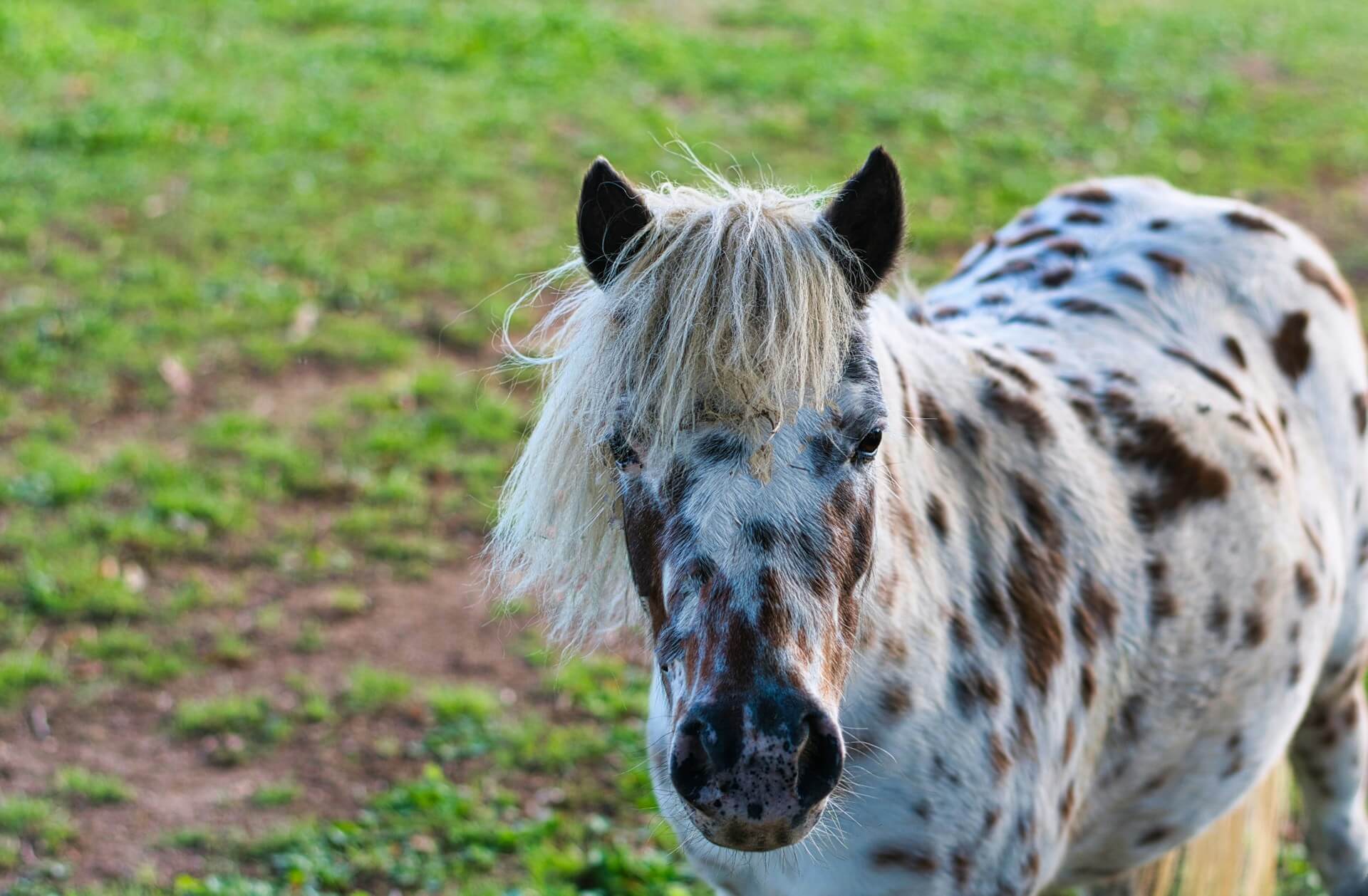
Photo by David Billington on Unsplash
Jacob Shigomitsu rubbed a shoulder blade against a rough-barked ʻōhiʻa tree as he worked the kinks out of a lariat and contemplated what to do with his mule. The mule swiveled its enormous furry ears toward Jake and stared back from between the rusty bars of the small pipe-panel corral.
It certainly wasn’t your average mud-gray, slab-sided, undersized Hawaiian scrub mule. Anyone could see this was a special mule. It was big, and it had the longest ears of any mule Jake had ever owned, but the first thing everyone noticed about that mule was its color: dirty white, with perhaps twenty huge black and brown blotches scattered over its body, all holoholo, like one unbalanced Dalmatian dog. Poho patches, the quilt ladies maybe would have called them. Broken pieces. But no respectable quilter would have designed anything so hideous. A plate-sized black stain rimmed the mule’s left eye and half of its jaw. Two muddy brown blobs dribbled down over its muzzle, and a heart-shaped black-brown splotch sat right where the saddle would go if the mule had ever tolerated a saddle, which it hadn’t.
Whenever a man saw that mule for the first time, he’d stop in his tracks and say Whoa! and maybe swear a little, just out of general startlement.
Jake had owned that mule from its birth, owned also its Appaloosa spotted horse momma, and still he got caught sometimes by the mule’s looks. At dawn, when fog lay on the old Puna cane-field pasture, that mule always appeared first among its half-dozen plain brown pasture mates. Like the nightmare version of those dreamy mystical unicorn pictures, up out of the swirling mist would appear this spectacularly ugly apparition, outlandish ears and all. Gave him chicken skin every time.
And when the mule opened its mouth, people really jumped. All mules can make enough noise to raise the dead, but that spotted mule possessed an excess of vocal talent. Once when Jake was late with the herd’s breakfast, that spotted one started shrieking and braying so bad the neighbors called the cops to claim Jake must've been beating a couple of women to death. And those neighbors were longtime farmers, people who knew all about mule noises.
Jake had decided this mule needed a job. He didn’t need the mule for himself, he already had five others that mostly just loafed around. This mule was so unusual, so special, it needed a special job. Jake had pretty much decided that the spotted mule should become the star attraction in CJ Nesbitt’s dude string, carrying tourists down the old cane-haul trails into Waipiʻo Valley. The tourists would love that big, loud, loud-colored mule. All Jake had to do was convince CJ to buy it, which might be a little difficult since the mule wasn’t broke yet.
Jake had intended to get the mule trained by now, but he hadn’t quite gotten around to it. He certainly was capable of doing the job himself—hadn’t he broken and trained half the stock at Waiʻolo Ranch all those years ago?
But every time he'd thought about starting the mule’s training, something came up. Last winter when the rains had come so heavy, he’d had to replace the leaky tin roof on his two-room house. Then his sister’s kid got into trouble over on Maui and he'd offered to help pay the defense lawyer, so he went to work in the lumberyard for a few months. Somehow the mule had just kinda grown up and gotten real big, real fast. Breaking mules and horses was a lot easier when they were two years old, and now this mule was four.
Jake himself was pushing sixty-five. At sixty, if you got dumped on the ground or belted in the ribs by a scared horse or a pissed-off mule, you don’t bounce quite as well as you did at twenty or thirty. And Jacob Shigamatsu, the product of a complicated mix of Japanese, Hawaiian, Portuguese, Irish and Samoan ancestry, had never stood taller than five-three or weighed much over one-twenty, even in his hard-muscled days on the ranch.
The four-year-old mule now stood close to sixteen hands and outweighed Jake by at least half a ton.
Not only was the mule unacquainted with a saddle, Jake had never actually taught it to lead, stand tied, or lift its feet to have its hooves trimmed. When Jake needed to move the mule from pen to pasture, he’d open the gate and chase it in or out by shouting and waving a stick, which seemed the safest way to handle it. The mule was therefore suspicious, foul-tempered, untrustworthy, and unpredictable. It was pretty close to being completely wild, but worse, because it wasn’t actually afraid of people.
The scraggly coconut palms behind the house began to sway and clatter in the breeze, promising rain. Jake coiled his lariat, eased forward off the tree trunk, and turned his back on the muddy, rock-strewn pen that held the spotted mule. He followed a well-worn path around the rusted tractor parts, paint cans and plastic tarps that littered his front yard and hung the lariat on a nail on the wall outside the screenless screen door. He found his cell phone on the stove, checked its charge, and closed his eyes for a moment, thinking about the words he’d need to say so CJ would want to buy the spotted mule. CJ was savvy, island born, almost as old as Jake. You couldn’t fool CJ.
“CJ, howzit.” Jake put on a big smile. People can hear the smile, his mother always said. Smile and sound like you mean it.
“Hey Jake, okay, howzit.” A heavy, phlegmy cough erupted. Everyone knew CJ smoked too much, always had.
“You need one mule, eh?” Jake didn’t need to ask; everyone knew CJ’s oldest jenny had colicked and died a week earlier. “Got one good mule for you, CJ. Nice and young, big and strong. Built good, carry any big haole tourist for you. And wait you see the color, big black spots on white, like one Appaloosa. The haoles gonna love this one. No one else has one like this mule, eh?”
There was a pause as CJ’s wheezing came clearly through the phone. “I think I know that mule,” CJ said carefully. “From that big Appy mare, what Charlie Nakoa used to have, yeah?”
“Yeah, from up in Havi. I traded him one old ropin' horse for his kids to ride.”
“You got that mule broke, Jake? I can’t run any wild mules. Can’t have the tourists hurt. Doesn’t matter how pretty the mules are, if people get hurt it costs me money.”
Jake kept smiling, kept the enthusiasm in his voice. “Little rough around the edges, maybe, but it’s a good mule. When you wanna see it?”
“Next week, maybe. This mule got a name?”
Jake thought fast. If the mule needed a name, he’d name it. “Mule’s name is Punahele.” The favored one.
“Okay then. I come see your mule one week Tuesday, and it better be broke good.”
Jake gave himself until Sunday to get it done. Six days.
He’d started green horses in three, back when he was young and stupid and didn’t know enough to be afraid. A mule was smarter than a horse, which was either an advantage or a catastrophe, depending on the mule. This mule, he suspected, was going to be the catastrophic kind of smart.
Monday morning, he backed his ‘89 Tacoma up to the corral gate, engine idling rough the way it always did until it warmed up. He’d rigged a heavy cotton lead rope through the pipe bars and looped it around the mule’s neck the evening before, working slow and patient through the bars with a long stick while the mule watched him and did nothing. Which Jake did not mistake for acceptance.
He tied the free end of the rope to the trailer hitch with three wraps and a quick-release. His hands knew the knot without him having to look.
“Okay, Punahele,” he said. “Time for school.”
He put the truck in low and eased forward. The rope came up taut. Behind him he heard and felt the mule plant all four feet and lean back against the pressure like a wall had decided to resist him. The Tacoma’s rear tires spun a little in the mud before they caught. Jake gave it just enough gas. Not a fight, just a fact: This is what happens now.
The mule shrieked. The sound bounced off the hillside and came back at Jake through the open window, and he was glad his nearest neighbors were papaya people who already knew about this mule’s opinions. The truck crept forward. There was a scramble of hooves on wet rock, a tremendous outraged bray, and then—briefly—the mule came.
It took an hour to get around the yard once.
The mule fought and yielded, fought and yielded. Twice it went down on its knees in the mud. Both times Jake stopped the truck and waited, watching in the side mirror, until the mule heaved itself up and stood braced and trembling, sides dark with sweat and big ears pinned flat. Then he’d ease forward again. By the second circuit, something in the mule’s neck began to soften. The resistance came in shorter bursts. Its ears, which had been saying murder since the start, began occasionally to say something closer to question.
By noon Jake’s back hurt so bad from hunching over the wheel that he had to stop. He tied the mule to a stout ʻōhiʻa post under the shed, letting it stand there in the shade and think about life. He ate rice and huli-huli chicken on his steps and watched it. The mule watched him back, not blinking.
“You’re not as dumb as you look,” Jake told it. The mule’s ears swiveled forward and Jake took that as a draw.
***
Tuesday, he tied up the left hind leg.
He’d done this a hundred times and he still didn’t love it. A mule with one leg up was safer than a mule with four on the ground, mathematically speaking, but a mule with one leg up was also a mule that knew something had gone wrong with the universe, and its response to that knowledge was the concern of everyone in the immediate area. While the mule was distracted by a bucket of sweet feed, Jake worked a soft rope below the ankle. Gently drew the leg up and tied the rope off on a loop low on its neck before the mule fully registered what was happening.
What followed was not graceful.
The mule hopped and thrashed and expressed itself at considerable volume. Jake stayed out of range and let it settle, the way you let a storm pass. When the mule finally stood still, sweating and indignant on three legs, Jake brought out the saddle pad.
The mule’s opinion of the saddle pad was unprintable. But with one leg up, it couldn’t do much more than hop sideways and thrash a bit. Jake kept rubbing the pad on its neck, its shoulders, its spotted rump—working in slow circles, talking low, waiting each time for the flinch to diminish before moving on. Twenty minutes of this. Thirty. The mule’s skin kept jumping under his hand like it was trying to shake off flies, but the mule finally stopped twisting away.
When the mule's three working feet stopped moving, Jake saddled it.
He cinched up slow, ready to duck away in case the mule’s head swung around with teeth out. When he was done, he released the hind leg and stepped back fast, sliding himself out a skinny gap at the gate.
The mule exploded.
It pitched and spun in the round pen, ricocheting off the twelve panels of heavy bolted-together pipe rails. The saddle stayed put, which was the point. The stirrups banged the mule's sides so it kicked at the stirrups and bucked hard, bellowing at the general injustice of the situation until at last it was blowing hard and standing with its head low. The saddle was still there, still cinched, going nowhere. The mule stared, cross-eyed, back over its own shoulder at the saddle. The saddle stared back.
Jake left the saddle on until near dark. When he pulled it off, the mule stood quietly. Not accepting, Jake knew. Scheming.
He spent Wednesday repeating the saddle work, added a bridle, led the mule around the round pen on foot until his arms and legs ached, and told himself it was ready enough. It had stopped flinching at the pad. It took the bit without too much argument. It led, more or less, though it still liked to drift its hindquarters away from him like a boat slipping its mooring.
Wednesday night he called CJ and moved the visit out to Friday, which in retrospect was the decision of a man who wanted to lie to himself. The mule was nowhere ready for CJ.
Thursday, a mistake.
Jake figured it was time to put a foot in the stirrup, ready or not, and climb on.
He got maybe two seconds of nothing, two seconds where the mule stood so perfectly still that for that brief moment Jake thought, Well, maybe. Maybe this one time.
Then the mule left the earth.
It came down stiff-legged and Jake’s spine said something rude, and then the mule went up again—not the wild random bucking of a panicked horse, but something more deliberate and rhythmic, like the mule had thought this through very thoroughly. Jake lasted three jumps and then he was in the dirt, on his back, staring at the sky, listening to the mule trotting briskly to the far side of the round pen where it stood blowing and watching him.
He lay there for a moment, taking inventory.
Nothing broken. Many things unhappy. His dignity entirely elsewhere.
He caught the mule, got back on.
Four jumps this time before the ground came up to meet him.
He lay there again. Above him, an ‘io floated over the treeline. Jake watched the hawk flap its wings once before resuming its glide on a warm updraft.
Thinking, I am sixty-four years old and losing an argument with a mule.
As his daddy used to say, “If can, can. If no can, no can.” Jake knew this was one of those no-can situations.
He did not get back on a third time.
***
He lay on his cot that night listening to rain on the tin roof and thinking about what the mule knew that he didn’t. It wasn’t afraid, that was the thing. He’d been treating it like a scared horse, trying to get the fear out of it, but fear was never the mule’s problem. The mule wasn’t scared of Jake. The mule just didn’t see any reason to cooperate.
And there it was.
You can’t scare a mule into obedience—every paniolo with half a brain knew that. Fear just made them most stubborn, and then dangerous. You had to make them want to cooperate or at least decide it was less trouble than not cooperating. The mule had decided the saddle was tolerable because the saddle was tied on, it couldn’t be argued away. But a rider was different. A rider was a negotiation, and the mule had discovered it could win a negotiation.
Jake needed the mule to be wrong about that. And he needed it to figure that out on its own, because a mule that learns a thing on its own believes it. A mule that’s been forced to learn is always looking for a way to unlearn.
He lay there listening to the rain pound the tin roof until the answer came to him, the way answers sometimes do when you stop chasing them.
***
Early Friday morning, before CJ came, Jake clipped a long rope on the mule’s halter and tied a new lash on what he called his aggravator, a long bamboo pole he used for training. Not really a whip, more of a director’s baton that he could use to tap and prod an animal, teaching it basic commands. He spent an hour working the spotted mule in circles in the round pen. Walk. Stop. Walk. Stop. He changed the direction every few circles so the mule couldn’t get ahead of him mentally, couldn’t decide what was coming next and pre-argue with him. To ask the mule to stop moving, he put a little pressure on the line. When the mule stopped, the pressure disappeared. That was the whole lesson, stated over and over. Yielding is comfortable, resistance is work. Figure it out, mule: How can you make yourself comfortable?
The mule was not convinced. But it was starting to listen a little.
At nine-thirty, he heard CJ’s diesel coming up the road.
Jake opened the gate and led the mule—and it led, this time, mostly square and only drifting a little sideways—to a spot in the yard where CJ could see it good in the morning light. Rain had washed the mud and sweat from the mule’s strange coat, drying it white and bright in the sun. The big black and brown blotches were as vivid as paint splashes. It looked like something a child would draw, if a child had no sense of proportion and a lot of enthusiasm.
CJ climbed out of his truck slowly, the way big men do when their joints have opinions. He coughed and knocked a fresh cigarette out of a crumpled pack.
He looked at the mule for a long time. Jake hoped it was a look of awe, not dismay.
“Ho, brah,” CJ said softly. “That’s one big mule.”
Jake only nodded.
CJ walked twice around the mule, unlit cigarette hanging off his lower lip. Studying the animal's legs, hooves, the depth of its chest. He was island born, he knew mules. He put a hand on the spotted shoulder. The mule’s skin twitched, but it didn’t move away.
“You said it’s broke,” CJ said. Not accusing, just wanting confirmation.
“It leads,” Jake said. “Takes the saddle. Takes the bridle. Round-pens okay. Needs time and plenty wet saddle blankets, but you know that with any green mule.”
CJ looked at him with the trust but verify eyes of a man who’d known Jake Shigomitsu for forty years. “Gonna ask you one time. Anyone ridden this mule?”
Jake met his eyes. “I got on it twice.”
CJ waited.
“It put me on the ground,” Jake admitted. “Twice. Third time, I had enough sense to stop.”
CJ was quiet for a moment. He dropped the bent cigarette back in its pack. A coconut palm rattled in the breeze, and the mule swiveled its enormous ears toward the sound.
“Forty-two hundred,” CJ said. “And you come spend two weeks helping my boy Keoni finish the training. That’s the deal.”
Jake thought about his sister’s kid’s lawyer bill. He thought about the lumberyard. He thought about lying on his back in the round pen with a hawk sailing over him. A good broke mule, four years old, was worth six or seven grand, maybe eight.
But that wasn't what they were discussing here.
“Forty-eight,” Jake said.
“Forty-four. And two weeks with Keoni.”
“Done.” Jake handed over the lead rope.
CJ took it. The mule and CJ stared at each other.
“Punahele,” CJ said, tasting the name. He coughed again. “Well, mule. You sure are something.”
The mule lifted its massive head, opened its mouth wide, and released a sound like a warehouse full of rusty gates, startling a pair of mynahs out of a nearby tulip tree and causing CJ’s truck to shake slightly on its springs. Both men stepped back and CJ wiped his eyes.
It took Jake a moment to realize the man was laughing.
“Forty-four,” CJ said again. “Plus, I need your mule story at the Thanksgiving potluck. Keoni’s friends gotta hear this.”
Jake coiled his lead rope. He was already thinking about what he’d say—the neighbors calling the cops, the hawk in the sky, the Tacoma tire tracks in the mud. A man shouldn’t get to sixty-four without a pile of good stories, and here was one handed to him by a spotted mule that had put him in the dirt twice and made him figure out something true.
He scratched the mule once between its ridiculous ears.
It didn’t bite him, and he chose to take that as a good sign.