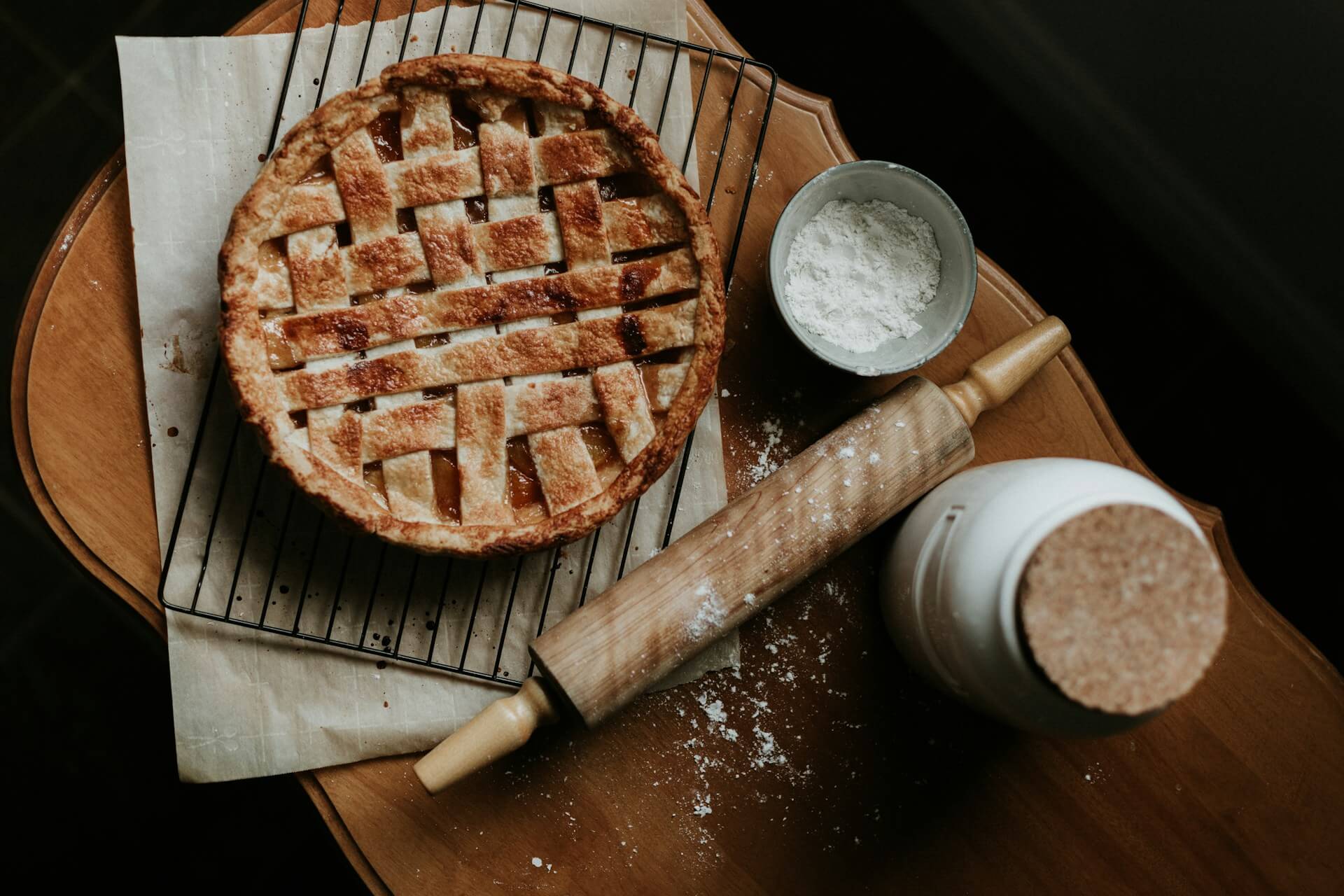
Photo by Priscilla Du Preez 🇨🇦 on Unsplash
Nobody in the lane, and nothing, nothing but blackberries,
Blackberries on either side, though on the right mainly,
A blackberry alley, going down in hooks, and a sea
Somewhere at the end of it
When our mother’s back was turned, my sister and I dug our fingers into the warm pie. We felt for stones inside the mushy fruit—feeling for a hardness, sharp at its edges. We were seven and nine.
If my father didn’t come home, my mother retreated to her bedroom at the far end of the house, drew the curtains, and closed the door. Sometimes she left a pie—rhubarb, plum, or blackberry—on the kitchen counter, covered with a faded tea towel. Alone, I placed my hands over the pie, feeling warmth rise through the cloth.
My mother never removed the pits from the black plums. If they were ripe enough, she quartered them with a small sharp knife, tossed them in sugar, then placed them gently on top of the pastry lined pie dish—stones and all.
The stones became markers of chance and fate.
I can still see my small mother in her mouse-brown sweater, its neck high at the throat, sleeves rolled up to the elbows. Her eyes a pale grey or green, depending on her mood.
My mother used to say she had a washerwoman's hands—fingers bent and trembling, stiff from years of twisting and wringing out damp cloths. It was a silent rhythm, broken now and then with a low sigh. When my father came home late, carrying the smell of another woman, she scrubbed the same corner of the floor over and over, as if doing so would make her feel better.
Her resignation and frustration—along with her loneliness and sorrow–were placed inside the gas oven.
From the other end of the table, I watched her.
She shook flour from a crumpled bag. It fell in a soft cloud, settling like powder paint. She spread it out with the flat of her palm—fast and certain—then smoothed it with her fingers.
I see now—she moved quickly to stay ahead of her feelings.
She made the pastry from scratch in an old, chipped bowl with fine spidery cracks. She sifted flour and salt, rubbed in butter, lifting her hands to keep it light as if she was conjuring something out of thin air. I was always convinced my mother had magical powers.
She worked in cold water with a knife, always finishing that part quickly.
“Stir with a knife, stir up strife,” she warned.
I started at the light thud of the knife as she placed it on the table.
She kneaded the dough until it held together, then dusted the table and rolling pin with flour.
The motion began: back and forth, side to side.
No sound. Just the roll, thump, roll of the pin. Then nothing.
*
I could read my mother’s tension in each of her movements. I tried to reconcile her silence with the arguments she had had with my father the night before. On a scale, I measured the slamming of doors and rising of voices, the breaking of objects, and the eventual dragging of her suitcase from the top of the wardrobe, the one she never left the house with.
My sister and I listened, our knees crunched into our chests.
“Shush. It’s ok,” she said, holding my hand so tight I thought it would break.
The day after a fight, my mother would leave her suitcase by the front door. Then she’d bake—a fruit pie or a cake—moving through the kitchen in silence. Every sound felt louder than it should have: the clatter of a spoon, the drop of a knife.
She didn’t speak but I read her like the weather—watching for signs of a sudden drop in barometric pressure.
Would she stay? Would she go?
*
The plums were soft and ripe, bought at the market the day before. I watched a man smile, twisting the brown paper bag shut before handing it to my mother.
My father had once promised her he would plant a Victoria plum tree in the garden but that never happened. One summer, he planted a Greengage instead, but it never fully flowered, its only fruit stony and unripe.
“These are like bullets!” my mother said, her voice tight with disappointment.
I wanted to eat one of the sweet plums on the way home, but my mother always said no, clutching the bag close to her. I had learned to never ask twice. Her wartime childhood made moments of lightness and joy especially scarce, depriving her of the capacity to experience or bestow them.
While the pastry rested, the fruit—if underripe or too firm—was cut into pieces and stewed in a saucepan over a low heat, to the point of near disintegration. Sugar was added along with a little flour to bind, then simmered until it reached a jammy sweetness. My mother stirred it with a wooden spoon to prevent it from burning.
The kitchen was filled with a warm and deep smell.
Tartness gave way to tenderness.
For a while, she watched the birds land and fly from the branches through the window.
Then, for her first drink of the day, she crouched on one knee and took a deep swallow from a dark bottle, stashed in the far cupboard under the sink, closest to the oven.
“Don’t tell your father,” she snapped if she caught me watching her.
After the fruit had cooled, she spooned it into the pastry-lined pie dish. A second round of pastry was gently laid on top. She trimmed the excess with a tarnished butter knife. Then, with the blunt end, she pressed the edges firmly closed as if sealing something in.
Two quick gashes in the center.
I never understood why she took so much time over it only to ruin it like that.
The pie was placed inside the gas oven. Gas mark 6. The window was opened to keep the glass from steaming up.
*
A gas oven, compact and white, was central to the claustrophobic kitchen of the childhood house. Stillness felt heavier than air. Now when I picture my mother, I can’t help but imagine her body—on her knees in front of it.
I wonder how many times the thought crossed her mind.
The oven was a silent witness to her desolation.
I’ve always been drawn to Sylvia Plath. I imagine her alone in that London flat—radiators cold, thin walls pressing in, her children’s cries echoing down stairwells.
Their doctors freely handed out small blue benzodiazepines, tucked into tiny white envelopes. They promised relief but only numbed the senses. I remember my mother’s pill bottle sitting on her bedside table, close enough for her to reach in the early light.
Valium was not prescribed to heal—only to endure. It just pressed the pain down so deep it couldn’t surface.
In February 1963, Sylvia Plath placed milk and bread by her children’s beds upstairs. Then, after carefully sealing the kitchen door, she turned on the oven and gassed herself. She was thirty.
I cried when I first read that.
That spring, my mother turned thirty-one.
She pushed my brother’s pram across the footbridge, gripping my sister’s coat sleeve. The river below moved quickly. She always stopped halfway, staring down at the dark water, considering her options: the art school she never attended, the washing on the line, the milk bottles. A husband who did not come home. Some kind of freedom that eluded her.
In the end, my mother chose a slow form of suicide. A bitter surrender. I was thirteen—my unlucky year. She nurtured a lump in her breast. Instead of going to the doctor, she tended to the hardening, feeling its smooth edges expand each day. She carried her pain in her body, dying slowly on her own terms.
All the while she made pies, making something sweet out of something hard.
I am the daughter of a woman who didn’t fight for herself. Her unfinished life lives in me.
My mother’s grave is in a Devon village, overlooking an estuary. Sylvia’s is far away, high in the lonely Pennine hills. Though separated by circumstances, their stories are linked with loneliness and longing. I feel bound to both.
*
My sister always found more stones than me, in a cherry or a plum pie. We lined them up between us, counting them out to see who we’d marry.
Tinker. Tailor. Soldier. Sailor.
“What’s a tinker?” I asked.
“You always ask that,” my sister said, flicking another stone into her pile.
“You will never have a husband,” my sister declared when I had no stones at all.
When it was blackberry pie, we had to gather the fruit ourselves. My mother sent us outside to find them—down the road, up the lane, out in the high-tangled brambles in the garden. My mother gave us an old silver colander to collect them in—dented from being thrown across the kitchen in my father’s direction.
We saw nothing, nothing but blackberries.
Trying to avoid the thorns, I picked the little pale green ones, but my sister scolded me, taking on our mother’s voice.
“Those aren’t ready yet!”
The ripe ones looked like flies to me. I didn’t want to touch them.
My sister stood on tiptoes, reaching for the fullest and blackest ones. She popped them into her mouth, one after another. Her lips turned dark like my mother’s after she drank red wine. Her fingers were stained too.
“Mummy said don’t eat them,” I warned, but she knew I wouldn’t tell.
To appease me, my sister put a blackberry in my mouth. I let it rest on my tongue.
“Go on,” she whispered.
It swelled with a dark sweetness, tinged with something sour. She wiped her fingers on her skirt. I said nothing.
We carried the rest inside.
My mother took one look at my mouth and raised her hand. The smack landed fast, across my cheek, sharp and stinging. I didn’t cry. I tasted blackberry on the inside of my lip.
My sister smiled, with tears in her eyes, swallowing a hard truth.
*
Years later, when I roll out pastry at my own kitchen table, the cool surface presses against my forearms. This happens once or twice a year.
I feel the weight of my mother’s hands as my own.
I push up my sleeve with my chin and elbow. Flour always gets on my nose. If I had a husband, perhaps he would brush it away with a laugh, a quick squeeze of my waist for good measure.
I find a kind of healing in the silence, with things unsaid—a quiet knowing in a moment without edges.
As I fold and press the pastry, I conjure my mother. I feel the years unraveling toward her magical powers, the alchemy of turning hardness into sweetness.