Creative Nonfiction
Casey Horner
For Unsplash+
Wilderness is not a luxury but a necessity of
the human spirit. — Edward Abbey
Perhaps it is the angle of light, turning the beige and gold carpet the same color as the dried grass outside my window that sparks this peculiar déjà vu.
Perhaps it is because that grass gently bends in the breeze, just like the grass did on the Cape Solitude Trail ten years ago on another October day when we were lost, obvious tenderfoots in an alien landscape.
That day, that day I can so vividly remember, we had been walking for six hours following a trail across the desert between the rim of the Grand Canyon and the Painted Desert. The contours of the canyon and pastel hues of the desert were hidden from view. We were in a deep wash, and we could not find the trail.
On our map, the trail paralleled the boundary of the Diné Nation. We were trying to find a fence that followed that invisible line. There, we were to enter a gate, continue a few hundred yards, and cross back through another gate…or so said the directions we had which the map confirmed.
We could not find the fence. For forty-five minutes we’d wandered in a sandy bottomed wash, criss-crossed with trails running through brittle grass and thorny brush. Every intersection required another decision. We had backtracked and still, no fence. We meandered around some more in the slanting light but only found a ruined hogan with crumbling walls and caved in roof. Frustrated and thinking some altitude would give us a different perspective, we bushwhacked up the slope. There, we found the fence but no gate. It was getting late. It would be dark in two hours, and we had no idea where we were.
After a day of walking, we were tired. We were hot, and we were dirty. There is no water on this trail that tracks thirteen miles across the desert. No toilet, no emergency phone, no friendly ranger station, no designated campsite, no people. We had not seen any hikers that day and would not until three days later when we returned to the parking lot at the head of the trail.
The extraordinary isolation of it registered as a slowly tightening knot in the pit of my stomach which grew with every step taken. To be so alone, to have no cell phone service, to look across as far as the eye could see, a landscape filled with rocks, mesas, buttes, and unfriendly vegetation not to mention unfriendly reptiles, and know that we were on our own only magnified the discomfort of being lost. No one had our backs.
We had been warned. One morning before we left, I stood outside the Watch Tower next to a former co-worker, a Diné man whose name was Anselma. We were enjoying the quiet and soft light of predawn turning the palisades muted shades of purple. Anselma told me he had met two women the night before who were hiking to The Confluence, that place where the Little Colorado, having snaked its way through the Painted Desert, meets the mighty Colorado River. A place sacred to the indigenous people of this area. The place the Hopi believe their ancestors entered this world through the sipapu, a huge travertine dome and spring at the bottom of the canyon. He hoped the women were okay.
Thinking of the narrow trails I knew running down steep canyon walls with hundreds of feet of drop off, I mentioned that the plateau they would cross looked flat from where we stood. “Yes,” he said, in that slow thoughtful way of other Diné I had met speak. “But there are other dangers out there.”
Something in his tone made the hair follicles on the back of my neck contract. “What do you mean?” I asked.
“Things can go wrong.”
I looked at him, but he offered no explanation, just continued to stare across the abyss between us and the plateau minding his own thoughts.
I was thinking of that conversation as Max, my husband and I discussed our options. We had been lost before. This was not unusual for us when we hiked, but not this kind of lost. Don’t panic I reminded myself. Don’t remember all the accounts of hikers who died from heat and dehydration you have read about. But of course, I did. Disaster coursed through my brain in a nanosecond leaving behind an adrenalin trail of worry and second guesses. Desert hiking, and the Grand Canyon in particular, are not places where you can make many mistakes. I hoped this was not one of them.
Since the map showed the trail running parallel to the fence, we decided to follow the line of wire and hoped we would eventually find a landmark on the map. We were on an open plain studded with rabbitbrush, cholla and sage. Cedar Mountain, our known landmark had disappeared, and the unknown, to us, Navajo Mountain rose on the horizon. The terrain offered no sheltering trees or rocks for a campsite as the sun drew closer to that line between heaven and earth.
Then, while once again turning right and left to survey our surroundings, the angling light highlighted the sparse grass in such a way as to reveal a trail moving off behind us. We didn’t know where we were, but at least we were on a barely discernible jeep track. For now, the dread and “what ifs” lifted. We had found a trail. We’d figure out the rest in the morning.
From where I had stood with Anselma that morning, the terrain Cape Solitude traversed looked like a sage-green, patch-worked quilt thrown over a lumpy bed. The trail was a jeep road until the 1990s. Looking at the axle breaking switch backs we wound down when we started our hike that morning, it was not surprising that twenty-five years later the road had faded to a path requiring considerable attention to follow.
Two years before, we had the privilege to live in the Grand Canyon National Park. Often, I walked to work on a path through a tiny forest, then home again under the Milky Way. From the second floor of our curiously modern staff apartment building, I could look out over the tops of trees south to the majestic snow-covered San Francisco Peaks. It was a landscape totally unfamiliar to my East Coast eyes. Everything I thought I knew about the natural world required revision in this foreign land.
The Cape Solitude Trail is a twenty-six mile out and back hike. We had followed Cedar Mountain Road from Desert View through the pigmy juniper and pinyon forest that borders the rim of the canyon. The trees thinned at the bottom of the switchbacks giving way to thorny brush and spectacular views. The road to Cedar Mountain, a flat-topped, fossilized, cinder cone we had hiked to in the past, continued to the right and the trail to The Confluence headed north. Earlier in the week we had cached two gallons of water in the brush off the tail. We were pleased to find them undisturbed.
Being in the desert without a water source is a serious challenge. “The Secret Knowledge of Water,” Graig Childs’ beautiful and nail-biting account of his search for water in the American Southwest changed the way I thought about water in the desert. Childs described finding small swimming pool sized pools of water atop mesas or refilling his water bottle by gently removing rocks to find an underground stream. Yet the cover of the book still proclaimed: “There are two easy ways to die in the desert, thirst and drowning.” While my thinking about water in the desert changed, my ability to find it beyond the obvious river or spring had not. Childs had decades of experience in the Southwest, I was a newcomer.
Still, more people drown in the desert than die from dehydration. How curious to be in a place where both things can exist simultaneously, an oxymoron only accounted for by the power of water and a certain topography channeling thousands of gallons of water through tight canyons and dry riverbeds. Here unsuspecting hikers, who set up camp in an arroyo on a bright and sunny day, might wake to the sound of rushing water during the night. The lucky ones make it to higher ground before a slurry of water, rocks and debris rolls through their campsite wiping out everything in its path.
Drowning though was not foremost on my mind that day, thirst was. What I know is that people can survive for about three days without water, but climate (desert) and activity (hiking) significantly influence dehydration, and dehydration significantly influences cognition and impaired cognition will influence your survival. For several weeks we had poured over backpacking accounts and talked to more experienced desert hikers hoping to learn how much water we would need for our three-day journey. Although we settled on a gallon of water per person per day, we never really felt comfortable with that decision.
There were so many variables, those things that “could go wrong,” that would determine how much water we would need. If injured, it would take longer to hike out, and the wandering back and forth to find the trail would extend our walk beyond the twenty-six miles. I read several accounts where hikers logged as many as thirty-five miles. For us, nine extra miles could translate as another day of hiking, requiring another day of water which we did not have.
We had planned the hike for mid-October counting on cooler weather. It was not. The Arizona sun turned mid-seventies temperatures into scorching heat, shade was minimal and all those heat radiating rocks only magnified our discomfort. Every time I sucked down a mouthful of water I wondered if I really needed it or could I wait.
At the end of the first day, we were grateful to finally set up camp. Since there were no designated campsites and it would soon be dark, we opted for a flat open area amongst all the scrubby bushes. I set up my tent. I was willing to add the weight of a one-person tent to what I carry because the idea of waking up with critters inside my sleeping bag was more than I could bear. My minimalist husband settled for a ground cloth as he claimed not to share my aversion for small crawly things.
We boiled some of our precious water for dinner and watched the mesa to the east turn salmon-pink with the sun’s reflected light. While we waited for our beans to rehydrate, Max asked what I thought the small holes around the base of the bush next to the rock we were sitting on were. “I think they are tarantula dens.” I said, lifting a spoon of chili to my mouth. Neither Max nor I had seen a tarantula outside of a zoo before we moved to Arizona, so I am not positive that those quarter sized holes dug at the base of the bush belonged to that spider. We had seen rust and black colored tarantulas from time to time walking across the trail when we were hiking. These holes looked like the size one of those spiders could call home.
Despite their reputation, tarantulas are not toxic to humans. Those who know describe their bite as something like a bee sting. Of more concern was the urticating hairs on their abdomens that when feeling threatened their superpower is to kick them off into the air to create a tiny cloud of flying barbed hairs for defense. Depending on where they land, those hairs can cause considerable damage. Thinking about the proximity of tarantulas as we finished our supper, I was glad they were one thing I did not need to worry about while asleep in my tent.
Sunset in October comes early; by six-thirty I had stretched out inside my cozy shelter and Max had moved his sleeping bag next to the door. We watched the stars light the heavens and told stories until the Milky Way gleamed across the inky firmament. At home, in Pennsylvania, the stars look flat and far away. Here, in our new home, they have depth like a hologram. That night, they hung so low it felt as though with one giant leap, I could walk around them like statues in some celestial garden.
Perhaps, all of this beauty and finding a trail had eased our worries. We didn’t talk about being lost, we didn’t talk about what we would do the next day. The decision in the morning would be whether to continue or turn back, whether to risk losing the thin thread back to home or play it safe and retreat.
“Things go wrong,” I hear Anselma’s voice in my head while lying there, watching the stars, my fingers probing the tender spot on my knee. I was surprised the bump was not bigger. Earlier in the day my toe caught a rock and a stumble I would have easily recovered from had I not been carrying a twenty-five-pound pack, sent me sprawling to the ground. The force of my pack rolled me from tail to head like a small boat on rough water. Again, I wondered, why was I doing this.
This was a difficult hike even if elevation change was rolling hills and not canyon walls. Granted, a twenty-year-old in good desert-hiking condition would shrug it off, probably do the twenty-six miles out and back in one go. But I’m not a twenty-year-old.
When friends asked why, which they did with some disbelief and the unspoken —are you out of your wee mind, I shrugged and said something like I wanted a challenge for my sixty-fifth birthday. I didn’t want the over the hill, time to retire, life retrospective sort of party. I wanted to see what I needed to navigate the next part of my life.
But in the quiet of moonless nights, I dreamed that perhaps the desert was a crucible, a place where heat, thirst and danger burned away my fears; perhaps those fears were the only things that held me back.
I told myself, there was little time left.
There was something about this place that was so alien to everything that I knew, the enormity of being so alone and out of touch that set me on edge and yet I could not resist. It was both exhilarating and unnerving. There was something almost tangible about the wildness of it all. Something I could touch, see, and hear.
Sometimes, standing on the rim of the canyon, an invisible force rose out of that space so strong I felt it would blow me off my feet. Sometimes, it was a sustained note on a finely tuned flute that set the universe vibrating. Fear, yes, and anxiety braided with something else that was vast, wild, and intoxicating. I came to know that on these hikes there were no celestial gardens without that accompanying knot of fear.
I heard it that first morning when I woke, sweeping across the desert settling against my heart burrowing deep, pricking at my confidence. What do we do as we rise to face this day? How do we face our lostness?
Both of us had enough of that uneasiness to say: What the heck, let’s go back. Why do this? Turn around while we still can. But something I could not explain pushed me to continue while Max had his doubts. We didn’t decide but made breakfast instead.
Perhaps it was the caffeine. Perhaps it was a compromise to hike on for a few hours and see how difficult it was. Perhaps neither of us wanted to be the one to say: Let’s go home.
We left camp set up on that lonely spot stowing our few belongings in my tent and carrying only enough food and water for the day. We estimated we were about three miles from The Confluence. But the unrelenting sun ground us into the dirt. It was as though some cosmic prism bent beams of sunlight scorching everything it touched including us. The farther we went, the hotter it got. As the vegetation thinned and the horizon flattened, it was harder to determine our progress. Dust covered my hands and face while sweat stiffly starched my tee. No amount of balm could soothe my lips or water wash away the grit accumulating on my teeth. In a few hours, we questioned the wisdom of pushing on.
The trail curved north toward the uplift that we thought was the rim of the Grand Canyon. There, we were sure we would be able to see the mighty Colorado heading for the Gulf of California. We gave ourselves another half hour before we would make the decision to go on or turn back.
Tourists have told me that they were disappointed when they visited the Grand Canyon. They felt underwhelmed. “This is it?” They puzzled looking around, hoping I would tell them they had missed that special something.
I have hiked there more times than I can count on both hands.
I will only say that disappointment was never my experience.
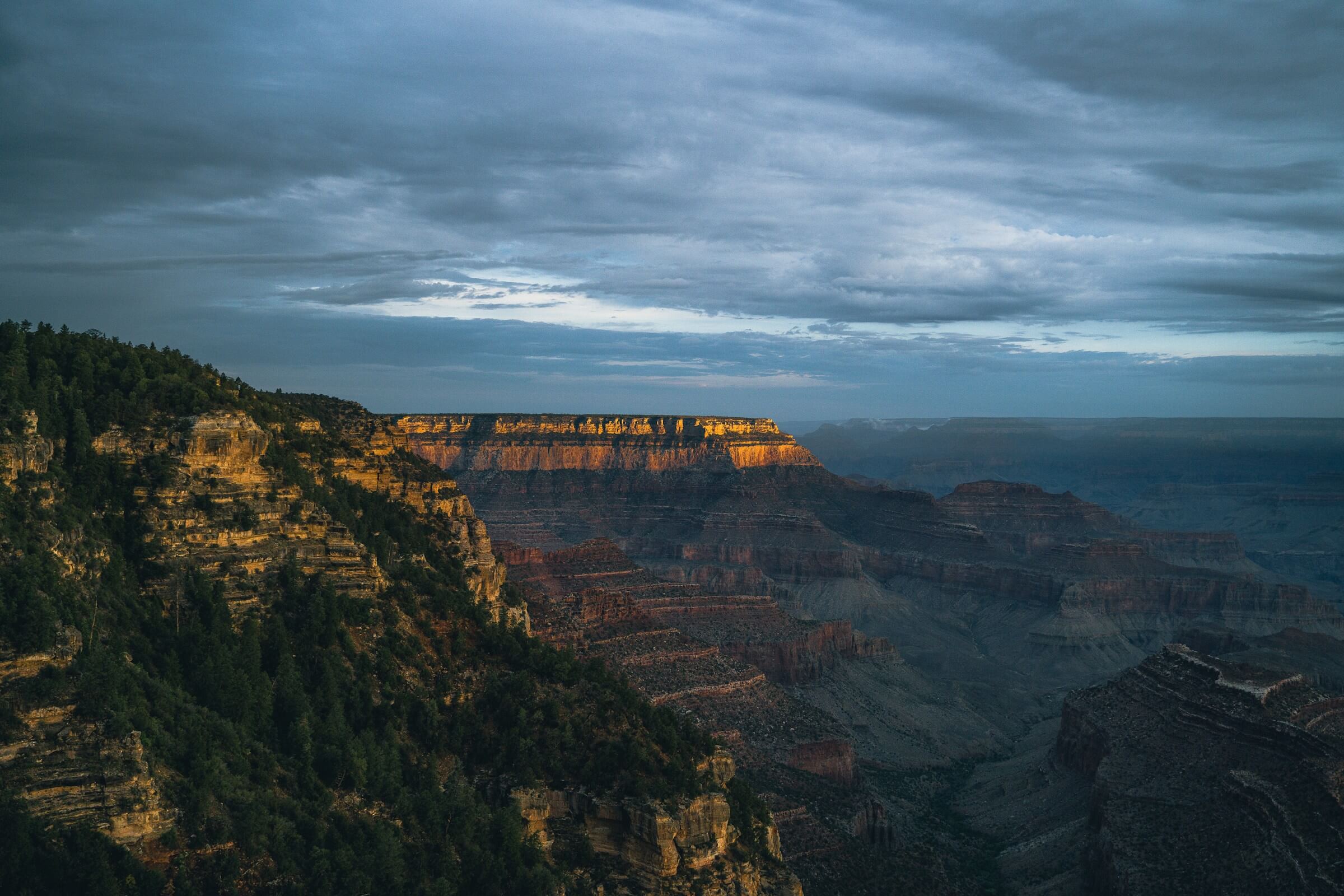
As I crested the uplift and stepped to the edge, tears filled my eyes. We were no longer lost. Below us the river, dwarfed by thousands of feet of open air, wound through the canyon; its terrible rapids reduced to glimmers of sunlight. These were not the turquoise waters of the Little Colorado merging with the red river we had hoped for, that confluence would be another two miles east. But now, below our dusty boots, the mighty Colorado curved within the confines of rocks so ancient that a billion years of geological time is lost in the Great Unconformity strata. The river’s rapids winked in the sun and the piercing sound of flutes in a soundless sky rose out of that boundless space.
I don’t understand why this place of rock, wind, and water moves me so deeply? Why seeing millions of years of geologic time spread out on thousands of feet of solid rock hurts my chest. I don’t understand this awe pulsing through my body. It is undefinable, transformative and it is fragile. Like magic, it will disappear in a whisper.
**
The next morning, a light breeze whispered through the tent flap carrying with it the sweet scent of sage and memories. Sleepily, I rubbed my sunburned face, hands smelling of chocolate and coffee with undertones of sweat and dust; the horizon, a pewter line in the wakening dawn.
Through the roof screen, the stars that had patterned the heavens the night before, were no longer visible. Something large, burned silver in the northeast, maybe a planet or satellite reflecting the approaching sun as we turned to face a new day. Like countless people before, I felt the promise returning light brings.
I remember watching my granddaughter riding a horse one winter day. She was working hard with her trainer; I marveled at how proficient she’d become in the year since she started lessons. When the class was over, she led Cisco to the stable, her voice bubbled with joy as she talked to me, unsaddled the horse, and offered treats. I asked her if she felt that happiness when she was riding? She paused then said, “No, I’m too busy thinking about what I have to do, but I feel happy when I am done.”
Backpacking is like that for me. That morning, I felt happy. Yesterday, had been arduous. We had made the right decision to not press on to The Confluence. It would have been dangerous for us to spend even more time exposed. That is when “things go wrong.” After eating lunch on the rim, we rested and watched ravens cavorting, before walking back to camp in the blast furnace heat.
The tent profile gave us a sliver of shade from the unrelenting sun. We sat in its meager shelter calculating how much water we would need for dinner and breakfast and our walk out taking small sips from our hydration packs and dampening our tee shirts in an attempt to cool down. Once the sun dropped toward the horizon and it was cool enough to do our few chores, we made supper and crawled into our sleeping bags.
Sometime during the night, I heard the zipper of my tent being pulled open and Max squeezed in. He was fatigued and grumpy and had little tolerance left for musing on the nocturnal habits of tarantulas. If the truth be told, I was not happy to share my little space even if it gave him peace. My first response was annoyance at being woken from a sound sleep, sleep I knew would be difficult for me to find again now cramped between a rock and his body curled around mine. I was right, I soon heard his soft snoring while I stared at the stars.
We love, support and annoy each other out here. I am often disturbed by his lack of preparedness: no tent and he is equally dismayed by all the things I worry about. Do we balance each other out? I don’t know. On our good days, we give shelter and forgiveness to each other as we travel through this world. On the other days, we growl, snap and begrudgingly give what is needed. I heard the coyotes howl and bark to each other as they hunted last night. I wondered if they did the same.
In the morning Max made coffee for me sweetened with hot chocolate, a peace offering gratefully accepted. We ate breakfast, packed our gear, and started our return to the Watch Tower. An oh so very thin veil of clouds obscured the sun and offered protection for our walk. As we made our way across the now familiar plain of golden grass, cholla and sage; and Cedar Mountain once again guided our path, I was astonished to see rainbows flash through the clouds though no rain fell. Like broken pieces of faceted glass, they shimmered periwinkle, rose and tangerine then disappeared only to reappear a few moments later in another cloud.
Cloud rainbows are a rare phenomenon. I’ve only seen them a few times. Small water droplets or ice crystals diffract the sun’s light and scatter rainbows through the thin clouds. I did not know the scientific explanation at the time, but on that morning, the cloud rainbows were just another thing that made me happy and optimistic.
The unscientific explanation, the one I am more inclined to accept without an iota of evidence, is that the Diné believe the rainbow is a symbol of protection and harmony, and that their Holy People use rainbows to communicate with the five-fingered people. I am not suggesting that the Holy People were communicating with me or protecting me that day. That would be for someone else to decide. But I can believe that all of humanity’s many “gods” do not worry so much about who’s who in the pantheon as much as we mortals do. And I can believe that being in the land of the Diné, the Holy People could send this five-fingered person encouragement.