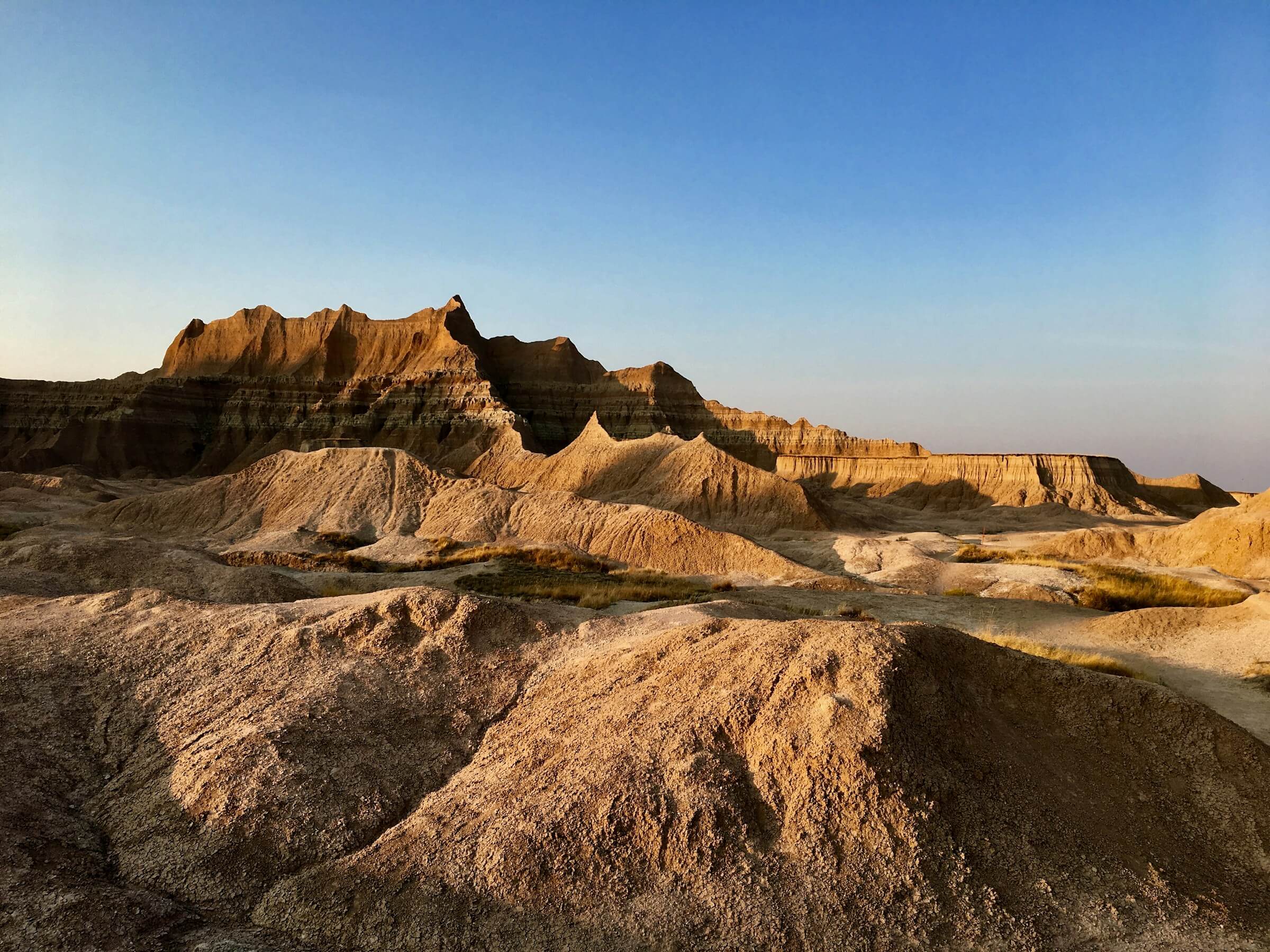
Photo by Aurora Wheeler on Unsplash
My skin is burning, the heat of the sun penetrating the top layer, leaving it red and itchy. Sweat trickles down my brow, across my forehead and into my eyes. Wiping it away with the back of my arm, I sit on my sleeping bag in the middle of the round, earthen pit. Miles away from the nearest town of Vermillion, South Dakota, high in the hills, without any distractions, I am grounded in the present. All I can do is feel. The unbearable heat. My discomfort. The hard ground beneath me. The buzz of flying insects. My utter exhaustion. After my gaze wandered around the external landscape overlooking the Vermillion River, there was only one other place to go. The internal. And as the guise of civilization fall away, the tears begin to fall down my cheeks and a gut-wrenching sob is ripped from my body. After forty-five years of avoiding sitting with myself, avoiding the inner territory of my mind, avoiding internal searching by staying so busy, so occupied that there was no time for those feelings, those thoughts to surface. But there in the hills, everything came to a screeching halt, and I was left face to face wth all of the things I had avoided my entire life.
The sobbing continues, loud and ugly, my voice turning hoarse, my throat raw, as decades of feelings are wrenched from my body. As my body convulses under the weight of those stored emotions, I lie down on the ground, and within seconds, feel Mother Earth welcome me home. There, cheek to dirt, no barrier between our skin, held tenderly in her earthen arms, heart beating loudly in my ear where it touched the ground. As my sobs slow, her hold never slackens, and the chorus of crickets chirping in the background remind me of my mother’s voice as she rocked me to sleep when I was younger, the low, melodic tone of her repeated shushing sounds grounding me. The overwhelming heat and the cathartic exhaustion dulled my senses. Lulled by the security and safety of that embrace, enveloped by the heat of the earth and the warmth of the sun, I drifted off into slumber. Blessed Silence.
This is what the quest demands, the shedding of the skin until there is no barrier between the self and the soil. The rules are simple, yet incredibly violent to a life built on busyness and momentum. No food. No water. No company. No shelter but sky. For the next twenty-four hours, the world is reduced to the diameter of the pit. It is called Hanbleveya, a crying for a vision, but lying there, cradled between earth and sky, it didn’t feel like a search for something new. Instead it became a stripping of the old, an abandonment of the emotional armor of decades, a cleansing of spiritual wounds. The Creator knew that before I could move forward, I had to leave the past and everything it entailed behind. It was about what remains when you can no longer run and no longer hide.
While I slumbered, the hills of Vermillion continued their existence, very much alive and a witness to all of time. Alongside my pit, the rolling plains, covered in tall, green waves of prairie grass came alive around me. One hill rolled into the next, the slopes soft and smooth, the lines blurring into each other, the topography of the high plains curving into half circles. Occasional zephyrs would send waves undulating through the prairie grass. Cheerful, whistling notes of Blue Jays and Dark-eyed Juncos floated on the breeze. A symphony of insects filled the warm, afternoon air. The buzzing of bees as they floated from wildflower to wildflower, accompanied by grasshoppers ticking away as they rubbed their legs against their wings, engulfed the space as nature’s orchestra began to play. As the breeze continued its journey through the prairie grass, a soft, sweeping note emerged, a texture, a whisper, delicately being shared by the land with its inhabitants. The rushing sound of buoyant water nearby, barely audible, drifted through the air.
The sounds of water and the ticking of grasshoppers are the oldest sounds of this land, a rhythmic baseline that has remained unchanged since the first seekers climbed these slopes. For centuries, the Hanbleceya, the Crying for a Vision, has been part of the sacred architecture of this geography. Long before Vermillion came to exist and way before there were fences or maps, the ancestors travelled to these hills, to these liminal spaces, borderlands where the physical world converges with the spiritual one. As the seekers climbed higher, they became physically closer to Wakan Tanka (The Great Mystery) or the Creator, the air became thinner, and the wind more honest. Atop these hills, isolated in sacred space, away from human distractions, seekers seek knowledge from The Great Mystery and ask for wisdom to help them live better lives.
When you are high in the hills, you are visible from every direction. There is no shade, no hiding away, no obscuring in the shadows. The history of the vision quest is a history of total transparency. Here, atop the hill, the spirits can see you clearly. Here, atop the hill, you are stripped of your titles, your work and your distractions. Down in the valley, the trees provide shelter, places to hide, and the river drowns out the sounds of one’s thoughts. But up here, there is only the prairie and the unblinking eye of the sun. The history of the quest is written into the dirt of the hills, in a place where the world is its widest, and the self its smallest. Lying in the pit, realizing it has been dug a thousand times before by a thousand other hands, all crying for a vision, all seeking the truth, the latest in a long line of the many who came before you. Predecessors sought as you seek, suffered as you suffer, a fine, silver thread connects you to those who came before and to all those who will follow.
The sounds of voices rising in song awaken me, and for a moment, I cannot remember where I am or what I’m doing there. A deep vibrating hum emanates from the land around me, words and phrases in a language I don’t understand, but the feeling behind them were as clear as the bright, sunny day. The words, sung in a deeply, harmonious tone resplendent with awe, respect and humility, resonated deeply within me, and even my unknowing did little to obscure the meaning.
Wocekiye Olowan (Prayer Song)
Tunkasila wakanmaya yelo hi.
Tunkasila wakanmaya yelo hi.
Tunkasila wakanmaya,
wakanmaya yelo hi.
Tunkasila wakanmaya yelo hi.
Tunkasila wakanmaya,
wakanmaya yelo hi.
Tunkasila wakanmaya yelo hi.
Tunkasila wakanmaya yelo hi.
Tunkasila wakanmaya,
wakanmaya yelo hi.
Tunkasila wakanmaya yelo hi.
Tunkasila wakanmaya,
wakanmaya yelo hi.
Grandfather, makes me sacred (holy).
Grandfather, makes me sacred (holy).
Grandfather, makes me sacred (holy),
make me sacred (holy).
Grandfather, makes me sacred (holy).
Grandfather, makes me sacred (holy).
makes me sacred (holy).
Grandfather, makes me sacred (holy).
Grandfather, makes me sacred (holy).
Grandfather, makes me sacred (holy),
make me sacred (holy).
Grandfather, makes me sacred (holy).
Grandfather, makes me sacred (holy).
makes me sacred (holy).
As the voices of the other men and women on the hill rose in unison, the wind picked up, grasping the music in its caress, carrying it far and wide, sharing it with the sun, the birds, the trees before letting it land softly on the prairie grass to be dispersed into the earth itself. Along with the sounds of the song, I exhaled the weight of a lifetime spent running, finding it quickly engulfed in the rushes and swirls of the breeze, sighed away, now light as a feather.
A rich, warm and sweet aroma wafts into the pit with the breeze, the earthy, sweet smell of the sacred tobacco apricated by the golden rays of the sun. Tobacco, prayers and intention filling each and every one of the small, sacred bundles circling the pit. The prayer ties represent the four cardinal directions, yellow for the East, red for the South, black for the West and white for the North. The four sacred colors of the Medicine Wheel embodied in the four hundred and five prayer ties marking the perimeter of the seekers site, delineating the veil between the physical world and the spiritual realm. The lush, verdant countryside lay in stark contrast to the bright ties, connected into a single, continuous string by a succession of string knots. To my left, my altar stood, with my chanupa in its center. The red, painted stalk of the choke cherry, an abalone shell, an Eagle feather, more prayer ties, along with prayer flags representing the four sacred colors, but with an added swatch of blue and green. The blue for Wakan Tanka, who dwells above, much like the Eagle, soaring speedily across the shining canopy of the sub-bleached blue sky, taking our prayers with it. The green for Mother Earth, who encompasses the soil, the bountiful nourishment she bears forth, the gracious green grass, the galleon green of deep, dark forests, the gossamer waves of the prairie grass and the ultimate cradle of life.
Watching the golden arc of the sun as it makes its way across the sky, shadows growing in one direction, shortening in another, I sit cross-legged in the pit, my heartbeat serving as a clock, every beat a second of the minutes and hours passing by. My throat, now a raw ache from the intensity of my wailing, becoming drier as the hours roll by. Fasting for twenty-fours didn’t cause any physical discomfort, but the thirst, the recognition of water’s life-sustaining force, that water is life, Mní wičhóni, reminded me that water is a living relative and the first medicine. Letting my gaze wander across the earthen carpet around me, I notice a singular ant, my surroundings fading to black around it, my vision narrowing down to that single being.
The small black ant with its segmented body, narrow waist and six legs meanders across the pit slowly, surely, securely in a serrated cadence. From the ant’s perspective the pebbles littering the terrain are massive boulders, the dry, cracked earth canyons and blades of grass thick forests. Intuitively I knew that the ant was female, a worker ant, who had set out to forage for food that morning, her sole purpose narrowing to the need to secure the future of her colony. Seemingly navigating a phantom path, tracing her way back to the colony, a chemical pheromone trail previously laid serves as an internal GPS. Along the way she uses her compound eyes to identify landmarks, memorize her surroundings all while taking note of the sun’s position to maintain her bearings, her antennae tracking the journey to and from the nest. Closing my eyes, I center myself before returning my stare to the ant. In that brief second, she has picked up a fragment of a leaf, one nearly as large as her entire body. The fragment was a muted, dusty gray green, with jagged edges and a protruding, sharp corner, and even from a distance its brittleness was physically visible. Hoisted above its head by its jaw-like mandibles, the ant stumbled, quickly adjusting her stance before anchoring her feet into the ground and redistributing her weight. Stable now, she continued her journey.
Witnessing her progress across the pit held me completely captivated. Her small, unassuming movements possessed an astonishing amount of weight. After a short distance, the ant would unload her cargo, drop the leaf to the ground and stand motionless, the sole source of movement her antennae. They begin sweeping back and forward in what seems to be an arc, no longer restricted of movement, quickly gathering sensory input, reading the air. Seconds go by and she stands still, no fretting and no pacing, Fully immersed in the moment, her lack of doing does not seem to bother her in the slightest. There is dignity in the stop, a recalibration, not a failure of strength, but rather the preservation of it. For the ant, the stop isn’t about avoidance, instead it is a clinical, necessary integration with the environment, her commitment to stillness identical her commitment to movement. Productivity replaced with presence.
A deep resonance with the ant bloomed in my chest, surging though my veins to envelop my entire body. As she stood proudly in the hot heat of the afternoon sun, no longer encumbered with her heavy burden, I grasped the meaning behind her visit. The leaf is a resource, it is not the ant. Just as my responsibilities and the burdens I carry are not me. At some point the weight that I carried ceased being something I had, evolving into who I was, the weight of it crushing me. But like the ant, I needed to exist alongside the burden rather than underneath it. Exhausted and raw I sat in the pit, motionless in the red dust, and my friend the ant stood right beside me. Both of us held by the same earthen arms, both of us finally, intentionally still. Watching her trek across the ground, release the leaf, take an intentional break, before once again hoisting the leaf into the air and picking up where she left off, I realized the lesson.
As the sun made its way overhead, afternoon turned to evening. The radiant hues of azure slowly begin to fade away before being replaced with the vivid colors of sunset. Vibrant swatches of fiery orange, vermilion and soft magenta painted the sky. The sweltering heat of the day began dissipating, the sun slowly loosening its grip and allowing dusk to take its place. Gone from sight, but not from mind, the ant had long made its exit, well underway on her journey home. Cooling temperatures brought cooler breezes, and the first drops of rain hit the ground around me. Completely exhausted, I curl into my sleeping bag, letting the rain wash away my burdens and cleanse my weary soul. Looking up into the deep, dark abyss, the moon rested high in her splendor, casting shadows over the living. A blanket of darkness lay draped softly across the line of trees. Wildlife, safely tucked away, passed away the waning darkness in deep slumber. Closing my eyes, I join them.
Once again, I woke to more music, the sounds of the hillside waking alongside me. The sun started to climb, a vibrant explosion of oranges, purples, pinks and yellows beginning their orchestra across the sky, the first stirring of life quickened beneath that pastoral view. Notes of bright, fiery orange are joined by the quick staccato of pinks and purples. Soft pastel yellow flutters its way across the horizon, weaving itself amongst the other colors, a tenuto in the musical score. Flushing the heavens with color, the last vestiges of the night transition from black to blue, the slumbering giant star ascending, slowly burning away the dew that lingering on the tall prairie grass around me, drying the delicate drops lingering on flower petals, and bringing warmth to the morning. Rising from my prone position, I sit wrapped in the warmth of my sleeping bag and observe the world coming to life around me. Another light breeze works its way across the countryside, playing with the grass, occasionally sending my hair twirling.
That external inventory was quickly followed by another internal one, only this time, the crushing emotional weight of the day before had vanished. I could breathe freely. My shoulders no longer felt tight. Still clasped firmly in those earthen arms, I allowed myself to feel, to be, to sit, fully encompassed in the moment. I felt the warmth of the sun slowly warm my skin, the soft caress of the wind graze across my cheek, the deep drag of my breath and the expansion of my lungs as I inhale. A profound shift had occurred there in that sacred space, my heart felt freer, my soul light as a feather. The unbearable weight of forty-five years of busyness lifted. The unbearable weight of forty-five years of busyness set down.