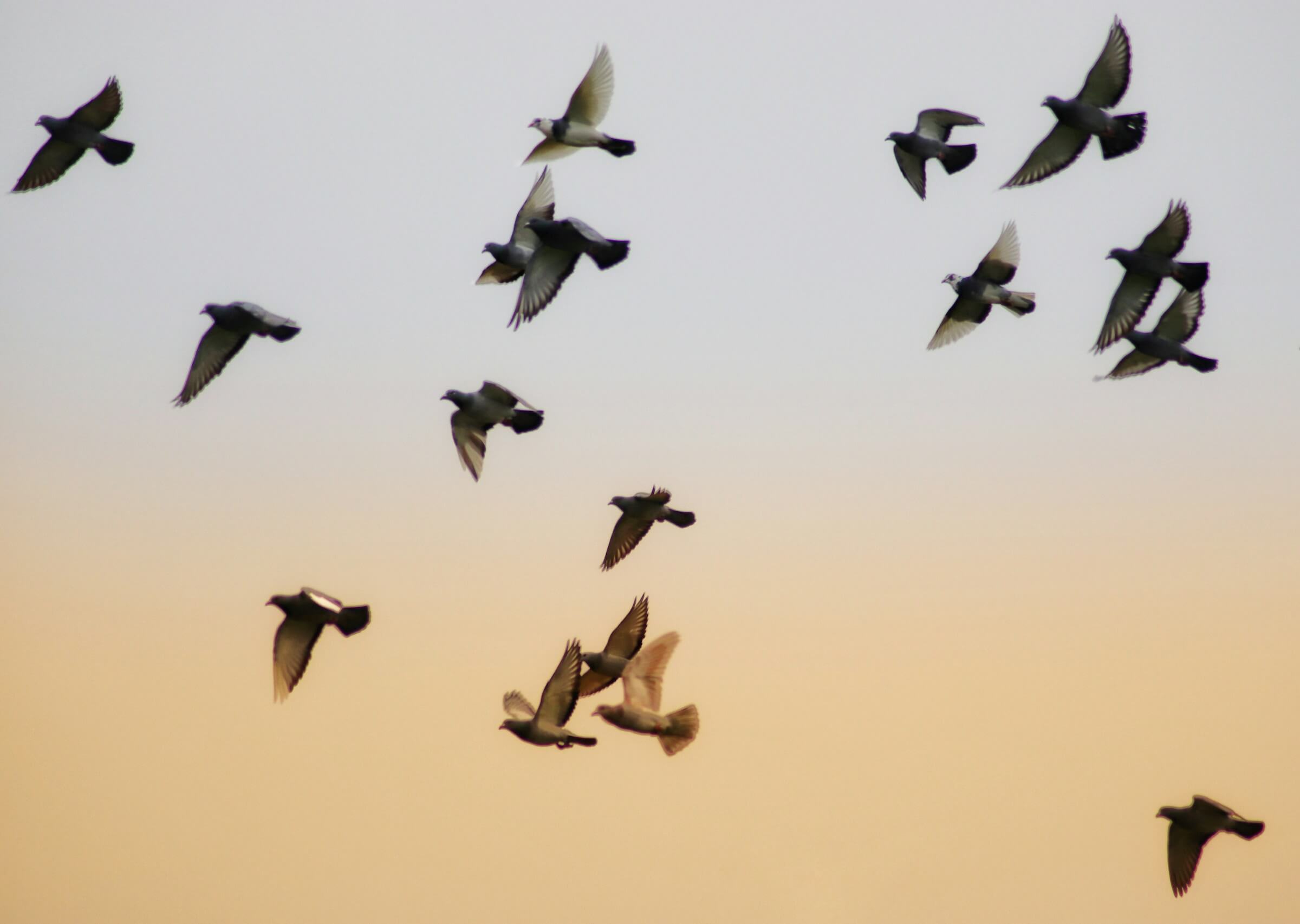
Photo by Catherine Leclef on Unsplash
There used to be mourning doves outside my bedroom window, and over the years I watched generations of grey birds nest in the same planter pot perched on top of the baker’s rack on my patio, where it stood with its back against the glass separating it from the bedroom. The dawn brought with it motherly “coos” and the chirping of hungry hatchlings, and the sunlight would streak in through the bare blinds and drape the shadows of birds across him as he slept. The last sunrise at that residence carried with it no chirps, no fluttering of feathers, no cries squalled between little beaks, no breath besides my own filling the bedroom. No echoes of Moon River sang softly as a lullaby from the night before remained, and no songbird slept beneath the sheets next to me.
I have a new view now that overlooks a nature preserve, where a trail bordered by trees and thick brush winds around in a half-moon loop by the pond below and leads uphill to a field of cattle. Here, a cacophony of avian calls comes through my bedroom window throughout the day. By midmorning, house sparrows have come out of their soffits, while pigeons occupy the eaves around my balcony, and crows and blackbirds call out from a tree line of American elms that border the walking trail. Woodpeckers, blue jays, and Carolina chickadees perch among the cottonwood and black locust trees. In the high sun, a red-tailed hawk accompanies a patrol of turkey vultures that circle the sky. Canada geese, herons, and cranes settle in the pond at dusk. As the sun sets there begins a chorus of crickets, amphibian croaks, and the splashing of nutria: a sewer-water symphony orchestrating this little space of suburban wild. When I awake, it is to the sound of cardinals clamoring in the morning light as it breaks over the canopy of trees.
Mourning doves usually have their broods in batches of two, though occasionally they will lay a single egg. In that final nest, there were two chicks, still small, covered in downy feathers, calling out for their mother’s beak in search of a breakfast of bugs. I noticed the first night she did not return; on the second, I began to fear that something had happened to her, or that she had abandoned the nest. I feared the chicks would starve without her, their wings too weak to take flight, too young to make it on their own. I’m not sure when the chirping stopped. It was early afternoon when I asked him to check the nest. I knew the answer to my own question but wanted so desperately to be wrong.
“It’s okay. They’re still alive. They’re moving, see?” he said, looking at the hatchlings. I peered over the edge of the pot and saw the pile of curled feathers writhing, their bodies rising and falling unnaturally, out of place, a mass of movement without breath. Then I registered the sound coming from the nest, the beat and buzz of flies inside the tiny hollow bodies. “It’s not them that’s moving,” I said. Then I saw them, the culprits of this crime. So small I had to squint to see the swarm of grey mites covering the chicks, the nest, the pot, the baker’s rack, and so many crawling up the window frame.
“What are they?” I asked in horror and disgust.
“Bird mites,” he said. “Don’t touch any of this. They’ll bite you. I’ll come back later tonight and throw the nest away. Once it’s gone, they should go away in a few days.”
Even as I showered after he left, I felt as if those mites were covering my whole body. I grieved those little birds, and I wondered if the mother had met the same fate, if she waited too long and was plagued by the same infestation, or maybe she left before with enough time to survive. Maybe the chicks were close enough to the end that she knew it was over anyway. How fine that line is between abandonment and survival. I wonder if I had known earlier, could I have done something to save them? Could I have done anything to change the outcome, or were mourning doves and Moon River never meant to last for me? Was this, like most things, inevitable?
He came back that night. I held the trash bag open as he threw away the nest and what was left of the life it bore into it. We raced the bag to the dumpster, horrified that the contents might come crawling out through the seams, and threw it into the metal shaft to be hauled off in the morning. In its depths, those little grey doves, the color of their name, were the last that home would see. He consoled me that night, for the loss of them, and tried, long after the birds were gone, to console me as he left. It had been close enough to the end to know it was too late, too far gone, as it has been with most things.
Six months later, I saw The Wonder Years play their album No Closer to Heaven in its entirety for its ten-year anniversary at the Granada Theatre in Dallas, TX. The week before, I reacquainted myself with the record; I leaned my head back on the couch and listened to it in its entirety, tears sliding down my cheeks, soaking in screams of songbirds, saints, and saviors. It brought up such great feelings of sadness, for those who have passed, for those still living but inaccessible, stirring up all forms of loss bonded together by all the bluest things. I stood against the back wall of the mezzanine at the Granada and saw Cardinals performed live for the first time, but not for the first time did the thought occur to me that I did not leave enough room for the loss in his life. How ashamed I felt then, to have had my jealousy so interlocked with his grief, how gutless it was to have felt in competition with the grave, and how convoluted it became to divine the line between love and loss. I should have let him love her in death, should have let him carry her with him in memory instead of hoping he would bury his loss and only ever love me. After that night, I came to accept the inevitable, that songbirds aren’t saviors, as much as I wish they could be, and that neither am I.
When I think back on that last night, on his birthday, lying in the dark in my bedroom, there’s a persistent and painful question that surrounds that last scene: if I had known, could I have changed anything? The repetitive replaying of that moment is involuntary; I know no good comes in wishing on the past as if it could be changed like the future. If I were being honest with myself, and if I had known it was the last lullaby, the last Moon River ever whispered into my ear, I know it would have only made it harder. As in fact, now, I’m sure it would have.
There are mourning doves in the preserve next to the pond, but they don’t nest on my balcony anymore, and I no longer hear Moon River every night, and I’m not sure which song I miss more. He won’t know the new birds that flit around my window, won’t hear me greeting my feathered neighbors with the day. And there is no longer the exchange of scent, of sweat, of soul, just birds that remind me every so often of beautiful things, and of songs he used to sing. I see him sometimes too, springing up in clusters of yellow flowers all along the waterline, singer’s plant, blooming by the bank. I think I knew I’d end up writing this even before I had accepted the ending, though I feared it for a long time. I found myself stuck between two titles, musing on the significance of words that start with “M” to this story, and weighing their gravity. Thinking they sounded similar, one a bird, one a song, both more than a little on the nose, but one, maybe, more than the other.