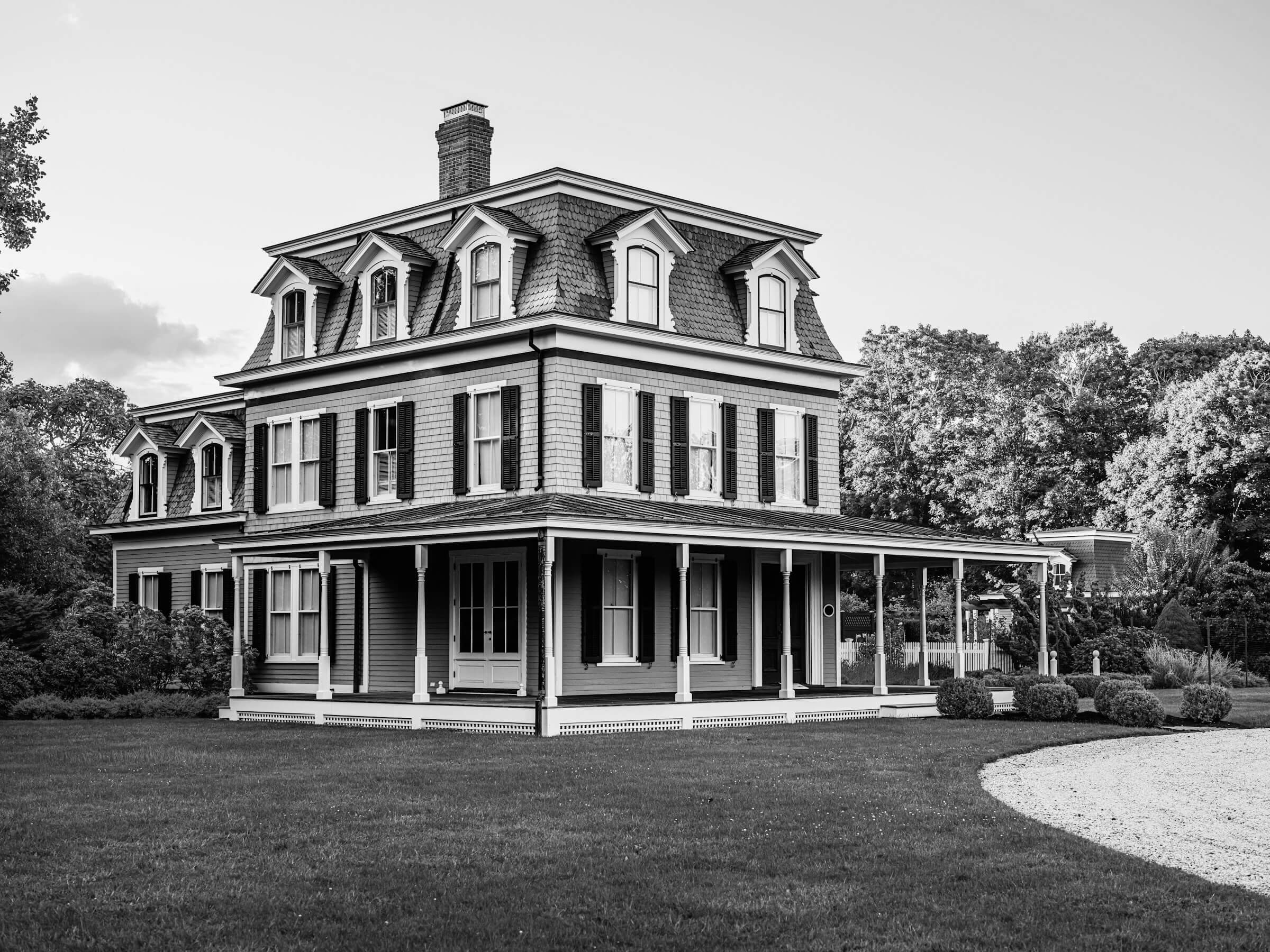
Photo by Lumin Osity on Unsplash
PART I
“So, what’s the name of this place you plan on renovating?” Mr. Eldridge asked, glancing up from the desk.
"Hart’s Content," Aaron Prescott replied, his voice unusually calm and devoid of enthusiasm. Inside, though, he felt a jittery uncertainty, masking the anxiety churning just beneath his composed exterior.
“And I’d call it a restoration, not just a renovation. The house is on its last foundations. I’d be surprised if it lasted another year like this.”
Eldridge eyed him inquisitively and leaned forward in his chair, hard-edged gaze unwavering. He communicated silently that he didn’t see much difference between the two terms. For someone like him, the deal's financial aspects mattered, not its terminology.
Doing his best to ignore Eldridge’s piercing gaze, Aaron pressed on, steeling himself against a prickling self-doubt. His palms dampened, but he forced his tone to remain steady as he continued his pitch.
“You’ve likely seen the old Edwardian mansion on a steep hill around the North Shore. Thick woods with ancient oaks and elms now crowd what were once open property spaces. It sits on Edgeworth Road in Cold Spring Harbor, a few miles inland from the sound. You can still smell the salty sea air there. It’s tranquil, secluded, and more remote than the better-known Gold Coast Mansions. Our team discovered the property is condemned and set for demolition unless we act.”
Eldridge looked away from Aaron and at his desk before turning back. A smile curled his lips, half grin and half sneer. Aaron wasn’t sure what it meant, but he disliked it. As soon as it appeared, it vanished, fading as if it had never been or was a trick of the dim lighting.
He seemed to nod to himself briefly before stating emphatically: “Ah, yes, I know the place you’re talking about,” Eldridge said with a wry smile. “I’ll be honest, I’m not too familiar with it because I live over in Glen Cove, but I have passed it by from time to time on day trips or traveling for client visits. Creepy old place, isn’t it? It’s probably old too, dating from at least the mid-19th century, am I right?”
Aaron nodded in affirmation, but his expression belied his movements. Subtle tension marked his jaw, his brow furrowed slightly, and his gaze flickered nervously around the calm office, painting a different picture. Though the room was spacious and Eldridge's workspace sat a generous five feet away, Aaron felt gripped by an unexpected, uncomfortable sense of confinement. The desk's polished surfaces gleamed with oppressive neatness. Silence, broken only by the faint hum of the ventilation, pressed in on him, amplifying his feeling of being trapped, despite the open space.
Aaron’s expression was tight and grim as he consciously tried to hide his true feelings from Mr. Eldridge, a loan shark in both meanings of the word. He was well aware of the desperation underlying his presence here; it gnawed at him, mixing wariness and frustration toward this last and least appealing option, as all the other avenues had been exhausted, even though one or two had initially seemed promising.
“You’re not far off,” Aaron said. He glanced at the edge of the desk, anywhere but Eldridge’s eyes. Eldridge’s gaze was like that of a bird of prey, an osprey or vulture, watching him hungrily. “According to the information my team has gathered so far, we now know that the first structure on the property was built in 1859 by Vesuvius Hart, the eldest son of a wealthy merchant and former sea captain named Mordecai Hart. Vesuvius was born at sea in 1831, somewhere off Tahiti, in the captain’s quarters of one of his father’s own whaling ships, the SS Vesuvius, hence his odd, but memorable name.
He paused, carefully unfastening the folder at his side, and slid a yellowed property map toward Eldridge. “After a failed attempt at fortune in the California Gold Rush in the early 1850s, he returned to Long Island with a pregnant wife, Amelia. They ended up having three kids together, one girl a two boys. Hart’s Content was commissioned shortly after his father’s death in February of 1858 and completed the following April. It was constructed in the Second Empire, or Mansard, style, which was quite popular among the wealthy and elite. It was supposed to represent a fresh start for Vesuvius and his steadily growing family. But that house ended up seeing more funerals than christenings.”
Eldridge gave a faint noise of interest. Aaron continued.
“His first wife, Amelia, died tragically during a stagecoach incident in early 1860 during a blizzard. Five years later, at the end of the Civil War, he married his second wife, a war widow named Isabella Burford, who eventually gave him three more children before passing away in the fall of 1884. His third wife, Florence Guillen, nursed him through grief and bore his final son, Malcolm, on September 13, 1886,” Aaron recounted. “Malcolm Hart was different from his siblings.” His voice tightened slightly, a flicker of uncertainty in his eyes.
“He was considered an eccentric, even in a family full of them. He was always something of an outcast, the black sheep if you prefer. By the time Vesuvius passed in 1912, Malcolm Vesuvius Hart was his only surviving son and sole heir.”
Eldridge grunted quietly, a slight nod in affirmation and a twitch at the corner of his mouth.
“Malcolm had only one legitimate heir: his daughter Rosamund, born in 1906 during a brief, unhappy three-year marriage. Despite a strained relationship with Rosamund’s mother, Judith Barry, Rosamund was the light and joy of his life. A talented musician, she excelled in piano and violin from a young age and was as devoted to her father as he was to her. She enjoyed traveling. A brief trip to London in early 1924 led to her meeting Arthur Coppin, a wealthy English aristocrat, and they ended up becoming engaged just after Christmas 1924. However, by the first spring thaw of 1925, she had vanished without a trace. There was no ransom demand, no witnesses, no trail to follow, she was simply gone. To this day nobody knows what happened to her. Her body was never recovered, dead or alive. Malcolm, as you could imagine, was completely devastated.”
Aaron let the words linger, allowing the weight of his previous statement to hang in the air. He sensed Eldridge’s curiosity shifting into something darker, which made Aaron’s stomach clench, but he forced himself to stick with the story, determined not to pull back now.
“Anyway, when Malcolm finally died in July of 1970, he left no heirs, legitimate or illegitimate. The house went into foreclosure and stood abandoned for over half a century, gathering dust and a bad reputation in equal measure. But by all accounts, it’s now been reduced to a mausoleum overlooking the sound and a relic of a forgotten era, biding its time as it slowly falls apart and waiting for someone foolish enough to disturb it. It’s on its last dying breaths, and soon the predators, sensing its weakened state, will swoop in and bulldoze it into oblivion unless we do something about it while we still can. If not, it will become just one more casualty of the Gilded Age lost to the cruel hands of time, decimated in the name of so-called progress.
“And that’s where you come in. Hart’s Content isn’t just a property; it’s a story. A full-fledged legacy, if you please. And if you help us restore it, Mr. Eldridge... well, maybe we’ll save more than just a few bricks and timber beams. And then, in our own way, we can become a part of that cherished legacy.”
Eldridge stared at him across the polished wood, face unreadable. “How much,” he finally asked, “are you looking for?”
Aaron briefly hesitated before giving his answer, although when he did, he locked eyes with Eldridge in what he hoped was a very straightforward and confident gaze.
“We’re asking for seven hundred and fifty thousand,” Aaron said plainly. “Enough to stabilize the property, replace the roofing system, gut the electrical and plumbing, and get it in a state where the historical society can actually set foot inside without it falling on them.”
Eldridge’s mouth twitched. “And if that’s not enough?”
Aaron swallowed. A look of pained uncertainty and unease crept into his features. “Then Hart’s Content falls. And so do we.”
A long, drawn-out silence stretched between the two men before Aaron finally spoke up once more. “Look,” he admitted, “we’re not just salvaging an old ruin. Hart’s Content is part of the town’s history. Its restoration could qualify for state preservation grants, historical tourism, private tours, heck, maybe even a museum. There’s a return on investment here. It just takes a little vision and a bit of commitment. We’ve got plenty of that already, so we just need your assistance for the story’s first act so we can step in and handle the final two.”
Eldridge clasped his fingers together conspiratorially and leaned forward with unsettling patience, like a spider considering a trapped fly.
“Vision’s expensive,” he said. “Especially when you’re blind.”
Aaron bristled but managed to keep his tone neutral. “Well, we’ve already secured provisional permission to delay demolition if restoration efforts are underway by the end of the quarter. That’ll give us a total of three months. If we’re able to stabilize the structure, clean up the facade, and open it up for inspection, the Historical Society will be much more inclined to back us. And then we can file for official registry status. After that, grants, tax credits, and real estate leverage.”
Eldridge said nothing for a long moment, only kept his same unreadable expression on his face and his hands tightly clasped over his desk in that same firm gesture that reminded Aaron of a snare trap. The faint tick of a clock somewhere behind him filled the silence. “So, have you got collateral?”
Aaron swallowed. “Only the property itself. And...” he briefly hesitated, “the personal guarantees of the project leads. Me included.”
A slow smile crept across Eldridge’s face, but it wasn’t one of amusement. It was the kind of smile a loan shark gives right before the teeth come out.
“You believe in this place enough to put your neck in the noose,” Eldridge said. “I admire that. Reckless indeed, but admirable.”
He stood then and rounded the desk. For a brief moment, Aaron thought he might extend a hand. He didn’t. Instead, Eldridge leaned close enough that Aaron could smell the faint, sour bite of whiskey on his breath.
“You will have your funding,” he said. “But, know that if you fail and the historical society laughs you out of the room or the roof collapses before you can hold your celebratory ribbon-cutting, then Hart’s Content won’t be the only thing condemned.”
And with that, he clapped a heavy, arthritis-stricken hand onto Aaron’s shoulder. The gesture was simultaneously firm, final, and even a bit possessive. “I’ll be collecting one way or another. That I can guarantee.”
PART II
It was a quiet, peaceful morning in early September, just one day before the new school year began and three days after Aaron came to Mr. Eldridge’s office with his financing request for Hart’s Content. On a quiet, hilly street blanketed by dense fog and flanked on both sides by thick green foliage, a solitary Chevy Silverado navigated the curving contours of the road with ease and efficiency, sporting a sleek new design and four-wheel drive for added traction, ensuring no difficulties in dealing with the otherwise rough, rocky terrain. Finally, the road reached an impasse, where an imposing, albeit rusted, wrought-iron gate emerged from the fog like a ghost. After that point, the entire remainder of the road leading up into the steep bluffs overlooking the Long Island Sound functioned as the driveway for Hart’s Content.
Aaron and his research assistant, Norah Byles, after spotting a decent roadside space half-concealed by shrubbery, carefully guided the car into position and turned off the headlights. They then climbed out on opposite sides, the click of the locks breaking the quiet morning solitude. Alongside Aaron, who functioned as the team’s lead and preservation architect, Norah served as the team’s historical researcher and architectural historian. Clasped tightly in her arms, she held a closed Manila envelope filled with archival references on Hart’s Content, including original floor plans, property records, and historical, colorized photos of the estate back in its heyday in the 1910s and 1920s. In addition to the archival documents and photos, she also carried a knapsack containing a fully charged DSLR Digital Camera for detailed object recording, a UV light flashlight, an audio recorder, and a field journal with a pencil encased in the binding for noting anomalies or decorative elements.
Going back nearly a month earlier, it was actually Norah who had first brought Hart’s Content’s current predicament to Aaron’s attention in the first place. She had brought it up, seemingly out of the blue, during a conversation at Starbucks, where both were sipping iced mocha lattes after a hard day’s work. Although initially skeptical about their ability to prevent the house’s imminent destruction, Norah shared enough intriguing information about it that by the end of their first conversation, he was nearly as committed to its preservation as she was. Hart’s Content, as he quickly learned, possessed a rich, vibrant, and tragic history that would bring shame on the historical society if it were allowed to be destroyed and forgotten.
The three additional members of the initial inspection team, tasked with assisting Aaron and Norah on that promising first day, had yet to arrive. As they waited under the bright morning sun, Aaron glanced at his watch, noting that time was ticking away. Norah reviewed the project plans, her mind racing with possibilities for the inspection. The excitement in the air was palpable; they were both on the brink of something significant. Each team member brought unique expertise, and their absence was keenly felt as Aaron and Norah prepared for the crucial tasks ahead. However, according to the estimated arrival time on their GPS, a text delivered to Norah’s phone by their structural engineer, Rigoberto “Bert” Rojas, had notified them that they were due to arrive sometime within the next half hour. That left the dynamic duo with a fair bit of alone time before the rest of the team arrived and their first day of restoration work officially began.
Aaron opened his knapsack and thumbed through it, ensuring he hadn’t forgotten anything important. Thankfully, and for the first time in quite a while, he was relieved to see that he hadn’t. All of his gear and equipment, including the laser distance measurer, Digital SLR camera, drawing tablet with CAD software, field notebook, moisture meter, UV flashlight, and P100 respirator mask, were present and accounted for, exactly where they were supposed to be. He glanced over at Norah, who was intently examining the rusted gates before them. The gates, thick with layers of peeling paint and corroded metal, looked and felt as if they had not been opened in years, possibly decades.
Norah’s brow furrowed in concentration as she traced her fingers along the intricate, albeit worn, designs etched into the iron. Aaron could feel a mix of excitement and anticipation growing inside of him, knowing that in less than an hour, they would venture through those gates and begin their latest project. This restoration could breathe new life into the hidden wonders that lie ahead.
Aaron walked over to Norah, still deep in thought. He doubted that she even noticed him until he spoke. “So, this is it, huh?” Aaron began, his tone as upbeat and enthusiastic as he could muster. “The big day when we finally start to salvage and build Hart’s Content back up from ruin. I’ll admit I’m curious, though. What initially caught your attention about this place, anyway? I’ll admit it probably would have remained under my own radar until long after being demolished, and possibly not even then, so where did you first hear about it?”
Norah looked up at Aaron, her light gray eyes filled with childlike wonder and awe. Aaron imagined that if she appeared this way just from looking at the gate, he could only imagine how she would react to the entire property, especially the interior and its myriads of hidden nooks and crannies.
“Before we start today, I suppose I owe you a confession,” Norah began.
Aaron’s eyes widened in surprise; she now had his full attention in anticipation of this sudden and potentially startling revelation.
“I actually have a bit of a personal history with this house. To be more specific, my family does.” She paused then, seeming to reflect inward as she attempted to find the right words to say. “It was my grandparents. They’re both long gone, but I knew them both very well before they passed. And it just so happens that both were employed at Hart’s Content as hired staff in the forties and fifties; Grandpa David was a groundskeeper, and Grandma Ruth was a housemaid. As a matter of fact, it was through their work there that they first met, got engaged, and eventually tied the knot in 1956, exactly one year before my dad was born. Therefore, as cheesy as it sounds, it holds a special place in the contents of my own heart, and to just stand by and see it getting demolished would feel like a part of myself getting destroyed in the process.
“So, I’m hoping you can see it from my perspective. I know it might sound selfish or egotistical, but I can’t deny how it makes me feel to know it might be gone in less than a few months. I’ve got all these old black-and-white photos in my cherished family albums back at home, filled with interior and exterior shots of the property before it was abandoned. So, this is more than just a simple restoration project for me, it’s a piece of my personal history we’re bringing back to life.”
“Wow, I’m not sure what to say,” Aaron began, his voice barely able to contain the mixture of shock and excitement gained amidst Norah’s abrupt and startling revelation. Then a memory surfaced within him, a brief flicker of curiosity, and his expression suddenly grew more strained and serious. “Did your grandparents ever mention anything about a deity or entity of some kind called Yam-Sabath?”
Norah’s bright, hopeful expression faded, instantly replaced by an even more dour and grim look than Aaron’s. “Yam-Sabath?”
“Yeah, I believe that was what he referred to it, or them, as,” Aaron replied, his face slowly retaining its previous look of excitement and intrigue. “Look, I know how it might sound, especially to someone like you. The name Yam-Sabath sounds like something out of a Lovecraftian horror story, but it is said to have been a real entity, invisible to the naked eye and perceptible only to Malcolm himself. He claimed that it provided him with detailed occult information, which he ended up applying to his bizarre inventions and architectural design features. I’m sure you know he had a few unpatented inventions in his inventory by the time of his passing.”
Rather than replying immediately, Norah only looked at him oddly. Her face was a mask where any deeper emotions could not be discerned. “I don’t remember either of them mentioning anything about invisible entities present on the estate. Even if he had revealed it to them at some point, they likely wouldn’t have shared that with me. Malcolm Hart was very private and expected his staff to respect his confidentiality. But even so, you know I don’t believe in that sort of stuff. Even as a kid, I was skeptical, so I probably wouldn’t have cared even if it had come up. Both were devout Roman Catholics, but they didn’t hold my atheism against me, so it wasn’t a topic they would bring up. They probably would have deemed it false and heretical.”
The exuberant expression on Aaron’s face faded, replaced by a look of genuine worry. “Oh, alright. I was just curious, that’s all. I didn’t mean anything by it. I’m sorry if I offended you.”
“You couldn’t offend me if you tried, Aaron.” She smiled at him. “But try not to let your curiosity get the better of you. It can lead you to places you don’t want to venture, and things you’d rather not see.”
All of a sudden, their increasingly odd and cryptic conversation was interrupted by the sound of a large van heading straight their way out of the then-dissipating morning fog. The three remaining members of their inspection team had finally arrived. Aaron breathed a sigh of relief. He had been unsure how to respond to Norah’s cryptic statement, and now he had a valid excuse to direct his attention elsewhere, just in the nick of time.
Fifteen minutes later, the gate having been successfully pried open after much trouble and turmoil, both vehicles began their upward ascent through the long, winding road leading to Hart’s Content. After turning a sharp curve in the road, they could finally see, several yards ahead, the condemned property in all its faded glory, an aged monument of Second Empire grandeur now cloaked in rot and ivy, a silent sentinel of a bygone era. Clearly, the place had seen better days, but Aaron noted as he first glimpsed it through the windshield that it still maintained a sense of structure and purpose. He thought it somewhat resembled a dollhouse. From what he knew of its architectural history, the building was initially constructed in the 1850s but underwent significant improvements and redesigns after Malcolm acquired it in 1912.
Aaron wondered what specific changes Malcolm had made once he had the opportunity to leave his mark on its legacy. He thought he would learn the truth in time as they began and eventually completed the restoration work on the property. Before, he had seen it only through the indirect lens of photographs and videos, making it feel almost unreal. Now, however, it seemed strikingly real.
Eli Becker, as the field technician and safety officer, had as his job’s focus the team's safety once they began venturing around the decaying house, setting up equipment, and navigating potentially unstable areas. His personality, however, left much to be desired. Nevertheless, he was essential to the overall team dynamic.
Rigoberto “Bert” Rojas would serve as the foreman of the actual labor team once renovations began and as a general contractor. As the leader of the actual construction team, he needed to see the site firsthand so he could later schedule the appropriate level of manpower and construction materials.
Claire Danvers served as the environmental specialist. She tested the estate’s interior and exterior for mold, asbestos, lead, and other hazardous materials. Her presence at the inspection was mandated by the state, as her subsequent report would determine whether the team could legally proceed.
Aaron and Norah had previously worked with Eli and Bert, so they knew what to expect from them. However, Claire Danvers was a newcomer, and they had not yet developed a clear impression of her character. From what little they knew, Claire was pragmatic and followed protocol closely. Depending on the current situation in Hart’s Content, this approach could be beneficial or detrimental.
All five members of the team were tightly clad in various types of protective gear to ensure their safety while poking and prodding their way around and inside the crumbling, weathered remains of the estate. It had been over fifty years since the place was actively maintained, and God only knew what they would find once they managed to pry those creaking, rusted hinges open and get inside. Alongside the mandatory P100 respirator masks that made them feel like they were back in quarantine, they also donned bright yellow disposable coveralls, safety goggles, and a pair of violet-colored nitrile gloves, along with various instruments and devices they carried depending on their specific role on the team.
Overall, Aaron silently reflected as he gazed upon the shattered remains of the once-proud estate, despite its relatively modest size and less extravagant design compared to more famous Gold Coast mansions like Oheka Castle, Caumsett, or Laurelton Hall, it still possessed a sense of grace and dignity. Despite the heavy weight of countless years pressing down on it, the original Mansard-style aesthetic that characterized the house in the 19th century still shone through Malcolm’s 20th-century improvements and additions. However, it still needed significant repair and structural stabilization work if it had any hope of being restored to its former glory.
The Mansard-style roof, once a proud symbol of elegance, was in particularly bad shape. The slate tiles were cracked, missing, or warped, exposing rotting wooden underlayers for all the world to see. Several dormer windows were shattered or had their panes missing, with pigeons and other wild birds nesting in their broken frames. At the very top, the iron cresting had rusted through in several places, with pieces either twisted out of shape or missing entirely.
The once-bright yellowish brick of the exterior facade was now weather-stained and streaked with moss, mildew, and years of acidic rain. Creeping vines had overtaken the right wing, especially around what used to be the solarium, now more like a ghostly greenhouse, with foggy, cracked glass panes and rusted frames. Cracks ran up and down through the masonry like veins, with some sections of decorative molding crumbled away entirely.
Gazing downward, Aaron could see that the stone columns of the front portico were heavily eroded and chipped, with the wooden double doors hanging crooked in their frames, one was ajar, the other stuck shut, and peeling paint and graffiti scorched into the surface. The front steps were cracked, with one corner collapsed into the earth and a large gaping hole centered on the front porch, like a home for nesting raccoons or foxes.
Beyond the house itself, gazing around the grounds and landscaping, Aaron noticed that the circular fountain, once the centerpiece of the front yard, was bone dry and almost black with algae and mildew. Cracks along its rim and missing stones made it look more like a ruined baptismal font than an elegant feature. Based on its current state, Aaron thought that water may have last flowed from its now rusted spigot sometime in the 1980s. What had once been the formal parterre-style garden had been steadily reduced to a chaotic tangle of thorns and brambles. The outline of its geometric shape was barely discernible beneath the wild grass, weeds, and shrubs. Surprisingly, a few rose bushes did survive, though they were flowering weakly and half-consumed by invasive vines. The once-crushed gravel paths leading to the portico were similarly overgrown with moss and sunken in places from burrowing animals.
The brick wall was mainly intact, but ivy had overtaken the archway, and one corner appeared to have collapsed inward. The gardener’s cottage was barely visible, its roof sagging, likely collapsed inside, and its doorframe overgrown. The carriage house also stood structurally, but the garage doors hung open. From what little could be seen of its interior, it looked incredibly dark and damp, with tools and rusted debris strewn around, as expected.
Once neatly manicured and deep, rich green, the lawn was now uneven ground covered in clumps of dry grass, patches of muddy earth, and gnarled roots. The tree line had also crept inward, with saplings growing close to the house. Animal tracks and signs of wildlife were everywhere, squirrels, deer, foxes, and others less easily identified. It seemed they had run amok in the years since human occupation had ceased, and it was likely that more than a few of them now considered Hart’s Content their abode, thus necessitating the possibility that they might not be inclined to vacate the premises without a fight.
Silence enveloped the atmosphere, occasionally interrupted by the wind through the gnarled trees, the rustling of underbrush, and the distant calls of owls and doves, which seemed to echo from numerous locations simultaneously.
Despite the clear morning light under a bright blue sky, a chill dampness in the air somehow gave the house a feeling of suspended time, almost as if something unnatural or unresolved lay within its walls. By that point, the windows reflected nothing but hollow emptiness and darkness, resembling open wounds more than decorative structural elements. They had significant challenges ahead. But Aaron thought that, despite the many obstacles they would have to overcome, they would see it through and come out on the other side, renewed and reinvigorated. All they needed was enough time and support.
Eli, as might be expected, was the first of the team to break the awkward silence. “Well, this place has certainly seen better days. But, to be honest, I’ve seen much worse on much younger properties. I think we might be able to pull this one off much quicker than I initially expected.”
“For once, I actually agree with you,” Aaron added, his remark completely genuine and lacking the usual snarkiness it had when addressing Eli. “As bad as it looks out here, I think we could do a decent job of the place once we’ve got a better idea of what’s happening inside. Given how long it’s been abandoned and left to the unforgiving climate, I think we just might be able to salvage this one if we play our cards right.”
“Well, we can’t really do anything about that just standing out here, can we?” Norah suddenly piped in. “But if I may make a suggestion. I suggest we proceed cautiously, even more so than usual. At least until we’ve gotten a good feel for the place, stick together as a group instead of splitting up like usual.”
“Why the sudden rush?” Eli asked, his face taking on a bemused expression, before quickly adding, “and what exactly are you so worried about, some demented homeless squatters we might encounter in there? As I’m sure you’re well aware, this estate is on private property, and any person caught trespassing will be arrested long before getting the chance to settle down all nice and cozy.”
“Thanks for the heads up,” Norah replied. “But that’s not what I’m talking about.”
“Well, what the hell are you talking about then?” Eli asked, an incredulous look now animated his usually relaxed face. “In case you’ve forgotten, we’ve gone through this many times before, and I’m pretty sure we’re prepared for anything or anyone that might still be in there. Is there something about this place you know you’re not telling us? Any helpful advice that you’d like to pass along?”
Norah did not respond to his pressing query, only shaking her head and sighing, her face a mix of exasperation and, Aaron saw, a hint of something else. Was it fear he thought he caught a brief glimpse of for a moment?
“I think Norah’s right. Why don’t we just head in and see the situation for ourselves before making any rash judgments?” Claire spoke up for the first time since her arrival.
Aaron thought she had a trace of a foreign accent. French maybe? The name Claire did have a French origin, making that a strong possibility. Her surname, Danvers, decidedly not French, may have simply been her married name. However, she was more likely of French Canadian origin rather than directly from France, given that they were in New York, which bordered Quebec.
“I agree,” Bert readily concurred. “We’re wasting daylight just standing out here as if we’re waiting for something to happen, or like someone else is gonna arrive. But today, it’s just us. This is probably going to be the quietest day for our team up here, so I suggest we relish it while we still can.”
They headed in, exuding a great deal of caution and wariness as they made their way up the cracked, crumbling steps of the once ornate stairway. The silence seemed overwhelming, almost, despite the creaking stairs under their combined weight. It was like stepping back in time, or into another world entirely. As the group headed into the damp, musty air, Aaron briefly imagined they were entering into some vast, chaotic, and undefined liminal space where the invisible barriers separating the world of the living from the world of the dead blurred together into insubstantiality, allowing occasional, unexpected interactions between the two states of being to occur.
As could be expected from a good, long look at the house’s exterior facade, the interior was much the same story, albeit in a much more personal and claustrophobic manner, like being inside the belly of a giant beast in its death throes where you could feel that it’s dying and growing closer to breathing its last, but it’s still fighting against fate and its own mortality. A battle is being waged within, and you’re trapped helplessly at the literal center of it all.
But gazing around at the inner sanctum of the house, Aaron could see there was still much that could be salvaged from the dying remains of Hart’s Content. Even after all this time, hope and renewal remained a possibility.
Walking inside as a tight group of five, the overpowering odors of miasma, rust, mildew, and decay were almost too much to bear, even with their protective gear. They stood huddled together in what used to be the house’s grand foyer, where a century earlier Malcolm and Rosamund Hart would have greeted the various guests and visitors who entered their home in a spacious chamber designed to arrest the senses upon entry.
Moving inward past the tall oak doors, visitors would be met with a checkerboard marble floor, polished to a mirror finish, stretching beneath a sweeping double staircase that split midway and curled up to the second floor in elegant arcs of dark walnut. The walls would have been paneled in rich wainscotting, rising halfway before giving way to hand-painted wallpaper depicting pastoral scenes, hunting dogs, sylvan glades, and Greco-Roman urns. Overhead, a grand chandelier, imported from Vienna and strung out with cut-crystal pendants, caught and scattered the morning sun like droplets of light, casting floral shadows across the floor.
Above the entry was a stained glass window depicting the Hart family crest, stylized antlers and a rose in full bloom. Servants once stood at attention here during formal receptions. Guests would pause, coats taken with subtle efficiency, before being led toward the drawing room, library, or the music salon beyond.
But now, all that remained to greet the group as they entered were shadows, dust, and spiderwebs scattered over the once grand entrance hall. The grand foyer stood silent and cold, a hollowed-out husk of its former splendor. The double staircase remained, but its banisters were splintered, and some parts were missing entirely. To top it all off, a thick coating of dust and bird droppings tarnished the once-proud walnut finish. Where once shone marble, now lay broken tile, the original checkerboard pattern fragmented and warped by buckled subflooring.
The chandelier, surprisingly, was still hanging intact. Still, it sagged crookedly and threatened to crash down to the cracked floors below at any moment, it seemed, to finally join the few crystals already long fallen and shattered on the floor. The stained glass above the entry was also intact but caked in grime, letting in only the faintest, jaundiced light. The wallpaper had peeled in long strips, revealing the lath and plaster beneath, and the once-decorative molding was split or missing in chunks. The air within was stagnant, carrying the scent of mildew, scorched wood, and something sweeter, rot masked by old perfume still clinging to the wallpaper. It was a room that seemed to remember everything but reveal nothing.
Once they’d fully taken in the extent of their surroundings, the team set to work immediately, for the time being remaining in the grand foyer until they could finish their investigations there and move on to the other rooms of the first floor, then to the upper floors. According to Norah’s floor plans, three floors total, plus a basement. However, the house lacked an attic, which was good news for them, as attics in old houses like these were often in the worst condition.
Aaron slowly and methodically worked around the foyer, taking photos and making sketches on his drawing tablet as best as possible in the dimly lit environment. He took out his laser measurer to check the room’s dimensions. Later, after Norah granted him access, he would compare them to the house's original blueprints. He did his best to carefully note any changes in style, such as different molding between rooms, sealed doorways, or unusual wall thicknesses that might suggest hidden voids. Occasionally, when passing by a particularly aesthetically pleasing artifact or architectural detail, he would pause to take it all in and reflect on how it might have looked way back when. He had a habit of doing this even when not surveying new projects he was working on, as he had an eye for the finer details that most people passed by without a second thought. Overall, in his initial clean sweep, he was quietly assessing what was worth preserving, what was too far gone, and where the heart of the house once was.
As the environmental hazard specialist, Claire was engaged in decidedly more strenuous and time-consuming work that required a more thorough, intensive analysis of the house's condition and potential biological or chemical hazards, particularly mold, asbestos, and dust. She began by carefully checking the air quality with a portable sampler pump to pull in as much mold and dust as possible. She would analyze the samples later, after the initial investigation was complete. Until then, she also collected swabs from suspicious ceiling tiles or insulation wrap for asbestos testing. She, like Aaron, had a keen eye for detail and could spot discoloration, water stains, or unusual odors that others might miss entirely.
As the structural engineer and survey technician, Bert’s main focus was checking the stability of the floors, walls, and roof, essentially, risk assessment for collapse or damage. Unlike the others, who were freer to venture around the entire foyer to inspect things more closely which caught their specialized interests, Bert immediately checked the floorboards and staircases for any indications of sagging, warping, or rot. Using his crack monitor gauge, he carefully measured the degree of separation in the plaster or stone foundations of the walls.
Out of the entire team, Norah had the least intensive job requirements. Still, she seemed most invested in her immediate surroundings, almost waltzing across the floor at times to get a better look at the faded architectural remnants of the grand foyer. That child-like look of awe and wonder had returned to her features and was in full effect as Aaron stole the occasional glance in her direction while engaged in his own musings. Having removed the contents of her manila envelope, she seemed to gaze down at them and up at the architectural details with an almost hypnotic, trance-like habitual quality to her movements. Nevertheless, she never forgot her role in identifying the period features present, such as the Victorian door hardware, original crown molding, and parquet flooring styles, and noting where they clashed, indicating the renovations undertaken on the house after Malcolm Hart took ownership in the 1910s.
Before the others could begin their duties, Eli had performed an intensive perimeter sweep of the floor, an act he would perform on each subsequent upper floor until they reached the third. He took careful note and marked unstable spots with chalk or tape to warn the other team members. He also checked for animal droppings, nests, or live pests, especially raccoons or bats, to ensure there was no risk of rabies contamination. In addition to all the above, he also carried a first-aid kit and two-way radios for emergency communication outside in case of injury or a situation that a mere first-aid kit could not remedy. He also had backup flashlights and any other emergency response items, in case a worst-case scenario unfolded before their eyes. He would later assist Claire in moving hazardous materials and, if needed, help Bert with ladder placement or crawlspace access.
All in all, despite the advanced state of decay on the first floor, the team did not find anything too amiss or indicative of an eventual unsuccessful restoration of the house. The situation was dire, true, but it wasn’t anything they hadn’t encountered before, and sometimes, in even more advanced states of decay and disrepair, they could still complete the renovations and restore the home eventually. So, as Aaron and the rest carefully analyzed and took samples, sketches, and photos of the house’s interior, for the first few hours, it seemed like a standard, routine operation that was almost guaranteed to have a positive outcome.
There were no strange occult symbols that would indicate Malcolm’s astral entity “Yam-Sabath” had any sustained presence on the estate either back then or in the current day and age, so he began to think as he did a more intensive look around the rooms of the first floor, that perhaps Norah was being completely sincere when she claimed that her grandparents had never encountered any mention of an invisible entity waiting and watching in the shadows for his name to be called and his assistance summoned.
That all changed once the team reached the second floor of Hart’s Content.
Aaron first noted the floor plan discrepancy, which Norah confirmed after being made aware of the situation. It was around midday when they finally made it up to the second floor after Eli had confirmed it was safe to venture up. To be more specific, while Aaron was doing a routine laser scan of the second floor, he and Bert noticed that the external wall measurements didn’t align with the interior room dimensions. They tried to figure out the cause on their own at first, but when they found themselves hopelessly stumped, they consulted Norah, who had all the necessary information about the second-floor layout.
At the time, Norah was heavily immersed in the master bedroom suite, or what used to be Malcolm Hart’s own bedroom. The largest in the house still contained a bit of regality in its contours and interior facade, even in its dilapidated, worn-down state.
Aaron, followed closely behind by Bert, burst into the room, a bit louder and more frenzied than either had initially intended, to reveal their most recent and unexpected finding down a different corridor. His eyes were bright and wide, like he had just discovered a hidden stash of gold or jewels in the walls.
“Norah, Norah, you’re going to want to check this out!” Aaron began, his face shiny with sweat, his expression a mix of excitement and anticipation.
“What’s up?” Norah asked.
She had been crouched down in one of the rooms, dusty, cobwebbed corners, running one gloved hand across the peeling wallpaper in an almost sensual manner that Aaron found a bit off-putting if not amusing in a vague sense.
“We were doing some measurements with the laser scanner and noticed an odd discrepancy in one of the hallways. There appeared to be 10 feet of missing space between two interior rooms. When Bert tapped the wall between them, he noticed an unusually hollow resonance, almost as if something was behind it that had been sealed off from view, like a closet, or maybe even an entire room!!”
Bert agreed. “Yeah, it appears we’re missing square footage there. It doesn’t add up.”
Norah sprang up, immediately intrigued. Her face was a mixture of excitement and enthusiasm. “Alright, let me go take a look.” She had placed the manila envelope on the floor near where Malcolm’s bed used to be, as the faded markings on the floor could be discerned.
Following closely behind Aaron and Bert, Norah had a sudden spring in her step that Aaron didn’t think she had previously possessed, from what he saw of her as she walked from room to room. They called Claire and Eli over as well, as it seemed the entire team needed to figure out the issue.
Once they reached the spot where the missing square footage was noted, Norah poured the contents of her manila envelope out on the dusty, weathered floor and quickly scanned them, searching for the original floor plans of the house, first taken after the construction work was completed on Malcolm’s additions in 1912. She quickly scanned through them and confirmed what Aaron and Bert already strongly suspected. There used to be an entire room, but now there was only a blank wall, sealed tightly. Further confirmation was obtained via Bert’s borescope camera, which revealed a sealed cavity with faded wallpaper or forgotten molding.
The team stood silently in the cool, damp upstairs hallway, the wind seeming to blow in from every corner of the house, making what was already a dismal scene even more fraught with tension and unease. They had to figure out what to do now with this unexpected revelation, discovered on the first day of inspection, of all times!
After a brief bit of discussion, the team members unanimously agreed they could not complete the renovation until the issue regarding the potential hidden room was fully addressed. However, some had reservations, particularly Aaron and Claire, albeit for different reasons. The unsolved disappearance of Rosamund in 1925 and the references to the astral occult entity “Yam-Sabath,” feeding Malcolm information for his renovation and invention ideas via channeling or other supernatural means of transmission was foremost in Aaron’s mind. At the same time, Claire’s concerns were far more practical and down to earth, being primarily focused on the potential levels of asbestos or risk of tetanus infection, given how long it might have been sealed off from the rest of the house.
She found herself suddenly thinking of the existence of the subglacial lakes of Antarctica and the potential for unknown life residing down in the dark, lightless depths, which had been sealed off like pressurized time capsules with little or no interaction with the environment above and isolated from the rest of the continent and the world for millions of years. Who knew what resided down there, and subsequently what resided in the sealed-off room they had all planned to excavate? Perhaps it was sealed off for a particular reason?
Using Claire’s thermal imaging camera, they were able to see, via remote methods, that despite the damp, moldy air they breathed in the hallway, her readings indicated an arid, uniform cold zone behind the wall. It seemed to exist with a clear sense of purpose and deliberate deception, but for what reason remained to be known until they got inside and saw the place for themselves. They would have to be careful and measured in planning the best way to enter the sealed room without causing excessive disturbance to the house’s overall structure. Otherwise, the project might have to be called off prematurely to minimize damage control.
Like the rest of the house’s walls, the hallway was constructed of lath and plaster, a common 19th-century construction method. Bert managed to drill a tiny inspection hole through the plaster using his borescope camera to get their first peek inside, specifically to check for floor stability, airflow, and the potential presence of furnishings or, unsettlingly, still air and preserved belongings. It was the equivalent of opening a time capsule that hadn’t been opened in one hundred years and seeing what was contained within. Would the interior be perfectly preserved, a testament to advanced refrigeration and dehydration techniques that Malcolm had mastered years before it became common technology?
They were on the verge of finding the answer to that exact question. It took over an hour, but after enough careful drilling and excavating through the sealed-off wall, they finally managed to penetrate beyond it and see what lay beyond in the hidden room. What they found was far more intriguing and shocking than any of them could have possibly imagined.
PART III
It was a bedroom. Specifically, it was a teenage girl’s bedroom, albeit one that might have existed in the 20s decade that all five team members had grown up knowing about rather than the current decade in which they now lived.
Pale pastels characterized the overall color palette: rose pinks mixed with a soft lavender were the prevailing shades in most of the furniture and decor, aside from the pristine wooden floor. All four walls were covered with delicate floral wallpaper that further accentuated the furnishings’ already rosy glow, giving the space a warm, almost fairy-tale-like feel. The room itself appeared to be rather spacious, measuring 16×20 feet, or 320 square feet, depending on your preferred measurement. But it seemed all the more fitting to a young woman of the upper social class Rosamund had been born and raised in. A lost world of tradition, etiquette, and elegance that most Long Islanders of her time could only dream of. But it seemed that under some bizarre manner of circumstances, a small piece of that bygone era remained in the 21st century, only to be uncovered and analyzed by a team of their caliber and expertise.
An oval-shaped mirror was placed on a wooden vanity in one corner of the room. Several items were also visible: a silver-backed hairbrush, cut-glass perfume bottles with atomizers, a porcelain powder jar, a lipstick case, and rouge. There was also what appeared to be a vintage music box, shut tightly closed, a jewelry tray, and a hand fan.
In the opposite corner was a writing desk or secretary upon which could be seen a small, thin notebook that possibly served as a personal diary, letters tied in ribbon, and pressed flowers scattered across the surface in no particular order. There was also what appeared to be a glass inkwell, fountain pens, and notepaper embossed with the name “Rosamund Hart.” Several closed drawers had keyholes and appeared to be locked.
Just before reaching the desk was a full wardrobe or armoire filled with fancy clothes, particularly cloche-style hats, white leather gloves, long frilly dresses, and high-heeled shoes. The clothes looked hardly worn, despite their extremely dated, vintage style and aesthetic.
There was also a small bookshelf with three shelves filled with numerous titles in various conditions, probably because they had been used before being sealed off. The titles ranged from fiction to nonfiction, and there also appeared to be multiple schoolbooks and instruction manuals for various domestic chores, such as cooking or cleaning.
Directly across from the bookshelf was a luxurious-looking chaise lounge upholstered in a floral brocade. It was positioned near a small side table, which was actually more of a desk. With a reading lamp carefully placed to one side and a vintage phonograph on the opposite side, it almost completed the scene, had it not been for one other glaring sight for the team to behold.
The room also contained a sole human occupant. Lying on the luxurious queen-sized bed, perfectly still, and with their eyes peacefully closed was none other than Rosamund Hart, still looking exactly as she would have looked in the cold, desolate winter of 1924-1925, when she had vanished without a trace. There had been zero effects of rot or decomposition of what they could see of her body, and she looked like she was in a deep sleep state. The room was icy cold, and its contents also seemed to be in a state of perfect preservation from the previous century.
“W-what the hell is this? “Who is that girl? What’s going on?!” Eli was again the first to speak up, his voice barely able to contain the level of astonishment he must have felt.
As Aaron took in the sight before him, he was temporarily at a loss for words. He had no idea what to say or what exactly he was looking at. True, it looked like a teenage girl’s room from a century ago, but even if it had been sealed off from the rest of the house, it shouldn’t look as pristine and unblemished as it did. He didn’t even see any dust in the corner, and that didn’t even begin to explain the presence of what he presumed was the body of a girl who had gone missing one hundred years ago, looking like she was asleep as she lay motionless in a large and relatively luxurious bed. What they were looking at, therefore, was a scene that shouldn’t logically exist, and yet there it was before their very eyes.
The decor and furnishings were all perfectly preserved relics of the Jazz Age that would likely fetch extremely high prices if auctioned at Sotheby’s or presented before a pawnbroker. But that was the least of the restoration team’s concerns for the time being. What was foremost in their minds was the extremely surreal, possibly supernatural scene which unfolded before them, particularly the girl who lay on the bed in what seemed like a demented homage to Sleeping Beauty. But unlike the fairy tale, it was doubtful that whatever state Rosamund’s body was in could be cured by true love’s first kiss, as her husband-to-be was long gone and currently entombed in his own eternal slumber somewhere far across the ocean.
It seemed they had unwittingly solved a century-old missing persons case, long after the trail had gone ice cold. But rather than providing some much-needed closure on the situation, it only succeeded in opening up a veritable maelstrom of new questions that desperately needed answers if the team had any hope of benefitting even slightly from this shocking revelation.
The most pressing query at the forefront of everybody’s mind was undoubtedly the ghostly visage of Rosamund as she lay unperturbed under the thick velvety covers of the mattress set located in the room’s center. She did look a great deal like a figure straight out of a Grimm’s Fairy Tale, like Sleeping Beauty or Snow White and the Seven Dwarves, but somehow transported to the real world where the laws that governed the room’s interior differed drastically from those that governed its exterior. It was like they had broken through a portal into another world, or a parallel universe, where witches, warlocks, ghouls, and goblins were very real, legitimate threats to the safety and security of mortal man.
Aaron thought as he took in the scene before him that even though there was nothing outwardly menacing or sinister about it, he still had this creeping feeling that they were looking at something they were not supposed to see.
“Who is she?” a voice asked behind him. Aaron thought it was probably Bert. Before he could answer, Norah spoke up for him, her voice steady and unwavering.
“It’s Rosamund Hart, Malcolm Hart’s daughter. She was first reported missing in March 1925, just over a hundred years ago.”
Aaron felt that when listening to her matter-of-fact response to Bert, there was something incredibly unnerving about her tone. It was like she was casually speaking about her list of groceries or what the forecast for tomorrow’s weather was. He briefly thought to himself that she had somehow anticipated this unwarranted discovery. Or maybe she was just in shock; it disturbed him almost as much as the room itself.
“That’s impossible,” he heard Claire say from her position immediately behind him. “She wouldn’t look so perfectly preserved after one hundred years of being sealed off like this. Not even after one year could she still look like she was asleep. It must be some kind of trick, a mannequin or doll made to resemble Rosamund. That’s the only explanation.”
Aaron looked more closely at what he could see of Rosamund beneath the heavy blanket cover and tried to think whether there was anything artificial about her appearance. As Claire said, she wouldn’t even look this well-preserved after one year of being deceased, let alone a hundred. But try as he might, he found himself unable to find anything unnatural about her figure that could hint at wood, plastic, or even wax. He had visited Madame Tussaud’s Wax Museum several times in his life, and the wax sculptures there looked incredibly life-like and realistic to the real-life figures, both present and historical, whom they were meant to portray.
But he didn’t think she looked like a wax doll either. She merely looked to be in a state of deep sleep, or perhaps just recently, deceased a day or two earlier. Her face was quite pale, but her cheeks were rosy and seemed full of life, and her eyes were closed in what looked like a peaceful repose, with long golden locks sprawled out all around her head resting on a lace-trimmed pillow before disappearing beneath the blankets. If not the actual Rosamund Hart, then it was about as close as you could get without being the real deal.
In his mind’s eye, he could recall with an unusual degree of clarity his web browsing activity about a week earlier, when he was trying to find out as much as he could about Rosamund’s disappearance. He stumbled across several photos of her, dating from 1919 to the last confirmed photo, taken in early December of 1924, which, oddly enough, while originally in black and white like the others, had been digitally colorized at some point. The way she looked in that photo was uncannily similar to how she looked in the room now, with the only obvious difference being that her eyes were open instead of closed.
“Should we go in?” Aaron asked no one in particular. It was almost impossible to tear his eyes away from Rosamund even as he spoke to the other members of his team; it was as though they had suddenly ceased to exist. The faint smell of rosewater, lavender, and some kind of powder clung to the linens, wafting over to his nostrils in an alluring manner that beckoned to him to tread further into the room and gaze directly into the eyes of Rosamund. If they opened, he would only see black emptiness, though. No signs of life and consciousness would be present, and he felt that he might go mad if she smiled at him.
“It’s so damned cold in here, where’s it even coming from?” Eli stated, which was immediately apparent to everyone else, though there was no sign of an air conditioner or refrigeration system.
The two most prominent odors in the room appeared to be those of various types of flowers and a more bitter-smelling chemical agent, although exactly what kind Aaron could not discern. The way they blended together was not exactly unpleasant either. Rather, they seemed to complement each other in an odd manner.
The room itself was almost completely silent, with the notable exception of a subtle but immediately discernible humming or vibrating sound coming from somewhere beneath it, almost as if there was a further hidden cache sealed away below. Its consistent vibrations below the floorboards made it seem like another important part of the scene that they needed to uncover if they had any hope of figuring out what the hell was going on.
Seeing that Aaron had entered the room and appeared unharmed and rational, the rest of the team followed him in. They proceeded with extreme caution and diligence, but there was definitely an unrestrained sense of morbid curiosity in their proceedings as they began to walk around the frigid room, touching things which had probably not felt the warmth of a human hand in decades, yet looked as though they had just been bought from an upscale department store the previous week. All in all, the prevailing theme was surreal existential dread mixed with an overwhelming sense of curiosity and fascination. It was like they had suddenly been reduced to a bunch of eager, restless children given free rein in a toy store to pick and choose any object their little hearts desired for free.
In an unconscious act, seemingly pulled by a power beyond themselves, the entire team suddenly formed a tight circle around Rosamund’s bed. The frame was an elaborate Victorian-era carved oak bed set with an unusually tall headboard sporting intricate floral designs. But the true showpiece was what lay motionless beneath it, a young woman who looked like she was a deleted extra from the set of “The Great Gatsby.”
“Is she...dead?” Eli asked quietly, his voice far more tense than it usually was.
A sudden hush had fallen over the group, and aside from the constant sensation of movement beneath them, no one spoke for several moments as they got a close, detailed look at Rosamund’s figure, trying to see if they could spot any sense of life or movement. There did not appear to be any.
If approached from a logical perspective, the most obvious diagnosis would be that she had fallen into a coma or similar state of deep unconsciousness where no amount of external stimuli could rouse her into waking life. It seemed that time was the only, or at least the most important factor. But a full hundred years could not account for her physical condition, thus leaving any sense of logic and reason to depart for the time being. But what else could they rely on for answers?
“Should we...examine her, check for a pulse, a heartbeat, that sort of thing?” Aaron asked. “I mean, just so we can get a good idea of what sort of state she’s in, and whether or not she’s still...alive?” He looked down at her still face, mesmerized at just how alive she still looked, but did not dare touch her, not until he knew whether or not she was still alive. Rosamund, are you still here with us, or is his only an empty vessel? What happened to you?
The thoughts flowed through his mind as he looked down at that delicate, doll-like face, the lips still red and full, the cheeks flushed pink, the eyelids delicately closed Yam-Sabath? Is he here right now, staring down at us from above, or lurking down below, waiting to be discovered?
“I’ll check for a pulse,” Norah said quietly.
They all stared closely at Norah as she proceeded to bend over and touch Rosamund’s still form. She lightly ran her fingers across her face, and then, removing them, she started to pull her blanket covers down, further exposing her night gown, a pink, rosy color, and seemingly composed of silk; it looked just as intact as everything else in the room. She pulled it down until she exposed her arms, then, moving gently, she stroked her fingers against her wrists, first the left, then the right. After a brief and cursory examination of sorts, she pulled her hands away and pulled up the covers, an almost ironic gesture but conceivable because of how cold the room was.
“There’s no pulse,” she remarked, still in that casual matter-of-fact tone. “I can’t feel anything, no signs of life. I think she’s dead.”
“Should we check for a heartbeat?” Bert asked.
“I’m pretty sure that won’t be necessary,” Norah replied. “No pulse generally equals no life.”
Their breaths appeared as visible puffs, a common occurrence for everyone present except Rosamund. Curiously, this discrepancy went unnoticed by the group until that precise instant.
Rosamund appeared lifeless for all intents and purposes, though the exact time of death and its cause were beyond determination. Despite this, her remarkably preserved and vibrant physical form suggested she had not been deceased for long, or was merely in a coma, complicating the exact determination of her state of being and the precise timing of her death.
To understand the anomaly, tests were necessary. While complete answers might be elusive, these tests could provide crucial clarity regarding the events within the room. Time itself appeared to be distorted there, either slowed down or halted to a complete standstill. Was it a temporal distortion? Time dilation? The situation felt impossible to fully comprehend.
Lacking all necessary materials for a complete examination of time’s differential effects inside and outside the room, they chose to keep their findings secret, particularly from Eldridge. They would leave the room undisturbed until a full assessment of the situation could be made.
The team members unanimously agreed to maintain confidentiality regarding the situation and decided to return home. They planned to reconvene in one to two days, if necessary, to collect essential materials for conducting several tests. These tests would include assessing air quality and the presence of contaminants, evaluating the room’s sterility, detecting microbial decay on Rosamund’s body, and analyzing the degree of oxidation and corrosion on the surrounding inanimate objects, among other less critical but still required diagnostic procedures.
Descending the stairs toward their waiting cars, they remained silent, forgoing any lighthearted conversation. The gravity of their upstairs discovery lingered, even keeping Eli quiet. The light filtering through the stained glass seemed changed from their ascent, illuminating dust motes in sunbeams that felt somehow different. Of course, they all realized that this was pure fancy and that its quality had not actually changed since they went up. Rather, it seemed that something inside of them had changed or been altered in some unknown way. Perhaps due to their exposure to whatever force was present inside the sealed room.
Returning to Hart’s Content with all the required testing equipment ended up taking several days. This was a complex process, often involving online orders shipped to their residences before they could gather everything.
A full three days later, the entire group had finally returned and stood before the shattered ruins of Hart’s Content on an unusually quiet, peaceful morning. In addition to the protective gear and supplies they’d brought along the first time, they now also sported additional tools to test and measure the effects of time distortion and aging on the objects within Rosamund’s room and especially Rosamund herself.
Unlike the first day, only the sense of quiet and isolation remained. A heavy, gray sky shrouded the landscape, casting the trees and birds in a constant, eerie mist. The limited morning light that managed to break through the overcast sky only emphasized the coldness of the ground. This almost ethereal, liminal quality was particularly significant to the five team members, now fully aware of what inhabited the dilapidated house. This time, however, they were hopefully better prepared to face it.
Carrying several extra bags of equipment and supplies, they headed straight inside, bypassing the unfinished renovations on the first floor. Eli paused only long enough to ensure the structure could bear their combined weight before leading them upstairs to the second level, where Rosamund awaited their return. They were eager to begin their experiments on the room’s interior, but they wanted to make sure the floor would not collapse beneath their feet as they focused on their time-consuming analysis. If that were to happen, the odd time distortions in the room, as fascinating and inexplicable as they were, would be the least of their concerns.
Although none would outright say it, they were all positive that Malcolm Hart was at least partially to blame for the situation regarding his daughter’s current state of perfect preservation despite being deceased for roughly one hundred years. He knew perfectly well that Rosamund had not been lost to the hands of kidnappers or any other sort of unsavory ne’er-do-wells who sought to do her harm, either for ransom or just for the thrill of it. And yet he claimed he had no idea of where she was and what had happened to her. But had he acted alone, or was Yam-Sabath more than just a part of his own deluded, depraved imagination?
Furthermore, if nothing else, they wanted to find out the cause of her death and whether it was by natural causes or some depraved act of violence that had somehow been covered up in the ensuing decades to make it look as though it had never happened in the first place. Either way, at least it could provide a sense of closure for anyone who might still seek answers about her passing. Possibly, extended family members are still alive and living on the island, in close proximity to the crime scene.
But in order to determine anything of that sort, there was much work that needed to be done first, and so on that fateful morning in early September with school now officially back in session, they proceeded up to Rosamund’s room, all together in a tightly huddled group, in order to figure out what was going on once and for all, or at the very least, as best as they could determine.
Returning to the now open entrance to Rosamund’s room, they were relieved but a bit surprised to see that everything within seemed to be unchanged from three days earlier when they had hesitantly abandoned the scene. The furniture, floor, walls, clothing, books, and decor in the room all looked exactly as pristine and unblemished by the cruel hands of time as they did the first time around. True, the initial shock had worn off a bit, but it was still there. Oh, it was definitely still there.
And of course, Rosamund still remained, her eyes closed shut and her face as youthful and serene as could be imagined on any person long since departed. It was a face that had entered the world in 1906 when fellow New Yorker Theodore Roosevelt was still in the White House, the automotive industry was still in its infancy, and the now-global Xerox Corporation had just been founded upstate in Rochester. It was a bygone world, but somehow, a piece of it still remained here, for reasons they hoped to determine that very day.
They got right to work, beginning their tests without any delay or small talk. Getting down to business, they first used air sampling pumps, particulate filters, and gas chromatography to determine the composition of the room's air. Unusual levels of air composition might suggest a sealed system or chemical preservation, which could finally lead to some important questions being answered.
They also used spore traps, microscopic examination, and DNA-based bioassays to analyze dust and fungi and determine the degree of sterility in the room. A sterile room would be found to lack typical microbial decay signatures, anomalous for a century-old corpse.
They also conducted material-aging studies on inanimate objects in the room by selecting some objects at random and deliberately placing them outside the room to test the effects of oxidation and corrosion, and whether they would occur naturally once removed from their sealed-off resting place. If the metals in the room had not normally tarnished or corroded, it could suggest a state of chemical stasis or an artificial atmosphere.
They performed the same tests to determine the degree of fabric degradation on bedsheets, lace dresses, and upholstery, using UV light inspection, tensile strength testing, and FTIR spectroscopy to reveal the extent of breakdown of natural fibers such as cotton and wool over time. If the materials are unusually flexible or unrotted, preservation methods would be a good implication.
But by far the most important testing was the forensic and biological tests that they performed on Rosamund herself. They used DNA swabs, invasive radiocarbon dating, and X-ray scanning to assess the levels of desiccation, collagen breakdown, and mineral content still present in her body, as part of a larger analysis of her bones and tissues. They also performed tests on her hair and eyes to determine the presence of ocular fluid residues and the degree of hair protein degradation. In addition to the former, they performed tests using isotopic and radiographic imaging with portable X-ray tools and isotope scanners to reveal bone density vs. tissue loss and detect traces of radiation or rare elements.
As an added bonus, Norah herself performed historical cross-referencing to create a temperature and humidity log reconstruction using decay models based on the insulation, house orientation, and climate history of the region to give an accurate estimate of what should have happened over the past century, compared to their actual findings that resulted when their thorough and somewhat invasive examination was complete.
All in all, it took several hours to complete their testing and analysis using all the instruments and tools at their disposal. The resulting findings revealed a far stranger and more unbelievable scenario than any of them had anticipated.
For starters, the environmental readings showed that the O₂ and CO₂ levels were abnormally stable, as if no respiration or microbial activity had ever occurred in the room. Any VOCs, or volatile organic compounds, that were typically present from off-gassing materials were nearly absent. And the overall humidity levels in the room were inexplicably stable, hovering around 50%, like a controlled environment you might find in a museum or self-storage facility.
After analyzing the findings, Claire stated her feelings. “It’s like the room’s been hermetically sealed in a vacuum... but the seal isn’t mechanical.”
It only confirmed what they suspected, but at the same time, it was still a bit of a shock to see it displayed in an official capacity through electronic readings. But it only got more shocking and unsettling as they obtained more findings and conclusions, rather than offering levity to the situation. The dust and fungal tests revealed no active mold, spores, or bacteria, even on food residue or organic matter. The swab samples yielded negative cultures, or the fungi appeared inert or long dead.
The material and object analysis was largely the same story. The fibers retained elasticity and tensile strength like newly spun cotton or lace. There were no indications of yellowing or brittleness, even under UV light or pH strip testing. Sewing threads showed no signs of fraying, which was a forensic impossibility after 100 years. The metal objects, such as the lamp, phonograph, and Mirror Frame, displayed no signs of rust, tarnish, or oxidation; the brass and silver appeared newly polished. The phonograph needle hadn’t dulled, and the lubricant residue had not congealed.
But, just as before, the most shocking finds came from the results attained from Rosamund’s body. It was like something out of a dream, or a nightmare. There were no signs whatsoever of bloating, collapse, or post-mortem gas expansion. Her skin appeared dry but not shrunken, suggesting zero desiccation. Her hair was full, intact, and with no root loss or brittle texture. Regarding the temperature, it appeared to match the mirror's room temperature precisely, with no thermal decay gradient. No lividity, no odor, no bacterial colonization, she was essentially unchanged from her physical condition back in the winter of 1924 when first reported missing.
“My God,” Claire stated emphatically. “This, this can’t be real. How can this be real!?”
“You can see with your own eyes just as well as the rest of us,” Aaron stated. “A state of perfect preservation. We’ve essentially stepped back in time to another world whenever we enter this room. Believe it, don’t deny it just because it lacks logic and reason.”
Standing less than a foot away from the phonograph, Eli’s gaze drifted first to the writing desk, where the small, slender notebook, once likely Rosamund’s personal diary, rested undisturbed. He silently wondered to himself whether anything written within its binding could offer any potential clues to whatever the hell was going on. Then he turned his head back and knelt beside the phonograph, hesitating. He wanted to see if it still played, even all these years later, after everything they’d uncovered. He wanted to hear some jaunty, old-timey tunes. He didn’t even know why, but something inside of him longed for some sense of levity and playfulness.
“Just to see if it still spins...” he said softly to himself. He wound the crank slowly. The platter shuddered once, then began to rotate with an old, mechanical grace. He lowered the needle with almost mechanical precision. There was crackling and static. A hissing noise like breath being drawn. And then...
Norah walked over to the bookshelf and began looking at the titles on each of the three shelves, perhaps hoping to find arcane, esoteric, or occult information that could provide insight into what they were experiencing. Unfortunately, none of the books seemed particularly out of the ordinary; they were mostly fiction popular among women and girls both then and now. Titles like “Anne of Green Gables”, “A Little Princess”, “Little Women”, “The Secret Garden”, “Twenty years at Hull House”, and “Peter Pan”, were among the more prominent ones that seemed to possess the most wear and tear. Norah picked them up one by one and briefly scanned through them but found nothing of particular interest or relevance to the situation. She carefully placed them back on the shelves in their former places, knowing fully well how odd and outlandish she must have looked but doing so anyway.
On the top shelf, however, there were a few books that seemed to be at least vaguely more pertinent to the situation, including what appeared to be vintage school textbooks on reading, writing, and arithmetic from the 19th century all the way into the 1920s, as well as various issues of scientific magazines, most prominently Scientific American being sold at only 35 cents a copy and advertising themselves as “The Monthly Journal of Practical Information.” There was one book titled Community Life and Civic Problems by an author named “Hill” and dated from 1922, that appeared to be a civics and sociology school textbook, The Laidlaw Readers: Book One, The Modern Speller: Book Two by an author named “Van Wagenen,” a Waterworks Handbook of Design, Construction, and Operations by Flinn, Weston & Bogert, and finally what appeared to be a school textbook from all the way back in 1882 written by an author named John S. Hart L.L.D. called Hart’s Composition and Rhetoric with the title page reading “A manual of composition and rhetoric: a textbook for schools and colleges.”
Located at the foot of the title page, beneath a curiously inscribed printer’s device emblem that appeared to be depict a winged heraldic figure, possibly a dragon or some other vaguely draconian entity, was a publisher’s imprint written as “Philadelphia, Eldredge & Brother, No. 17 North Seventh Street.”
Eldredge? Norah thought to herself. Could that be connected to Eldridge? Before she could figure out the logic behind that question, the sudden sound of old music being played pierced the cold, hushed stillness of the room. She immediately shot around from where she was standing and looked toward the phonograph, which Eli was playing with a look of amazement, since it was still fully functional, lacking even the scratchy quality they usually had. It was playing a song she didn’t recognize, but it nevertheless had a sad, somber tone.
“I’ll see you... in my dreams...”
Frank Bessinger’s voice floated out, haunting, nostalgic, beautiful. The notes were warm, but slightly warped by age. Eli smiled faintly, seemingly unconcerned with the reactions to anyone else in the room. How he had managed to wind the phonograph up and get it to play without any of them noticing was another matter entirely. Then...something started to happen.
Eli smiled faintly as he looked down at the old phonograph, which looked and played as though it were brand new. That’s when he heard it. A creaking sound came from somewhere behind. The smile instantly faded from his face, quickly replaced by a sense of primal, unutterable dread as he turned around, toward the direction of the bed.
Rosamund’s right hand had slid off the coverlet. It hung loosely, unnaturally, fingers slightly curled. The bed creaked again. Her head turned. Now all eyes were away from Eli and the phonograph and towards the bed where Rosamund had been lying still but now showed signs of movement.
“Hold you in my dreams....”
Her mouth didn’t open. Her chest didn’t rise. But slowly, maddeningly slowly, her legs began to pivot toward the edge of the mattress. The music played on, now with an unnatural, haunting reverb that echoed throughout the room and into the adjacent hallway, filled with shadows, dust, and decay.
“Though the days are long...”
Her feet touched the floor with a soft thud. She stood with mechanical grace that seemed too fluid for a corpse but too wrong for a living girl. Her nightgown rustled as she swayed gently in place, as if in sync with the music.
Eli bumped back against the wall. He couldn’t speak; his heart thumped so hard in his chest that he was afraid at one point it would burst right out. Thankfully, her eyes were still closed, as if she were sleepwalking rather than actually getting up out of bed of her own volition.
Rosamund began to move forward, away from the bed and toward the center of the room, as if drawn by the music. As though it had activated something slumbering deep within her body memory. She wasn’t walking, she wasn’t gliding. She shifted, bones cracking and limbs rearranging themselves in sudden, elegant jerks. Her head turned slightly with each note of the chorus, as if hearing it for the first time.
Then she began to dance. Her eyes opened, revealing empty black sockets hollowed by time where life and awareness had long since departed, yet fixed directly on Eli as if looking for a dancing partner. Not joyfully, but ritually, a looping sequence of a ballroom waltz long forgotten. Her arms extended, as if she was reaching for a partner that never came.
Eli stood frozen in place.
She stepped forward slowly, her mouth opened wide, and she proceeded to mouth the lyrics, soundlessly: “I’ll see you in... my dreams...”
The phonograph crackled again. The record began to skip, stuck on the final line.
“In my dreams... in my dreams... in my dreams...”
Rosamund’s movements grew faster. Her head lolled. Her arms spiraled too wide. Her knees began to bend inward as she collapsed in mid-turn, folding to the floor like a puppet whose strings had been cut.
That did it for the entire team. They all rushed out of the room, tripping and falling over each other in a frantic rush for the exit, eager to get away from this unexpected danse macabre. Their investigations long since forgotten, they rushed into the hallway and down the stairs without speaking. This was the final straw. Somebody had to be told or know what was happening at Hart’s Content.
Aaron called Eldridge and told him everything.
“Ah, yes, I’ll be right over,” Eldridge had calmly stated over the phone. “You made the right choice in contacting me. I’ll take care of everything.”
Aaron was incredibly disturbed by Eldridge’s complete lack of shock and disbelief at the things he had just revealed to him, even Rosamund’s sudden “dance” at the very end. He instantly understood he had made a horrible mistake calling him and revealing everything, but now it was too late. Too damned late.
The five team members stood outside, waiting in the dreary, dismal weather for what seemed like hours, when finally, Eldridge arrived in a white van. Norah found to her surprise that she still held the 1880s textbook she had found on Rosamund’s bookshelf before the music started playing.
Eldridge wasn’t alone. There were others, people Aaron and Norah had never seen before.
When Eldridge stepped out of the van, still dressed in his familiar two-piece business suit, Aaron noticed something new. Hanging at his chest was a pendant, an ornate piece bearing a strange heraldic emblem. At its center was the face of a cherubic figure, flanked by curling acanthus leaves and intricate scrollwork that suggested old symbols of learning or hidden knowledge. Beneath it, etched in fine lettering, ran a Latin inscription: Spectat in fine saeculi. Below that, a single marking—III. The design carried an unsettling gravity, as though it belonged not to ornamentation, but to some quiet, watchful order that had endured far longer than anyone realized.
But what did it all mean? Was Eldridge somehow involved in what was going on at Hart’s Content? At the very least, it would explain the complete lack of disbelief and skepticism at Aaron’s frenzied revelations. Spectat in fine saeculi, when translated into English, means She watches at the end of time. Eerily reminiscent of Rosamund.
Flanking Eldridge were four men dressed in dark, ritualistic robes that looked like those of a monastic order straight out of The Vatican. They seemed to completely ignore Aaron and the rest of the team as they marched up the stairwell to the entrance of Hart’s Content in perfect synchronicity. Eldridge followed close behind and seemed similarly uninterested in speaking with the team members; he wore a big, sly grin that silently conveyed excitement and spectacle. Aaron had no intention of being ignored or pushed aside like it was nothing. He wanted answers, and he suspected Eldridge had more than he let on over the phone with his feigned sympathy and reassurances.
“Eldridge, what’s going on here? Do you know something that we don’t?!” He walked up to him as he ascended the steps and wasn’t surprised to see the big, wide grin remaining on his face when he turned to face and properly acknowledged him.
“As I’ve said before, everything is under control. You have nothing to worry about; we’ll take care of everything from here on out. Thank you for all the work you’ve done here, but I’m afraid this is where your little restoration project ends. You and your little team stumbled upon something you seem unable to handle or understand, so we’ve decided it's best to unburden you from this system.”
It took a few moments for Eldridge’s words to sink in and their meaning to fully materialize in Aaron’s mind. His eyes widened, and he felt his fists start to clench. “You’re firing me, I mean all of us?!”
“It’s already been decided, the system at Hart’s Content must remain untarnished by outside hands, and I’m afraid you fall firmly into the category of outsiders. Rosamund was a successful case demonstrating the proper use of Yam-Sabath to trigger and stabilize preservation fields, and she needs to remain under his authority for as long as everything remains in place.” Eldridge was attempting to feign sympathy, but it came off as mocking rather than genuine.
“What are you talking about?” Aaron demanded angrily. “What goddamn system are you talking about? What’s going on with Rosamund and her room? There’s some kind of temporal distortion going on up there. Is she dead or alive?!”
“As I said before, as an outsider, I can’t reveal too much to you, but I will give you this. Make of it what you will. He took out a piece of paper and quickly wrote something on it with a fountain pen, then handed it to Aaron.
“SYB-Θ” (Pronounced “Sib-Theta”)
And then he felt strong hands grabbing him from behind. He was held in place by one of the tall men in black robes and restrained until the rest of them made it successfully into the house undeterred. Aaron could smell the mingled scents of incense, spices, and a chemical odor that was reminiscent of ammonia. It triggered his gag reflex, and he felt his strength drain out of his body momentarily. He fell to the floor in defeat. Norah ran to his side after the man let him go and then went up the stairs to join the others.
“Are you alright?” she asked.
“I don’t know,” he said in a low tone, unable to look up into the gray light of day.
His strength eventually returned, and he got up and stared up at Hart’s Content for several moments in a straight line with all the others who remained silent as they gazed up at the gloomy old house beyond time. They all silently understood somehow that they would never be allowed to set foot in that damned place ever again. But it wasn’t anger on their minds; it was fear and resignation. As sinister as Eldridge might have been, and what strange society he and Malcolm Hart were both a part of, he was right that they were dealing with something they weren’t suited to handle or properly understand, even if they tried to tell others, no one would believe them. And so, they stood and gazed up in silence.
High up on the branch of a towering oak tree, an enormous bird glared at them with a crooked beak and burning red eyes.
Epilogue
text
Footnotes
text