Image by Marianne Dalton
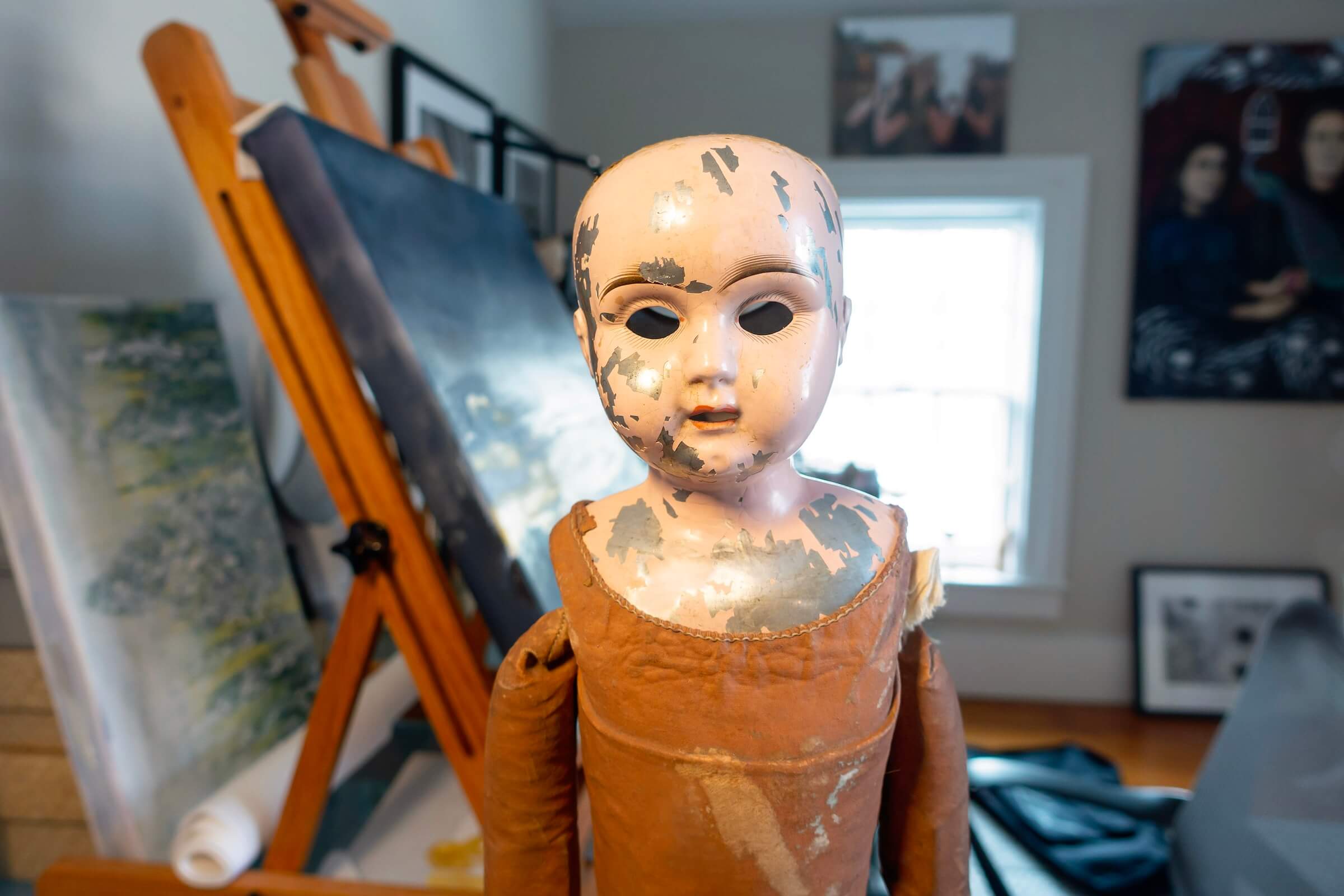
It’s a chilly Sunday afternoon in late October; I drive past a busy garage sale and pull over to check it out. I navigate the lawn’s clutter, heading straight for the garage. The first thing I notice upon entering is an unusual doll sitting on the edge of a shelf. I’m not big on doll collecting, but this doll has a beguiling allure. I think it’s because she is rather startling as I look her up and down closely. No clothes, empty eye sockets, and bald. What’s worse, and quite disturbing, are the mysterious scratches that mar the doll’s face, neck and shoulders, which are made of a silver metal, leaving only her painted pink lips and finely lined eyebrows intact.
Overtaken by my inquisitive reaction to such a doll, I concede it’s because I’m drawn to the dark side, and after all, Halloween is just a few days away. These facts motivate a performative behavior on my part, especially because the doll looks so dramatic staged under a spotlight in the otherwise gloomy garage.
I pick the doll up and, with arms outstretched, I hold her out in front of me. Stunned, I sigh painfully. I can’t help wondering why her face and body are so brutally scratched. Thinking about this makes me feel uneasy as I inspect her injuries. As I study her further, I notice her tiny, pale pink hands look to be made of porcelain, and as I outline each of her fingers with mine and turn her over, I see her country of origin is France. No doubt this is a high-quality doll, likely from the Victorian period. Surely, she was once very desirable.
I carefully stroke my hand over the stitches of the doll’s sewn, stiff brown leather body and analyze her articulated elbows, knees and hips held together by silver stud fasteners, which allow her to bend, albeit only slightly. The smooth silver studs mysteriously sparkle in the dingy lit garage. A feeling of blissful nostalgia comes over me as I contemplate the doll’s history and think about the little girl who received her decades ago. Spooled into the past, I think of myself as a child. I don’t remember ever playing with or even having a doll.
Suddenly, I grin and remember Sylvia. Wow. I almost forgot about her. Sylvia also provoked a kind of spontaneous performative behavior on my part, and she too was a vintage doll, but not nearly as old or worldly as this one. I got Sylvia just after I finished graduate art school when I was a punk living in Philadelphia.
I hold the damaged doll close as I saunter around the garage and think back.
Sylvia was a plastic doll that was considered a walking doll, as she had wide, flat feet that enabled her to stand upright, and if you held both her hands and rocked her from side to side, you could make her look like she was walking. She had light blue eyes, pale skin, blonde curly hair and stood about thirty-two inches tall. Coincidentally, she was from my childhood era, the 1960s. I bought Sylvia at a thrift store in Philly with my brother Bill, and the first thing we did when we got her to our apartment was to shave her hair into a mohawk. Then Bill drew a fancy lettered “Dad” with an arrow through a red heart on her upper arm resembling a tattoo. We dressed her in a black sleeveless T-shirt with a studded black leather belt wrapped twice around her waist.
I chuckle to myself thinking about life with Sylvia as I continue to roam the garage sale.
I uncontrollably giggle out loud remembering the day Sylvia almost met her demise in the dormitory at Philadelphia College of Art when she was thrown out of my brother Bill’s dorm room window during a party. Unfortunately, Bill got barred from the dorm after that event because we made a slight ruckus as Sylvia fell several stories. Plus, it didn’t help that somebody was screaming, “My baby, my baby” as Sylvia fell, just missing getting run over by a passing car.
I tried my best to change the administration’s mind about kicking Bill out of the dorm. I even set up a meeting with his school’s administration, determined I could pass as our mother. Many deemed the idea absurd, but I was resolute and adhered to my mantra of never say never. I covered my magenta-dyed hair with a chic short cropped black wig and dressed in a stylish grey vintage suit jacket with a matching fitted knee-length skirt and black high heels. To top it off, I carried a 1960s beaded handbag. I thought the Jackie-O inspired outfit would transform my twenty-three-year-old self into a fifty-year-old mother figure. To put it mildly, my disguise was poorly received. Afterward, Bill moved into my apartment with me, Sylvia, and our sister Terri.
I snicker, remembering the Sylvia fiasco and my absurd notion that I could pass as my mother. Although I was and still am a dreamer, I know I gave it my best shot and wouldn’t change a thing about that decision. As I look around, I notice the garage sale attendees seem to give me a wide berth. This reminds me of when Bill and I would take Sylvia shopping at the Acme Grocery on Walnut Street in Philly. First, I’d secure Sylvia in the shopping cart before we gathered our groceries. Shoppers would take a circuitous route around us so they would not get too close. I’m sure my deliberately theatrical behavior helped keep the other shoppers at bay as every so often I’d scold Sylvia in a raised, angry voice for being a naughty child as we walked through the grocery aisles. It was pure performance art. Maybe even Academy Award-worthy, at least in my mind.
So too, this was the early 80s and punk was new, and it was rare to see a punk during the daytime. Plus, we did look intimidating in our studded black leather jackets, army boots and metal spiked wrist bands. My magenta-dyed spiked hair that stood about six-inches tall and the heavy black eye makeup added to the drama. Bill had an extraordinary haircut that I proudly designed myself. I shaved his hair three inches up, starting at the ear and going all the way around. Then the five-inch-long hair above was twisted into a dozen pointed spikes. This was during what I refer to as my “hair-don’t” phase, which started right after I designed my hair to look like the Three Mile Island nuclear reactor.
I grin broadly. Ha-ha! Those punk years and life with Sylvia seem unbelievable now, but I have the photographic proof.
As I walk around with the disfigured doll held close, I see a pile of books on a table in the garage corner. It looks to be a perfect place to prop the doll for further study. I position the doll against the books and step back for a better view. A woman approaches, shocked by the doll. She asks in a loud, annoying, matter-of-fact manner. “Why is that doll so scratched and freakish?” Then she reaches out to grab the doll. I feel like a protective mother with her newborn baby and gently block her hand with mine and continue to gaze at the doll, never making eye contact with her. The woman grunts something incoherent and plods away. Pleased, I cross my arms in front of me and stand tall. I conclude the doll looks contented, even quite royal, sitting there as I stare at her. I squint my eyes to a blur and think about how beautiful she looked in her earlier life and imagine the fashionable attire she once wore. Being French, I decide she likely wore a mid-calf ruby red velvet dress with a white lace collar and a wide navy satin sash secured around her waist. Her sapphire-colored stockings and black leather ankle boots with silver buttons up the side were the latest fashion. To top it off, a black velvet hat perched sideways on her long, wavy dark brown hair with a large feather plume was the final ooh-la-la fashion statement.
I tilt my head from side to side as I contemplate her once-strikingly beautiful face. Her creamy smooth skin accentuates her rosy cheeks. I decide her eyes are deep emerald green. Yes. No doubt about it. Green eyes that shimmer in the light, framed by long, black eyelashes that flutter when you sway her back and forth.
I pick the doll up and cradle her stiff, unhuggable body in my arms. I wonder again about the little girl who first had her. Was she surprised and overjoyed to receive such a special doll? Did she love and display her in a prominent place in her room? When did the doll leave her possession, and who later disfigured her? I recognize this is a bewildering, even painful perspective delving into the secret past of this dejected yet wondrous doll. Overwhelmed, I turn to place the doll back on the shelf where I first saw her. Instead, something changes my mind.
I had not thought of the garage sale doll until this morning when cleaning out a closet. As I unwrapped the mummy-like cover containing the doll, I felt a similar sense of wonder come over me just as it did on that afternoon decades ago. I sat on the edge of my bed and held the long-hidden doll as the memories of that day and the one other doll in my life; Sylvia came flooding back. For a moment I inexplicably considered donating or disposing of the doll but instead rewrapped her and put her back in the closet.
I suddenly feel uneasy and walk back to the closet containing the doll. I find and unwrap her once more. I look her up and down. My whole body feels warm as I gently stroke the doll’s scratches and declare in a singsong voice. Your scarred face is not frightening like I originally thought, and ironically, it’s much like the lines on my face now.
Cradling the doll like a newborn baby in my arms, I carry her upstairs and place her on a conspicuous shelf in my art studio.
As I stand back and observe the doll sitting in its new place of prominence, I feel blissful. I understand now why I brought this doll home on that day so long ago and why I will never give her up. She is special and represents much more than her wounds once dictated. She is not simply a totem of injury and loss. Instead, she’s a symbol of overcoming, of strength, of endurance.
With this recognition an overwhelming feeling of peacefulness comes over me. My eyes blur as I gaze further at the doll now newly born. Her flawless skin shimmers. Her eyes sparkle and mirror the light just as they did in the little girl’s room where she first lived over one hundred years ago.
Lightheaded, I shiver with awe and cry out loud.
Yes! Beautiful. Beautiful green eyes.