Paulius Dragunas For Unsplash+
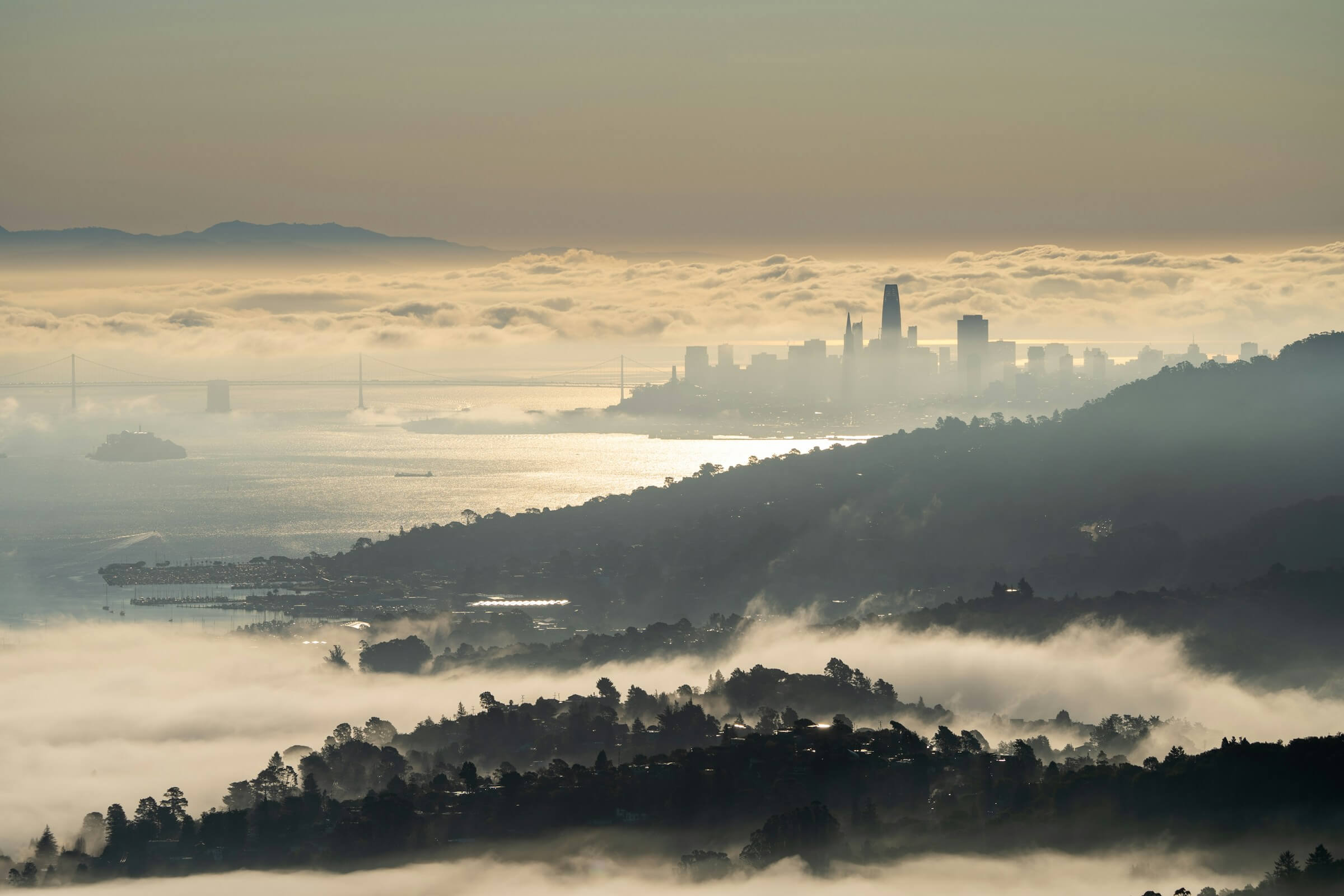
The house we live in is built into the side of a hill where invasive French broom and oleander plants grow wild after it rains. The treetops above the ridge shield the state of the sky, so I look to the west to see what kind of day it will be. Usually visible is Mount Tamalpais, a point so tall it pokes above the thick, opaque fog that rolls in and out like the tide. In the foreground, tall pine and redwood trees cover the unnatural slopes of rooftops, streets, and lamp poles between the mountain and our garden so that signs of civilization disappear from a certain angle. This was the fresh, green start our family needed after my high school suicide attempts and the loss of my father’s job as a scientist so many years ago.
After we moved from Orange County to the Bay Area, I started attending school again, Appa found a new job, and Amma and Saumia resumed life as if the previous difficult years had never happened. My sister is no longer here, but the rest of us have remained in this house that has sheltered our family ever since. The garden beneath the dwelling was the first and only endeavor my parents jointly embraced by planting apricot, fig, and peach trees; blackberry and honeysuckle bushes; birds of paradise, roses, geranium, lavender, and daisy flowers that return every spring to this day. It’s a testament to what they can accomplish together when they are not busy fighting each other. Yet for most of my life, that is how I have witnessed my parents, especially when my sister and I were younger and we lived in a dry, barren place.
***
Orange County was a desert. A real Wild West terrain where tumbleweeds rolled over artificial golf courses and five-lane highways when the Santa Ana winds were especially strong, careening from east to west during certain times of the year. I loved those days when it was windy, and I felt giddy at the way my hair whipped across my face or when a sudden gust made it impossible to standstill. Everything was picked up and moved by some invisible force with no reason, order, or purpose that could be explained away by anything in my school books.
Most of the trees stayed rooted on those windy days, even though the soil was really caked-over dust, and when it rained, the roadways flooded and people forgot how to drive. The native oaks, foreign eucalyptus, and invader palm tree species gave way on occasion, like when El Nino struck in 1998 and brought hailstones over the beach towns and kept everyone cooped inside as if it were a snow storm. Only the line of skinny date palms along the ridgeline above our side of town remained erect against the rise of the sun and moon, like a signpost for how close we were to coming home. Once the trees were in view, Amma and Appa would sing to me, “Aa-thi-kku Van-thaa-chu” while I grumbled in my car seat after a long day of driving on the I-5 freeway.
When I was older, Amma told me that a developer planted those palm trees after his proposal to build a single mansion across forty acres was rejected. Some of the neighbors said it was because the structure would have been a blight on the community. Others claimed the real reason was that the hill was once sacred burial grounds for the Acjachemen tribe, whose spirits would haunt anyone that tried to disturb them. But those were stories with origins from hundreds of years ago. The existing town was constructed without much regard for the Indigenous people or their customs, except the old Mission, which was where they were converted, enslaved, tortured, and infected by the Spanish missionaries, and the chapel next door where Father Junipero Serra occasionally gave sermons when he was not overseeing their widespread abuse across the entire state.
These vestiges, however, were not important to Orange County in the ‘90s. The Mission was reinvented as a museum, and a tall bronze statue of the Catholic priest stood outside the church. Its bells reverberated over the town and its suntanned denizens who were more interested in their house remodels and new convertibles. Life at the time was a sedate rhythm of beach barbecues, talk radio, chlorinated swimming pools, shopping malls, and diet coke. At least that was what I saw in public, and that’s what I thought was American life.
American was a word I heard Appa call the neighbors. He would never call himself or anyone else in the family American, at least not in the beginning. Like the different trees, Americans were considered a different species–some native and some not. I was curious about what they did and the ways they lived, so I studied them like researchers watching chimpanzees groom each other on the Discovery channel. When Amma had her back turned, I went to the backyard and climbed on top of the defunct built-in grill that sat untouched by my parents. The grill’s only use was to know my five-year-old footprints which retraced a path over the brick exterior wall that reached the overhead patio awning. If Amma caught me climbing on top of the wooden planks, she would demand that I come down because they wouldn’t support my weight. But I didn’t share her worry that I would fall through and crack my skull on the concrete. I left preoccupations like those behind when I could be above ground level, above my family and other people, and my line of sight was equal to those of the pines that grew along the perimeter of our backyard.
Ours was the only house in the neighborhood to have such towering, evergreen trees whose trunks were so thick that my arms could not reach halfway around them. It was unusual for those trees to grow in a dry climate. The tops of them reached above the height of the two-story houses next door and cast a long line of shade under the harsh sun. From this position, I could not be easily detected while balancing like a cat against the stucco exterior of the house. I could peer over the wall that separated us from the neighbors and look at who they were without them knowing they were being watched. The lives I witnessed from either side were unlike anything that took place in our own house.
On the left side, the husband and wife did things my parents didn’t do, and their three boys, all fair-haired, fair-skinned, and fair-eyed, ran around like wild animals, whooping and hollering, wrestling each other, and pushing one other into the pool. If their mother was outside, she would be tanning on a reclined pool chair while sipping an iced tea. Occasionally, she might tip her sunglasses down to look over at her children and tell them to stop splashing her exposed limbs. I had never seen a woman bare so much skin, inside or outside the house. My own mother would not have dared to ever be seen in such a state of undress. It was also rare to see her sit down for too long or take part in any kind of indulgence.
One after the other, I heard the boys yell, “Geronimo!” and “cannonball!” before tucking their legs and jumping into the water, ignoring their mother. On the weekends, the father joined the family and flipped pieces of meat over their functioning barbecue with a ladle in one hand and throwing back beer bottles with the other. When I looked past the charcoal smoke and pungency of charred beef and sausage wafting over the wall, the most shocking thing I saw was the father leaning over the mother and putting his mouth on hers. They stayed there like that for a long time, oblivious to the chaos behind them or to the little girl next door watching with her mouth open. I craned my neck as far as it would go while clutching the beams with my fingers and toes, because this was behavior I had never seen before–a kind of intimacy not performed in my own household. My parents did not do things like hug and kiss or hold hands. They ate their meals at different times and usually kept to separate corners of the house. The only thing between them was silence, unless there was an argument to be had. But these people across from me didn’t mind being close together. They couldn’t keep their hands off each other and didn’t care if their children saw. Everything about their lifestyle was unapologetic and out in the open. They drove big cars with loud engines, hung patriotic flags and multicolored lights on their houses, and made lots of noise over sports. And they did all of this without explaining any of it.
As the sun started to set and the sky turned a darker shade of blue, it was time to climb down from the awning before Amma came looking for me. On the descent from the neighbors’ world to mine, slowly stepping back onto the brick wall and placing my hands where my feet were, I wondered if what I had observed was the way families were supposed to behave. ‘Supposed to’ was a phrase I had picked up at school for what should or was allowed to happen, which was enforced by a combination of rules and expectations that took the form of stern expressions, finger wagging, or worse. Being on the receiving end was enough to steer myself in this or that direction–all for the ultimate purpose of knowing how to move around within the bounds of other people’s acceptance. Who those others were and what met their terms changed if I was inside or outside the walls of our perimeter.
With each step down, comparison after comparison turned over in my mind. Between the images of my family and theirs, I was forming conclusions about my reality in relation to what I saw. I was learning what I was based on was what I was not. I couldn’t yet find words for the separation hardening inside of me, but I could feel the tightness in my chest and took this sensation as proof of the truth. I did not think to consider from where the conclusions came, how they were used to know my place, or why I needed one to begin with, only that they landed in me as heavily as the gravity that pulled my five-year-old body closer to the ground.
Knowing that my family and I were different made evident that we were Indian people in an American world, which lent a sense of surety through something I later learned was called an identity. By naming us and them, I didn’t have to remain unsure about my conduct or character. I could give my choices over what to do, say, think, feel, or be up to something outside myself–a concept, a set of rules, a group of people, an entire world–that seemed bigger than what I was. In exchange, I would know what was expected of me and could therefore ensure how others would treat me, or so I believed, even at that age. This unwritten agreement I made with myself was the beginning of my drift from the innocence that existed before I climbed on top of the awning.
Even though it pained me, I still wanted to know who I was. Through contrasts and opposites, I thought I would understand how we were like this by knowing how the neighbors were like that. They had been there before we arrived, and from what I could glimpse over the other sides of the wall, the other houses in the neighborhood looked more like theirs than ours. I started to wonder if that meant they, the pale-skinned people, were what was called normal–another word I had learned in school that meant something was typical or ordinary–and could exist without any doubt or confusion, while checking off all of the ‘supposed-to’ boxes.
My feet hit the ground with a thud, and I remembered people I had witnessed in the grocery store, at the post office, and in other public places when Amma took me with her to run errands. They all seemed to move around, behave, and look like the neighbors. There was a seamlessness between who these people were inside and outside of their homes. Although ours had a similar frame, the one I reentered had dark skinned people who acted in ways that were not the same as when we were out in public. Following my theory of opposites meant that my family was abnormal and our existence would be plagued with questions if we were to consistently remain as ourselves, regardless of where we were, which was ironic because I thought the world and our place in it would make sense using reason and logic. The scrap of assurance I thought I had gained from my investigation paled against the consequences that followed when I saw myself as unlike others by separating all to which I belonged–my body, my culture, my family, and my house, including those tall backyard trees–from the rest of our surroundings. Furthermore, it made us unusual, atypical, unprecedented, unequaled, and also alone.