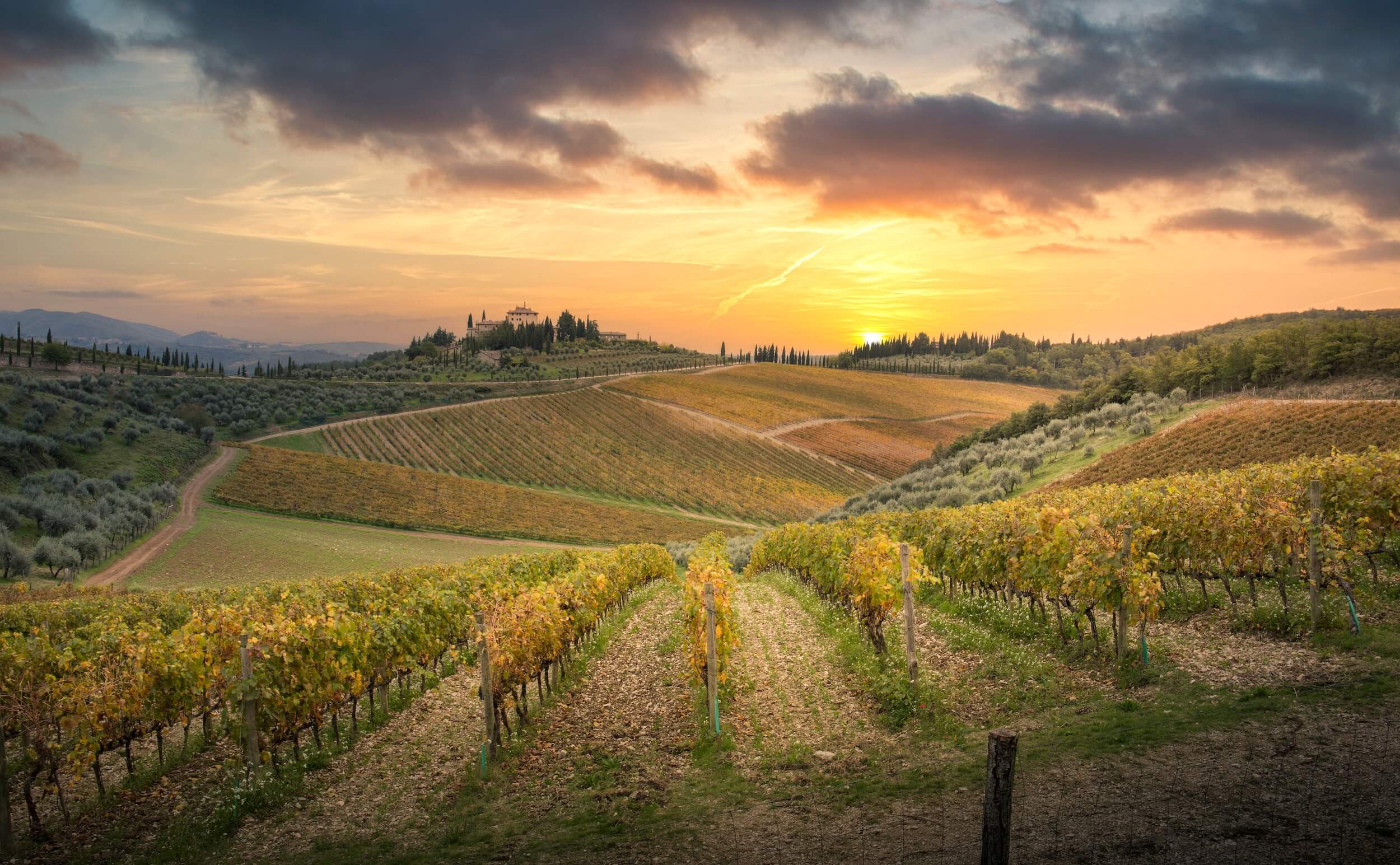
Image from Adobe Stock
History doesn’t repeat itself, but it often rhymes.
Attributed to Mark Twain
2018
Dodging cyclists, I scurried across the narrow road and headed toward Gaiole’s town center. A small Tuscan village of twenty-seven hundred souls in the Chianti region, Gaiole is known for its idyllic beauty, and these days for L’Eroica, an increasingly popular vintage cycling event.
Taking in the surrounding low hills, pear orchards, and omnipresent vineyards glowing in the early autumn sunlight, I was also taken by the single and tandem riders whooshing by. Warbling lively tunes at the top of their lungs, some wore cycling kits—jerseys, shorts, helmet and accessories—that matched their bikes’ vintage. Families, teams and friends zipped along, dressed in their kits or turn-of-the-century costumes, singing and chatting with each other as they pedaled by.
The closer I got to the center, the better I could hear the PA system barking enthusiastic event descriptions in Italian cadences, only a little of which I could understand. Interspersed, a variety of Beatles songs, old swing favorites, and a little opera added to the festal atmosphere. All around me cheerful Italian accents mingled with German, Scandinavian, Spanish, Japanese, English and languages I couldn’t identify. The mix of familiar and strange struck just the right note for the occasion, especially for this American. The diverse voices reminded me of the founding promise of my own country, whether melting pot or tossed salad. I was captivated—again.
Every nation has its favored sports, and for Italy, it’s soccer and cycling. While I’m not a big sports fan myself, I understand their value in promoting a sense of community and national belonging. I know that by bringing people of different backgrounds together, sports offer a unique symbol of unity. For this occasion and the celebration of this sport, I appreciated that people from all over the world flocked to this postcard hamlet, with its cobblestone piazza and centuries-old buildings, to ride or cheer on riders, while paying homage to cycling greats, past and present. Some of those cyclists had brought encouragement to others in difficult times of war and recovery, greats who had had overcome enormous obstacles in grueling classic races that stirred and uplifted the whole country. Others went further, risking their lives to help those in danger during World War II, which moves me even more deeply as I think of it now. As part of the resistance, they stood out but were joined and backed by many others in myriad ways, a testament to the power of working together.
Giancarlo Brocci was the driving force for L’Eroica’s creation. As a child, Brocci had learned to read through newspapers, particularly the cycling news. He admired the values of cycling luminaries and was an ardent cyclist himself. To help save Tuscany’s white gravel roads, the iconic strade bianche, from being paved, Brocci, along with a few others, introduced the idea of a vintage bike festival on those roads. Such a festival also offered an opportunity to promote a connection to Italian literature, art and history, which naturally included cycling.
L’Eroica’s launch in 1997 and consequent impact was a familiar story, one I’d heard in Gaiole and surrounds multiple times, but one that never failed to awe me. Because of L’Eroica, Tuscany’s iconic white roads remain unpaved, and the astonishing deeds of earlier cyclists were honored annually by participants from around the world. The numbers tell the story: ninety-two Eroica participants in 1997; seven thousand representing sixty-two countries in 2018. That small group of people working together had created something so inspirational that it would continue to grow. Back in 2018, we had no idea that only five years later it would attract ten thousand participants and that L’Eroica would be duplicated in countries all over the globe.
While L’Eroica’s intentions may seem modest when compared to national and international political upheaval, it illustrates the power of everyday people working together to address challenges, whether large or small. Small steps add up, as they did in saving Tuscany’s white roads, as they did in Italy’s resistance to fascism, as they do in the situation in our country today.
2025
A jolt of pure joy coursed through me as I sat transfixed by the news on my computer screen. Between seven and eight million souls had turned out for the second No Kings protest, a sizable increase from the five million of the first No Kings rallies some months ago. Pride kicked in with that joy, pride in knowing that so many people felt moved to decry the savaging of our democracy by the current administration. And that was just in the U.S., where I didn’t happen to be. I was in the quiet Italian countryside, incidentally, not far from northern Abruzzo, where Benito Mussolini had been imprisoned after being removed as Italy’s leader. Although I wished the timing of our trip had been different, I was proud anew, reliving the multiple protests I’d participated in since January and the strength I’d felt in the jubilant crush of those gatherings. For this No Kings protest, in cities around the world, including in Italy, crowds had gathered in a showing of solidarity with U.S. protesters for upholding the democratic values of due process, rule of law, and justice for all.
Nor was I alone in my elation. Numerous stories and videos from multiple corners of the planet radiated joy in these celebrations of unity, of standing together for what we collectively cherish. Music, chanting, laughter, dancing filled the screen, with people of all ages wearing everyday clothes and symbolic costumes—frogs, chickens, hots dogs and more.
Humor can be an effective tactic in resisting authoritarianism say researchers Sophia A. McClennen and Srdja Popovic. Among other effects, humor shifts the narrative and brings expanded participation by making resistance more accessible and appealing. And laughing at would-be dictators can erode the wannabe’s authority. A sixty-one-year-old grandmother in Fairhope, Alabama, wore an inflatable phallic suit with an American flag draped around her. The sign she held read, “No d**k-tator.” Three male police officers tackled and arrested her for indecency, that in itself an ironic commentary on the nature of indecency. Watching the video replay, I yelped with laughter as those three large men struggled to grasp her in her giant inflated penis suit.
The administration and its party had been calling the No Kings rallies “Hate America protests, and both had suggested that people had been paid to protest, an indication of how threatened they felt by what was shaping up to be an enormous event. I saw multiple signs with variations on the message, “I’m not a paid protestor. I hate Fascism for free.” References to the slime in ICE abounded.
One sign in particular caught my attention. “My Italian grandma warned me about this.” There I sat, watching the day’s events from a country that had experienced an authoritarian regime firsthand. Italy had resisted and with help, had won, though it had taken more than twenty years to do so.
2018
Early morning shafts of sunlight penetrated the dissipating fog as David pulled his bike from our car and began adjusting and testing various parts. All along that road, cyclists had been clamping wheels and brakes in place, checking tire pressure, adjusting their kits, and posing for their personal pre-ride photo session. The morning chill had done little to dampen enthusiasm. I had taken photos of my rider, too. Then he was off, pedaling the final three kilometers to the piazza and the starting area.
Although I didn’t ride, I thoroughly enjoyed the camaraderie this event roused, along with people watching at its best. In what other circumstances would I get to see a man sporting a perfectly waxed handlebar moustache, one of the Imperial variety in which the tips curled upward? And wearing an old brown tweed jacket as he browsed through vintage bikes in one of the booths? Several of those bikes had wooden rims, dating back to the early 1900s. I could easily see this man riding one.
How often do I see a blond woman in a blue poodle skirt swish by, looking as though she’d stepped from the pages of a 1950s magazine? Or, striding in another direction, a woman dressed in an ankle-length black pencil skirt, a smart black jacket and white lace blouse? Netting that descended from a small black velvet hat perched atop her head partially covered her face, adding a touch of mystery. She walked with such purpose that I could imagine her on her way to meet an equally striking man in a dark suit and bowler hat. But the men in respective uniforms of 1930s fireman, postal carrier, policeman with their official bikes may have been the most memorable in terms of the centrality of bicycles in Italy’s history—and their eye-catching appearance.
My husband David, a history buff and avid cyclist from whom I’d absorbed much about both, loved l’Eroica, a blend of the two. He’d brought his vintage bike, a 1959 Rafael Geminiani, all the way from our Boulder home for this ride. For in the spirit of L’Eroica, participants had to ride bikes made before 1987, when such advancements as indexed shifters and clipless pedals came onto the cycling scene. No easy rides on modern bikes here.
Instead, the founders of this event believed that if people could ride those challenging roads on the bikes of their eras, so could cyclists today, even if that meant getting off the bike and changing gears by hand. Or, in the spirit of Alfredo Binda, a cycling great of the 1920s and ‘30s, trying to remove a tire with his teeth. Much of the appeal of L’Eroica is in striving to do what these heroes did, to move beyond perceived limitations.
I knew there were different routes for the riders, ranging from thirty-two kilometers for the more leisurely to the seventy-five kilometers David usually rode. Those riding the long route of two-hundred-nine kilometers had left before dawn, pedaling the candlelit climb through Castello di Brolio and on about forty kilometers south of Sienna. Being there to cheer on David and the other riders, I felt part of the occasion and not just an onlooker. The celebratory air was palpable, and it was a thrill to be caught up in it. It seemed impossible not to be, given the sense of genuine delight. The celebration really was about heroes, and that’s why L’Eroica is a ride in the spirit of community and not a competitive race, something at the time I didn’t know we would be longing for seven years later in our polarized country.
Heading toward the piazza, I paused to watch the next group start out. That was when I spied David, his blue, white and red Raphael Geminiani jersey a kit to match his bike. David had told me about Geminiani, whose family moved to France when he was a boy, fleeing fascist violence. He later raced, primarily during the 1950s, subsequently coaching Tour de France great Jaques Anquetil to five wins. David admired Geminiani’s contributions to cycling and was particularly fond of his bike and kit.
Waving and grinning, David shouted at me as he rode past. Seeing him and his obvious delight brought a lump to my throat, reminding me there was something profound at the root of all this frivolity. Not only did Italy and its cyclists persevere through the war, triumphing over fascism, but I thought of how communities all around the world work at the local level to solve problems, to resist injustice, to make life better. David’s work in civic engagement and public leadership was just that, sometimes requiring heroic skill and persistence. He thinks of leadership as an activity available to everyone, not a static concept limited to special people, and works to help others draw on their own leadership capabilities. In the process, he underlines the importance of acknowledging and celebrating progress.
Knowing it would be at least five hours before David returned, I stood for a while watching other riders as they started, then I set out for the exhibit hall. Eager to refresh and expand my understanding of this event’s multilayered history, I wanted to know more about how it reflected a larger context, particularly Italy’s struggles with fascism and World War II. Thinking of that context now, the roots of L’Eroica seem more important than ever.
Entering the sparsely populated great hall in the civic building that held the exhibit, I found that, fittingly, the first display featured Giancarlo Brocci and the instigation of L’Eroica. Then the next exhibit brought me face to face with the history underlying the festivity and romanticism of Italian cycling, as I stood looking at photos of Fausto Coppi. At age twenty-one, Coppi was the youngest rider ever to win the Giro d’Italia, Italy’s parallel to the Tour of France. It’s a three-week race through Italy, and sometimes parts of other countries. Started in 1909, it runs an average of 3,592 kilometers (but never longer than 4,500 K), a portion of which is through the rugged Italian Alps, the Dolomites.
Coppi won the Giro on June 9, 1940, the day before Benito Mussolini declared war on Great Britian, after he’d thrown his in lot with Hitler. This fact had intrigued me when I’d read about in one of David’s cycling history books. I’d been captivated by how Coppi and some of the cycling greats played significant roles in helping Italy regain its spirit after World War II’s devastation. It was part of the reason I also turned to L’Eroica for encouragement. I’d been shocked to learn the extent of the bombing Italy had suffered and just how high fatalities had been. This on top of barely beginning to recover from World War I. But the acts of these cyclists in overcoming great odds brought a sense of pride that united people and helped them through disastrous times.
Coppi was conscripted into Italy’s military soon after Italy entered the war. But he wasn’t an enthusiastic soldier and fought only a short time in the Africa campaign. The British captured him, and he spent most of the war in a POW camp where he caught malaria. Somehow, he returned to Italy in 1945, before the war ended.
The legend referenced Italy’s other big race, the Milan-San Remo, which had been suspended during the war, then came back in 1946, with Coppi in it. When he got back to Italy, he had nothing. He’d begged for help and a local paper put out an appeal to its readers, who put their money together to buy him a bike. I smiled, again thinking of the power of communal efforts.
The Milan-San Remo was Italy’s first big race since they’d entered the war, and Coppi’s performance was truly legendary. He rode half the grueling one-day, 289-kilometer course from Milan to San Remo alone, outpacing the other cyclists and finishing an astounding fourteen minutes ahead of the second place winner. It was such an amazing feat that Italy and Coppi, who one writer described as “a superman in peasant’s clothing,” instantly became as one. An Italian, a commoner from a poor region, could do this. It made Italians proud, and it helped them briefly push away troubling war memories. Aware of Italians’ penchant for nicknames, I searched the legend again to find Coppi’s nickname: Il Campionissimo, the Champion of Champions.
Remembering this now, I think of how the power of an ordinary person overcoming tremendous obstacles can inspire and motivate us, helping us reach our own personal goals, discover a new reservoir of strength, a renewed sense of purpose. And when they risk their lives to help others, they become my heroes, too. As did Gino Bartali, featured next.
Bartali won the Tour de France twice and the Giro d’Italia three times. Rising to fame with his cycling achievements during fascism’s strongest hold on Italy, he was a favorite of Mussolini’s, but Mussolini was far from a favorite of his. After Bartali won the 1938 Tour de France, Mussolini invited Bartali to dedicate that win to him, but Bartali refused.
I was awed by Bartali’s response to Italy’s circumstances, especially when Mussolini joined Hitler in his effort to send Jews to death camps. Bartali joined the resistance as a courier crossing the country carrying documents secreted in his bike frame that would get imperiled Jews to safety. Though dangerous, Bartali’s unique position as a cycling hero permitted him freedom of movement rare at the time, allowing him to ride long distances claiming to be training for a race. He kept his bike from being searched by asserting that it was set up in a particular way for racing. Riding countless miles across central Italy, he saved hundreds of Jews from the Nazis. While Bartali was the face of this courageous effort, numerous other resistance fighters had worked to set up and coordinate complex, dangerous communications and other logistical underpinnings that resistance demands. Another instance of people working together for a noble cause with no thought of reward, despite the high degree of danger involved. Bartali certainly played a key role in the resistance, using what he had available to work for a higher good. Among other deeds, he hid a Jewish family in his cellar until the liberation of Florence in 1944. I wasn’t surprised to learn that, because of his strong religious beliefs, his nickname was Gino il Pio, Gino the Pious.
Bartali rarely spoke about any of this, but the 2015 film, My Italian Secret, reveals the story. In a news outlet’s interview after the film’s release with his son Andre Bartali, the younger Bartali remembered asking his father why he couldn’t tell anyone about these deeds. His father’s response: “Doing good but broadcasting it to others is taking advantage of the other’s misfortunes for your own personal gains.”
Andre also said that when people told his father that he was a hero, his response was, “No, no – I want to be remembered for my sporting achievements. Real heroes are others, those who have suffered in their soul, in their heart, in their spirit, in their mind, for their loved ones. Those are the real heroes. I’m just a cyclist.” Which supports the point that every one of us, even “just a cyclist,” has an inner hero to call upon.
Grabbing a panino caprese and filling my water bottle at a public fountain, I found a place to sit on a low wall that bordered the road into Gaiole. From that vantage point, I was able to see participants as they rode to the finish. The afternoon sunny and lovely despite predictions of rain, I watched those returning, some singly, some in groups. It was impossible not to laugh and applaud those who threw their arms up and shouted, “Arrivo! Arrivo!” I arrive.
Among them was a woman in vintage clothing, the breeze sweeping her skirt back to reveal high-heeled boots. Next, a team of five, side by side, arms across each other’s shoulders, singing in victory. There was a couple, both wearing plus fours—baggy knickers that hang four inches below the knee, four inches longer than knickerbockers—and flat caps, holding hands, pedaling casually, grinning at each other and the crowd.
A lone young woman approached, pedaling slowly but steadily. Her head hung down, but what I could see of her face conveyed both exhaustion and determination. As she passed, I clapped my hands and, on an impulse, yelled, “Brava.”
She turned her head toward me, and we held each other’s gaze for a brief moment. A smile lit her face, and in that small action, as if I had been in her place, I felt the challenge, the uncertainty, the effort and accomplishment of that day. My eyes moistened and my heart filled with understanding. I couldn’t know for certain, but I felt that this resolute young woman must know depletion, perhaps even beyond the physical. And by pushing beyond her own seeming limitations, she likely knew the renewal that completion can ultimately bring.
Soon I saw the familiar Geminiani jersey and jumped to my feet cheering David on. As he rode to the finish, I headed there, too. There was the usual backlog as each rider clocked in, but shortly my own eroe joined me. Happy and a little mud-spattered from the brief showers he’d passed through on his five-hour ride, his sparkling eyes and wide smiled conveyed his elation. He, too, felt that sense of completion, accentuated by the stimulation of the day. People had joined together in the spirit of saving le strade bianche, to honor and remember their heroes, to push themselves and to enjoy life. We felt lucky to be part of it, once again.
2025
Among the early protests against this administration’s overreach were those that brought people together to dispute the indiscriminate firings of National Oceanic and Atmospheric Administration (NOAA) scientists. Firings in the laughable guise of cutting government fraud and waste—for which there was no process for determining either.
Since NOAA’s headquarters are in Boulder, I expected our engaged community to react when the scientists were fired. Still, I was astonished by the turnout and the buoyantly defiant air that engulfed me that day as I joined the throngs. My eyes swept over what must have been a thousand and more protesters. Science itself lay on the chopping block with these scientists, many unacknowledged heroes through their life-saving research. In response, people of all ages had gathered to display signs, chant, sing, laugh, celebrating their solidarity in opposition to the firings while hailing those passing in cars, trucks and on bicycles waving and honking their support. One protester held a sign that said, “God warned Noah about the flood. With NOAA gone, who’s going to warn you?” But more sobering were the signs warning of a direction no one ever expected in this country: Fascism has arrived in America.
Fascism. The word, I’ve discovered, comes from the Latin word fasces and refers to a bundle of wooden rods, a bundle because it is stronger than a single rod. The symbol usually includes a protruding axe blade. In ancient Rome, it symbolized authority and power. I was surprised to learn that Mussolini is known as the “inventor” of fascism, applying that term to what internationalist writer Peter Fischer Brown described as “a new type of nationalist-populist politics that diverted attention” from the difficulties of Italy’s recovery from World War I. That, on top of the decades earlier, but still fraught, unification of the northern and southern provinces into what became Italy. Most definitions of the term I’ve come across include the descriptors far-right, authoritarian, and ultranational.
Mussolini was all that, and he created a clear playbook, part of which involved invoking national identity by emphasizing who didn’t belong. This eventually led to his collaboration with Hitler to exterminate Jews. I find it interesting that he also coined the term Mare Nostrum, which meant Our Sea, suggesting Italian legitimacy in controlling the Mediterranean, although, perhaps to his credit, he didn’t try to rename it the Gulf of Italy.
Mussolini consolidated power for himself by delegitimizing the judiciary and controlling the media message. And he built on a cult of personality by appearing strong, action-oriented and not intellectual, since intellectuals tend not to be popular. As a journalist, he knew that style and vocabulary hold emotional appeal, regardless of the message’s veracity. The parallels, in my mind, with what’s happening in our country are striking. They rhyme. Consider these couplets and their implications for everyday citizens:
•Fascism demanded obedience and conformity from everyone. An intricate network of spies helped enforce this. Women were trapped in domesticity, considered incapable of serious thought.
Here in the U.S., the current administration requires conformity to its agenda in all arenas—military, higher education, media and more. This, of course, includes opposition to Diversity, Equity and Inclusion efforts. Diversity and conformity don’t fit together well. In general, this administration would rather the public be comatose than woke.
•Mussolini ordered renovations in Rome that involved the ravaging of the historic city so that public buildings celebrating the “fascist revolution” could be built. Hundreds of working-class people were displaced, sent to houses newly constructed just for them. The dwellings were constructed with poor quality materials, lacked running water and bathrooms, offering only public water fountains and communal latrines.
Here in the U.S., the current occupant of the White House, The People’s House, has ordered the demolition of its historic East Wing, to be replaced by a huge, ornate ballroom. At the same time, he has fought to reduce the food program for those in poverty, leaving children, elders, veterans and others to go hungry. He is also behind the construction of buildings in which to involuntarily commit the homeless.
Before the election, I’d been uneasy, worried about the present state of our democratic republic and how the election results could increase its fragility—or break it altogether. My decades of work concerning the crucial role education plays in fostering a healthy democracy no doubt helped me understand the stakes all too clearly. That education itself was on the list of direct targets—from book bans to exclusionary practices to the dismantling of the U.S. Department of Education—drove my anxiety ever higher. Democracy, as philosopher John Dewey noted, depends on the education and enlightenment of its citizens. Without an educated populace, democratic practices cannot thrive. There’s a reason that targets of authoritarian regimes include schools, higher education, research institutions, and the free press. An ignorant and disinformed populace is easier to manipulate.
Yet, for me, here, now, hope resides in seeing that the more the unconstitutional and illegal acts roll out and are exposed, the stronger the opposition seems to grow. I’m inspired by judges who issue decisions that halt unconstitutional executive orders and other illegal power grabs, despite questionable rulings by our highest court, now a curated Supine Court. I applaud the increasing numbers of citizens contacting their representatives, despite the ruling party’s cowardice in avoiding town halls. And I cheer for those governors who call out the administration’s gross overreach in their states, naming them for what they are—dangerous power grabs, the aim of which is complete authoritarian control. These heroes motivate me and others to speak out, too. That peaceful protests grow ever larger stirs me to continue taking action myself, rousing me to draw upon my own inner hero, to decide whether I want to be a bystander or join in doing the work that needs to be done.
In that doing, we can draw lessons from surprising places and from surprising people. Thinking of L’Eroica in the midst of the NOAA, No Kings and other protests, reminds me again to recognize that, along with creating thoughtful, courageous responses, we also need to celebrate, to hope, to inspire and be inspired. Solidarity around something we believe in generates enormous power that refuels us and continues to intensify. We can see in countries today, Turkey, Hungary, Brazil, among others, where judges were subdued, where civil society didn’t unite in time, authoritarian leaders have won. We can’t let that happen.
We have met challenges in our country before and can take heart in past gains we’ve made toward valuing science along with equal rights and justice for all, despite current threats on all flanks. Now, with our heroes, both inner and those beside us, I fervently hope that we can continue to summon the courage to metaphorically pedal our way through our own difficult territory. What brings us together is hope and a fierce desire to protect what we care for, what we believe in—the ideals of our democratic republic that so many have fought to defend and have died defending, for centuries.
Notes:
- John Foot, Pedalare! Pedalare! A History of Italian Cycling, Bloomsbury, London, 2011
- Heather Cox Richardson, Substack, Letters from an American, May 27, 2025
- https://encyclopedia.ushmm.org/content/en/article/gino-bartali
- https://radixuk.org/opinion/the-mussolini-populist-playbook-a-guide-for-the-2020s
- https://sjsu.edu/faculty/wooda/2B-HUM/Readings/The-Doctrine-of-Fascism.pdf
- https://italiancyclingjournal.blogspot.com/2011/01/fausto-coppi-51-years.html
- https://stanfordmag.org/contents/the-psychology-of-heroism
- Sophia A. McClennen and Srdja Popovic, “Laughing in the face of oppression: How humour can defy autocracy.” https://www.dandc.eu/en/article/humour-can-be-powerful-and-non-violent-tactic-protesting-against-authoritarian-regimes-it
- Caroline Moorehead, A House in the Mountains: The Women Who Liberated Italy from Fascism, Harper Collins, New York City, 2020
- Joyce Vance, “Civil Discourse: The Week Ahead.” Sept. 1, 2025