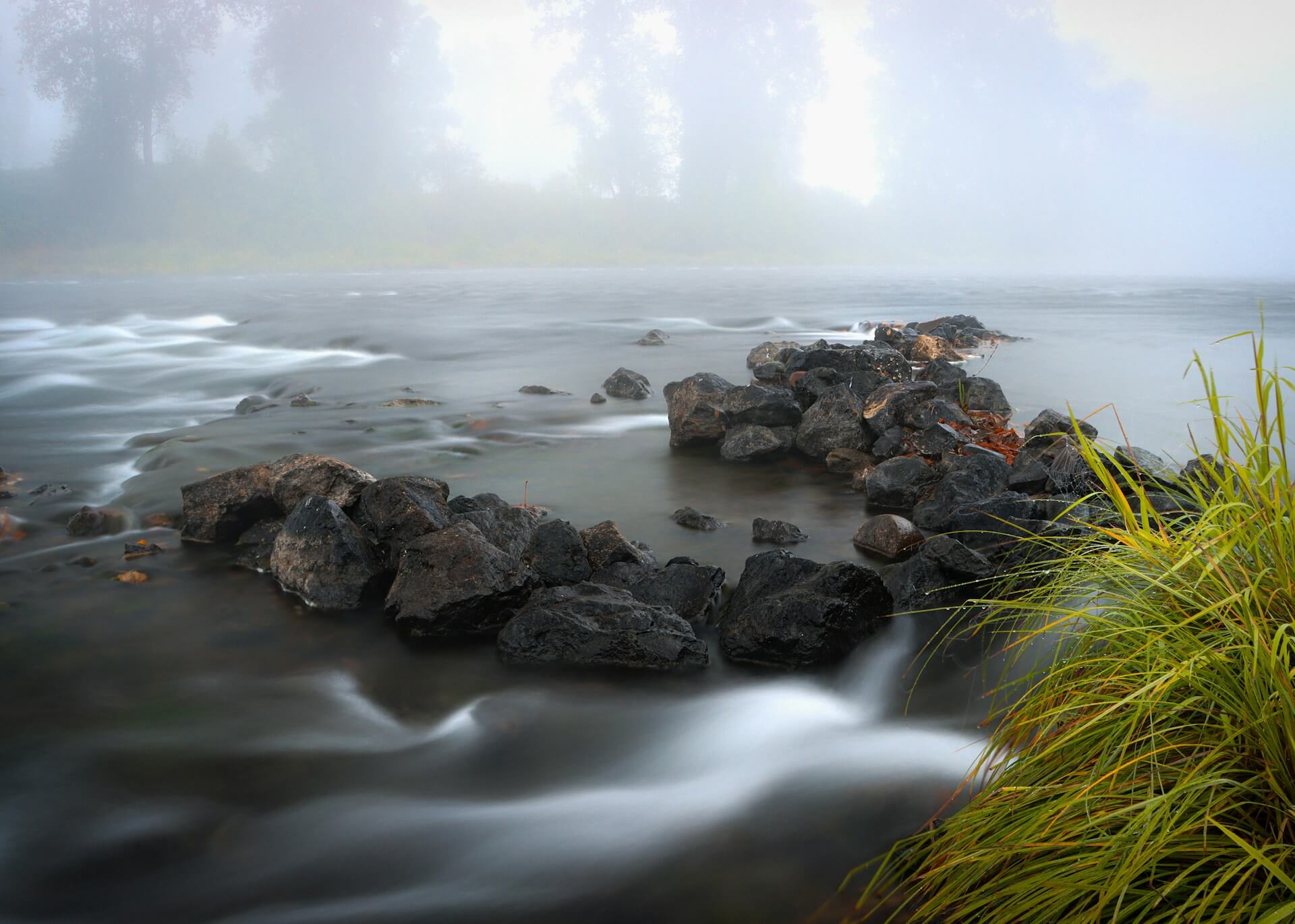
Photo by David J. Boozer on Unsplash
I grip my fishing rod, stand on the edge of the railroad trestle and look at the water fifteen feet below. The wind and an incoming tide jerk the Umpqua River into choppy crests. I take a step forward, my chest tightens and I start to sway.
When my older brother Dave said I could tag along with him this morning, I couldn't dig the worms fast enough. I pictured casting from the bank behind the sawmill, not walking out on the railroad trestle, a bridge with ties, tracks and no deck.
Light-headed, breath held tight against the nausea, I tell my ten-year-old self I'm too big to fall through the foot and a half space between the ties even as my vision dims around the edges. I exhale and step onto land. The sulfur smell from the paper mill stings my nose and I take a breath through my mouth.
"I'll just fish from the bank," I call to Dave. He's already ten feet out on the bridge. He's twelve and so at home in his body he doesn't bother to check his footing before he turns around.
"You're not gonna get anything from the bank,” he says, his voice distant in the wind.
"I can try," I say under my breath as I pull out some line and look down over a jumble of boulders to the edge of the river. Gulls, white against the sky, hang over the water. To the west I can see a sand dune and the bend in the river where it flows towards Winchester Bay then out to the Pacific.
When we lived in California, I knew someday I’d do big kid things. I’d stand on top of the monkey bars, swim the length of my uncle’s pool underwater and reach for the brass ring on the Tilden Park merry go round.
I turned seven the year Dad brought us here to Oregon and I had to make a new list. So far, I’ve climbed on the roof, walked along the top of the picket fence and body surfed in the ocean. I need to get out on the trestle while I’m still a kid, before I turn into my older sister, Elizabeth, sitting in the house playing solitaire, listening to records and smoking Mom’s cigarettes.
Mom went to work on our newspaper with Dad a few months after we moved to Oregon three years ago. At first my Aunt Mayme took care of us. After she died, Elizabeth took over watching us in the summer.
"You won't be able to cast far enough in this wind,” Dave says. “You haven't got enough weight on." He’s not judging, just stating a fact. "When you reel in, you'll get hung up on the rocks. Come out here and drop it straight down."
My sinker is the size of the last joint of my little finger and I can't add lead. We didn't bring the pliers in the tackle box. I catch my baited hook as it swings towards my face, bite my lower lip and walk back to the trestle.
As soon as I look at the water between the ties, my shoulders rise and my stomach jumps. Hands shaking, I blink hard and step onto land, relieved there's no one here but Dave to see me chicken out.
I reel in my excess line, drop my pole in the tall grass next to the worm can and step up on a railroad track. The rail, warm through my Keds, is the same width as my shoe. I concentrate on a spot a yard down the track, exhale, tighten my stomach, tuck my chin and put one foot in front of the other. Arms at my side, I walk along the rail, eyes half-closed against the sun.
Why am I rock steady here and not when I look straight down at the water? The summer sky, usually lint gray or wispy white, holds armloads of clouds.
Dave's back on the bank, a flat, hand-sized pogie flipping and twisting on the end of his line. I run over and stand next to him as he kneels to take out the hook. If I hadn't lost my nerve, that could've been my fish heaving on the gravel.
"Gimme the worms wouldya?" he says as I crouch down next to him and run my finger along slick scales.
This is exactly the kind of thing I want to tell Mom about. How the fish breathes fast and the sun reflects off the scales as its side moves up and down. Except she won’t be there when I get home, and by the time she’s finished work, changed her clothes, made dinner and washed the dishes it’ll be a small flat story.
"What if the train comes while we're out there?" I say, holding out the tin can. Trains run from the paper mill a mile north of here to the Gardiner junction, three miles south. They don't come by very often and they're slow but they take a long time to stop.
"We don't go that far out," he says, threading a worm onto his hook. "You'll see it way before it gets here. Just walk off the trestle."
"I'm scared to walk out there," I say, watching his fish open and close its mouth.
"Then don't do it," he says. He stands, wipes his palm down the front of his tee shirt and turns to walk away.
Why won’t he tell me how to walk out on the trestle? When I tried to chop wood for our woodstove, I couldn’t even get the blade to stick in the wood. Dave taught me how to hold the hatchet over my head and let gravity do the work. Just today, I was sure I’d poke myself with the fishhook and he showed me how to skewer the worm.
"Does Mom know you do this, walk out on the bridge? " I ask.
"Only if you tell her,” he says without turning around.
Elizabeth told Mom we went up on the roof while she was at work. I wanted Mom to be so worried she’d stay home to watch us. Instead, she told us to be careful and not to go up if it was raining.
I sit on a rail, the steel warm on my bottom, stretch my legs out straight and stare at the brambles creeping out of the ditch. No sense wasting the afternoon just ‘cause I can't fish. I'll collect some rocks and sticks and build a little fairy house. I've been playing pretend a lot since we moved up to Oregon.
I hunt deer with an alder branch bow and arrow and make cakes with grass seeds ground to a paste. I build lean-tos from sword ferns in the woods behind the cemetery and weave mats of cattail reeds from the swamp. Mostly, I try to make believe that I like Oregon better than California.
It doesn’t work. Ripe blackberries in the sun will never smell as good as the eucalyptus out the back door of my grandmother’s kitchen. Why would I trade the sound of Mom laughing with her sister on the patio for the screech of the green chain at the saw mill across the street.
A few months ago, I asked Mom if we'd ever go back to California.
"I love it here," she said. "The beach, the dunes, the river.”
When I want a straight answer, I go to Elizabeth.
"No." she said. "We aren't going back. Ever. Get used to it."
I can’t. The stakes on a log truck next to us at the stoplight could break, and the logs would roll off on top of us. A sneaker wave could get me at the beach. A sinkhole around buried trees on the dunes could swallow me. This place will never feel like home.
The sun, straight overhead when we got here, glares from the west. A horn rips the air. I jump up and look down the empty tracks. Must've been a log truck warning a car not to pull onto the highway. On the river, a log drifts by on its way to the ocean. It got loose from a log boom and no one went after it.
It dawns on me that Mom doesn’t want to stay home with us. She likes working, spending all day with Dad. I could fall in the river and she still wouldn’t quit her job.
I pick up my pole and walk to the trestle.
Even though the water is way down there, it looks like it’s even with the ties. I lift my foot, and for a second, I don't know if I'll step on water or wood. I switch my gaze to my shoe. There's a hole the size of a dime above the big toe, and purple and black splotches of smashed blackberries stain the canvas.
If I watch my feet, I'll never do this. I pull myself up tall and pretend I'm standing on the rail. Pole tight in my fist, I hold my arms away from my sides in an A shape, focus my eyes two ties ahead and step forward. The breeze feels cool on my sweaty underarms.
Another step. The wind lifts my hair and the rough wood of the ties grips the bottom of my shoes. With each step my feet, knees, chest, arms and shoulders line up. I stop and glance down at the water. The urge to turn around pulls at my chest. I look across the river to where the railroad tracks meet Bolon Island and take a deep breath.
I can’t go back. I won’t be a kid forever.